
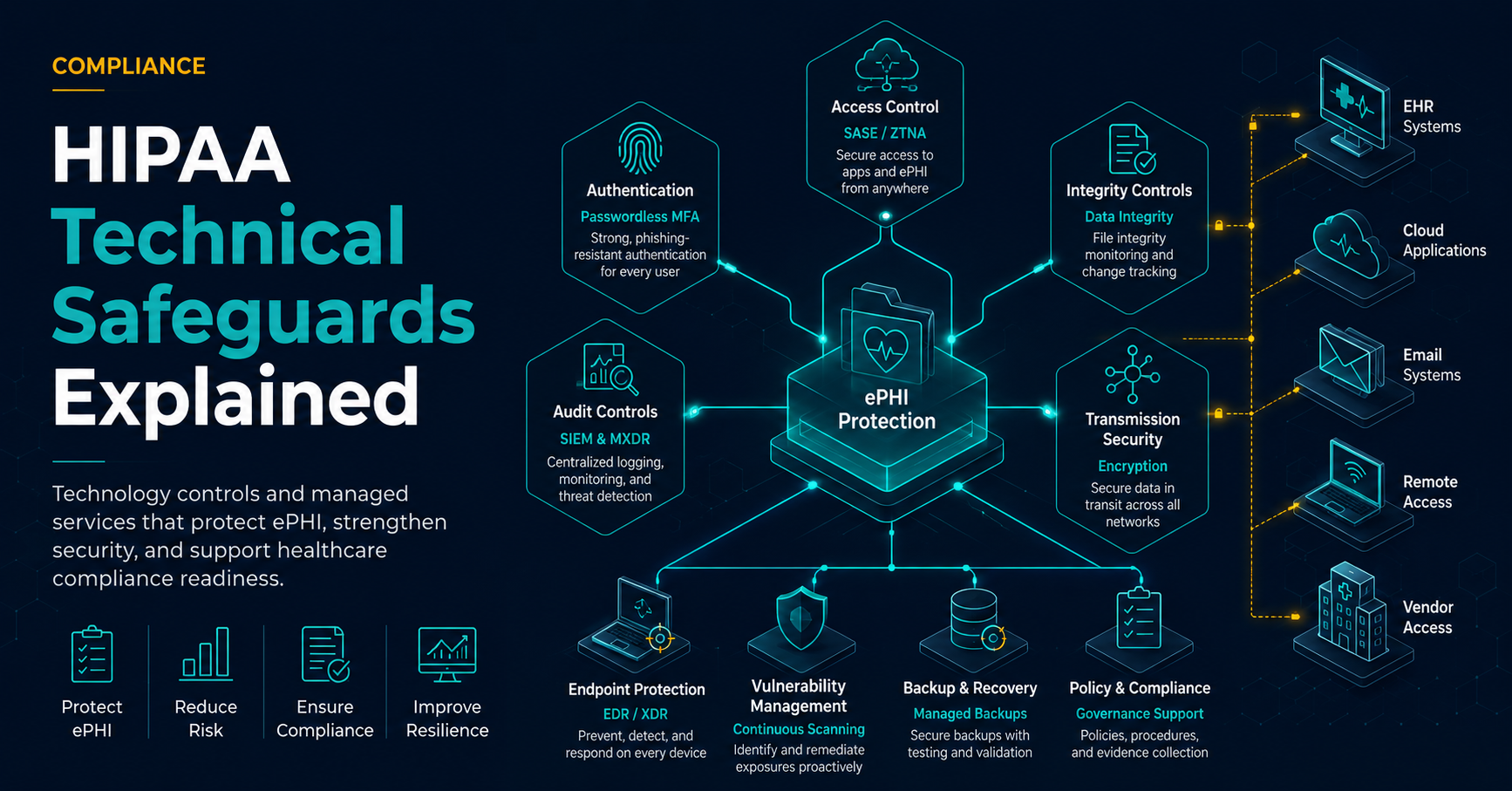
What Are HIPAA Technical Safeguards?
HIPAA Technical Safeguards are the technology-focused requirements within the HIPAA Security Rule. They address how healthcare organizations protect electronic protected health information, commonly referred to as ePHI, through access control, audit controls, integrity protections, authentication, and transmission security.
Technical Safeguards are not just product requirements. They are operating expectations. Healthcare organizations need to understand who can access ePHI, how access is authenticated, whether activity is logged and reviewed, how data integrity is protected, and how ePHI is secured when transmitted across networks or systems.
For executives and IT leaders, Technical Safeguards provide a practical framework for translating HIPAA compliance expectations into identity controls, logging, encryption, endpoint protection, security monitoring, vulnerability management, and incident readiness.
Key Takeaways
- HIPAA Technical Safeguards focus on technology controls that protect ePHI.
- The core areas include access control, audit controls, integrity controls, person or entity authentication, and transmission security.
- Technical Safeguards should be tied to risk analysis, administrative governance, and evidence collection.
- MFA, centralized logging, managed SIEM, encryption, endpoint protection, and access reviews can support HIPAA readiness.
- Healthcare organizations should be able to prove that technical controls are implemented, monitored, reviewed, and improved over time.
Technical Safeguards vs. Administrative Safeguards
Administrative Safeguards define the governance program. Technical Safeguards define many of the technology controls used to enforce that program. For example, an administrative policy may state that access to ePHI must be limited to authorized users. Technical controls enforce that expectation through account provisioning, authentication, role-based access, MFA, logging, and access review evidence.
The strongest healthcare security programs connect both areas. Policies should reflect how systems actually work, and technical controls should support the organization’s risk analysis, workforce procedures, incident response process, vendor governance, and executive reporting.
| Safeguard Type | Primary Focus | Practical Healthcare Examples |
|---|---|---|
| Administrative Safeguards | Governance, policies, risk management, workforce procedures, incident response, and oversight | Risk analysis, security responsibility, workforce security, security awareness, contingency planning, evaluation |
| Technical Safeguards | Technology controls that protect access to ePHI and system activity | MFA, unique user IDs, audit logs, encryption, authentication, access control, SIEM, integrity monitoring |
| Physical Safeguards | Physical protection of systems, devices, workstations, and facilities | Workstation security, device controls, facility access procedures, media disposal, equipment tracking |
The Core HIPAA Technical Safeguard Areas
The HIPAA Security Rule organizes Technical Safeguards into several major standards. Each standard helps protect the confidentiality, integrity, or availability of ePHI. Healthcare organizations should evaluate these safeguards based on their actual systems, workflows, users, vendors, risk analysis findings, and operating environment.
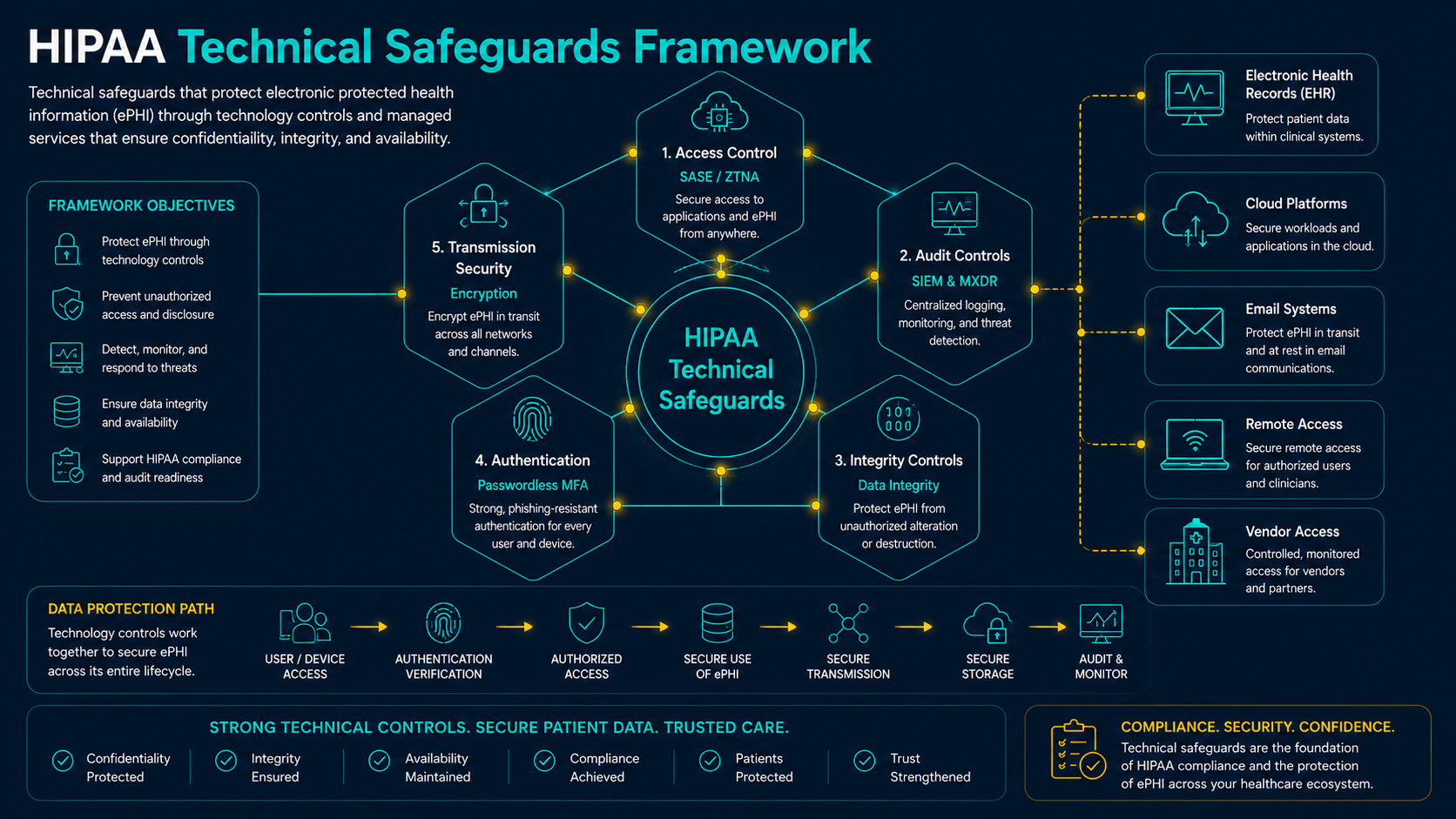
| Technical Safeguard Area | Operational Objective | Example Evidence |
|---|---|---|
| Access Control | Limit ePHI access to authorized users and appropriate workflows | User account inventory, MFA coverage, role-based access model, access review reports |
| Audit Controls | Record and examine activity in systems that contain or access ePHI | Log sources, SIEM reports, alert tickets, audit log retention settings, review procedures |
| Integrity Controls | Protect ePHI from improper alteration or destruction | EDR alerts, file integrity evidence, backup reports, change control records, application controls |
| Person or Entity Authentication | Verify that users and systems are who they claim to be | Authentication policies, MFA configuration, passwordless records, privileged access controls |
| Transmission Security | Protect ePHI when it is transmitted over networks or between systems | TLS configuration, email encryption procedures, VPN settings, secure file transfer records |
Access Control
Access Control is one of the most important HIPAA Technical Safeguard areas. It focuses on ensuring that only authorized users and processes can access systems containing ePHI. Access control should cover the EHR, email, file shares, cloud systems, billing platforms, remote access, backups, security tools, and vendor portals.
In practical healthcare environments, access control usually includes unique user identification, emergency access procedures, automatic logoff, encryption and decryption considerations, role-based access, privileged account controls, and recurring access review.
- Unique user identification: Assign named accounts so activity can be traced to individual users.
- Emergency access procedures: Define how authorized users access ePHI during emergencies or downtime.
- Automatic logoff: Reduce the risk of unattended sessions exposing ePHI.
- Role-based access: Align access with job responsibilities and minimum necessary principles.
- Privileged access control: Limit and monitor administrative access to systems containing ePHI.
- Recurring access reviews: Validate that access remains appropriate over time.
Compliance Principle
Access control is not a one-time configuration task. Healthcare organizations should maintain evidence showing how access is requested, approved, modified, reviewed, monitored, and removed across systems that contain or provide access to ePHI.
Authentication and MFA
Person or Entity Authentication requires organizations to verify that a person or system seeking access is actually who or what it claims to be. In modern healthcare environments, this means authentication should be stronger than passwords alone, especially for remote access, cloud applications, privileged accounts, vendor access, and administrative workflows.
Multi-factor authentication is not explicitly named in every HIPAA implementation specification, but it is often a practical and defensible control for reducing credential theft, remote access compromise, phishing, and unauthorized administrative access risk. Passwordless authentication and phishing-resistant MFA can further reduce exposure where appropriate.
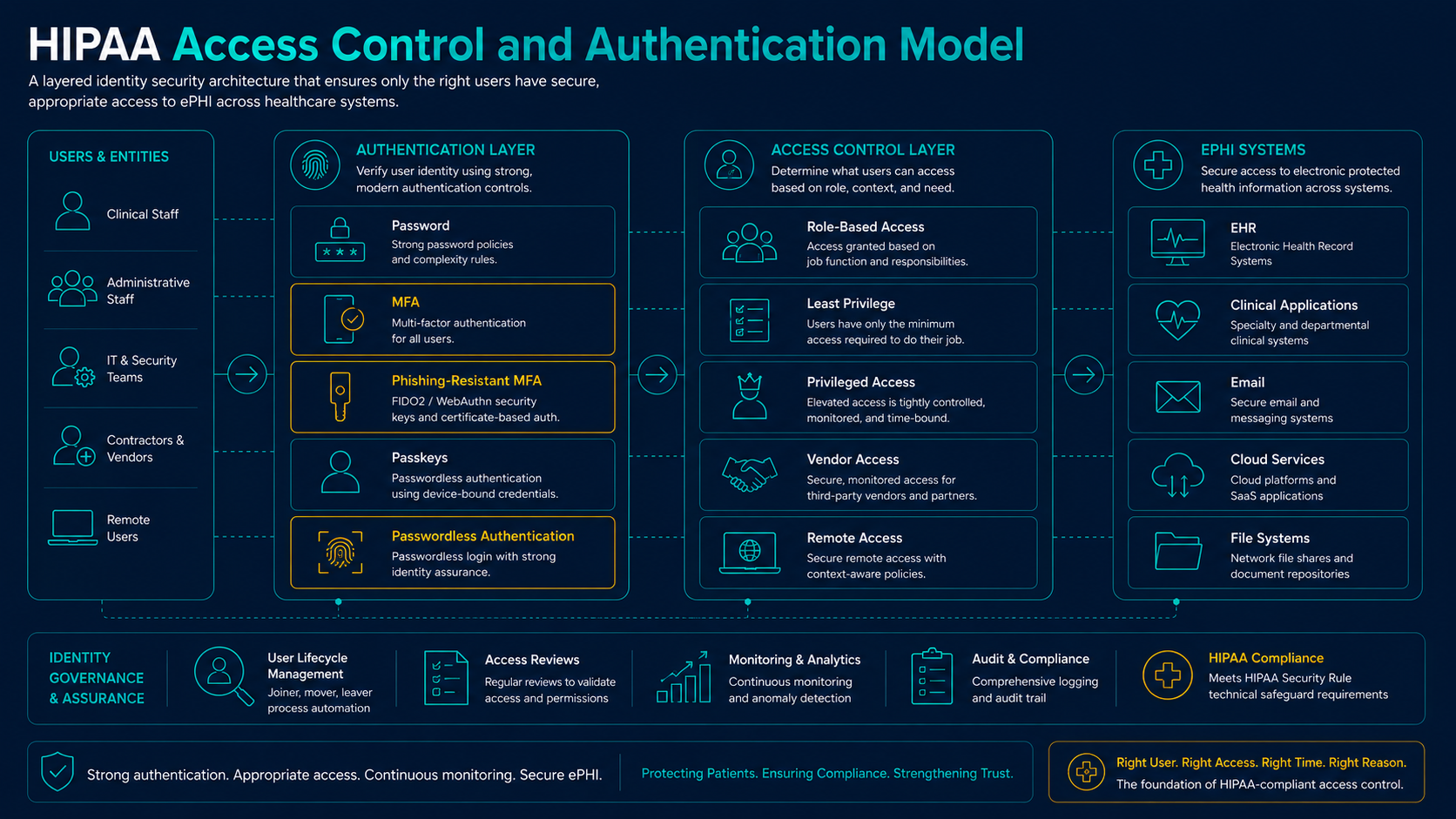
| Access Scenario | Authentication Risk | Recommended Control Direction |
|---|---|---|
| Remote Access | Stolen credentials can enable external access to internal systems | Require MFA or phishing-resistant authentication; log and monitor access |
| Cloud Email and Collaboration | Account takeover can expose patient data, attachments, and business communications | Require MFA, conditional access, suspicious login monitoring, and user training |
| Privileged Accounts | Administrative compromise can affect many systems and large volumes of ePHI | Use separate admin accounts, MFA, least privilege, logging, and recurring review |
| Vendor Access | Third-party credentials may be persistent, shared, or poorly monitored | Use named accounts, MFA, access windows, approval workflows, and vendor access reviews |
| Shared Clinical Workstations | Unattended sessions can expose ePHI to unauthorized users | Use automatic logoff, session controls, user accountability, and workflow-aware access design |
Audit Controls and Log Monitoring
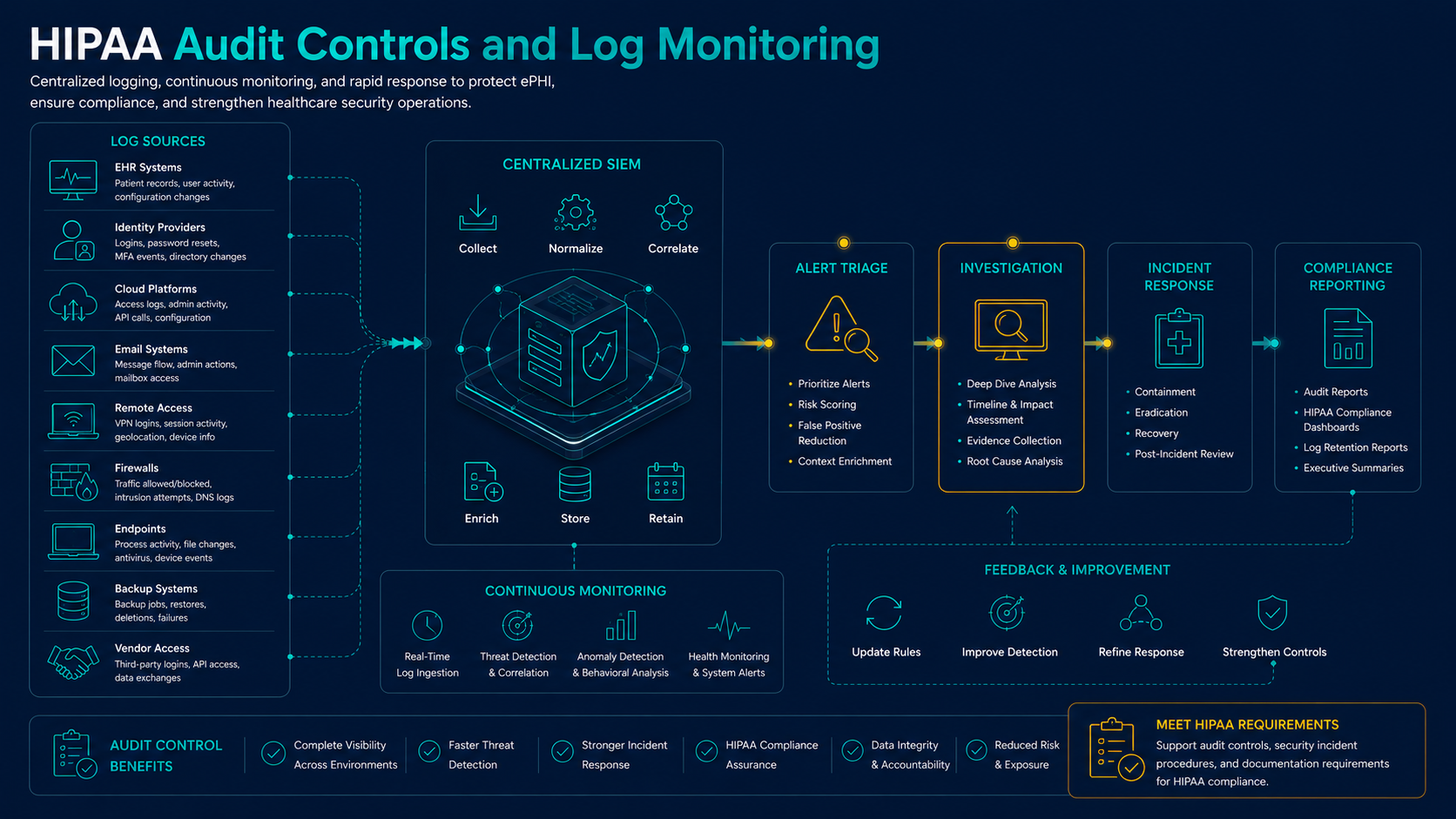
Audit Controls require healthcare organizations to implement mechanisms that record and examine activity in systems that contain or use ePHI. Logs are essential for detecting unauthorized access, investigating incidents, validating access control, supporting audit readiness, and reconstructing events after suspicious activity.
The key issue is not just whether logs exist. The organization should know which logs are collected, how long they are retained, who reviews alerts, how suspicious activity is escalated, and whether evidence can be produced during an investigation or audit request.
- EHR audit logs
- Identity provider and authentication logs
- Email and collaboration platform logs
- Remote access and VPN logs
- Endpoint detection and response alerts
- Firewall and network security logs
- Cloud platform activity logs
- Privileged account activity
- Backup and recovery activity
- Vendor access logs
Integrity Controls
Integrity controls help protect ePHI from improper alteration or destruction. In practice, this includes safeguards that reduce unauthorized modification, detect suspicious changes, protect systems from malware, validate backups, and ensure that critical healthcare data remains reliable.
Integrity controls may be implemented through a combination of application controls, access restrictions, endpoint protection, change management, backup validation, database safeguards, file integrity monitoring, and incident response procedures.
| Integrity Risk | Potential Impact | Supporting Control |
|---|---|---|
| Ransomware encrypts clinical or business data | Loss of availability, patient care disruption, recovery cost, breach investigation | EDR, patching, least privilege, immutable backups, recovery testing |
| Unauthorized user modifies patient records or billing data | Data accuracy concerns, privacy exposure, operational disruption | Role-based access, audit logs, approval workflows, anomaly detection |
| Misconfigured synchronization or integration changes data incorrectly | Incorrect records, workflow failure, reporting errors | Change management, testing, monitoring, rollback procedures |
| Backup data is incomplete or unrecoverable | Extended downtime, data loss, failed recovery | Backup monitoring, restoration testing, criticality analysis |
| Malware changes files or system configurations | System instability, unauthorized activity, data corruption | Endpoint protection, configuration monitoring, vulnerability management |
Transmission Security
Transmission Security focuses on protecting ePHI when it moves across networks, between systems, through email, over remote access connections, or through vendor integrations. Healthcare organizations should understand where ePHI is transmitted and whether appropriate protections are in place.
Transmission security commonly includes encryption, secure protocols, secure email workflows, VPN or ZTNA protections, secure file transfer, API security, certificate management, and monitoring for insecure communication paths.
- Encrypt sensitive communications where appropriate.
- Use secure protocols for system integrations and administrative access.
- Avoid sending ePHI through unmanaged or unsupported channels.
- Review third-party transmission paths and vendor portals.
- Monitor remote access and cloud access activity.
- Document approved methods for transmitting ePHI.
Important Compliance Note
This article is not legal advice. Healthcare organizations should work with qualified legal counsel when interpreting HIPAA obligations, reviewing policies, evaluating breach notification duties, or responding to regulatory inquiries.
Common Technical Safeguard Failures
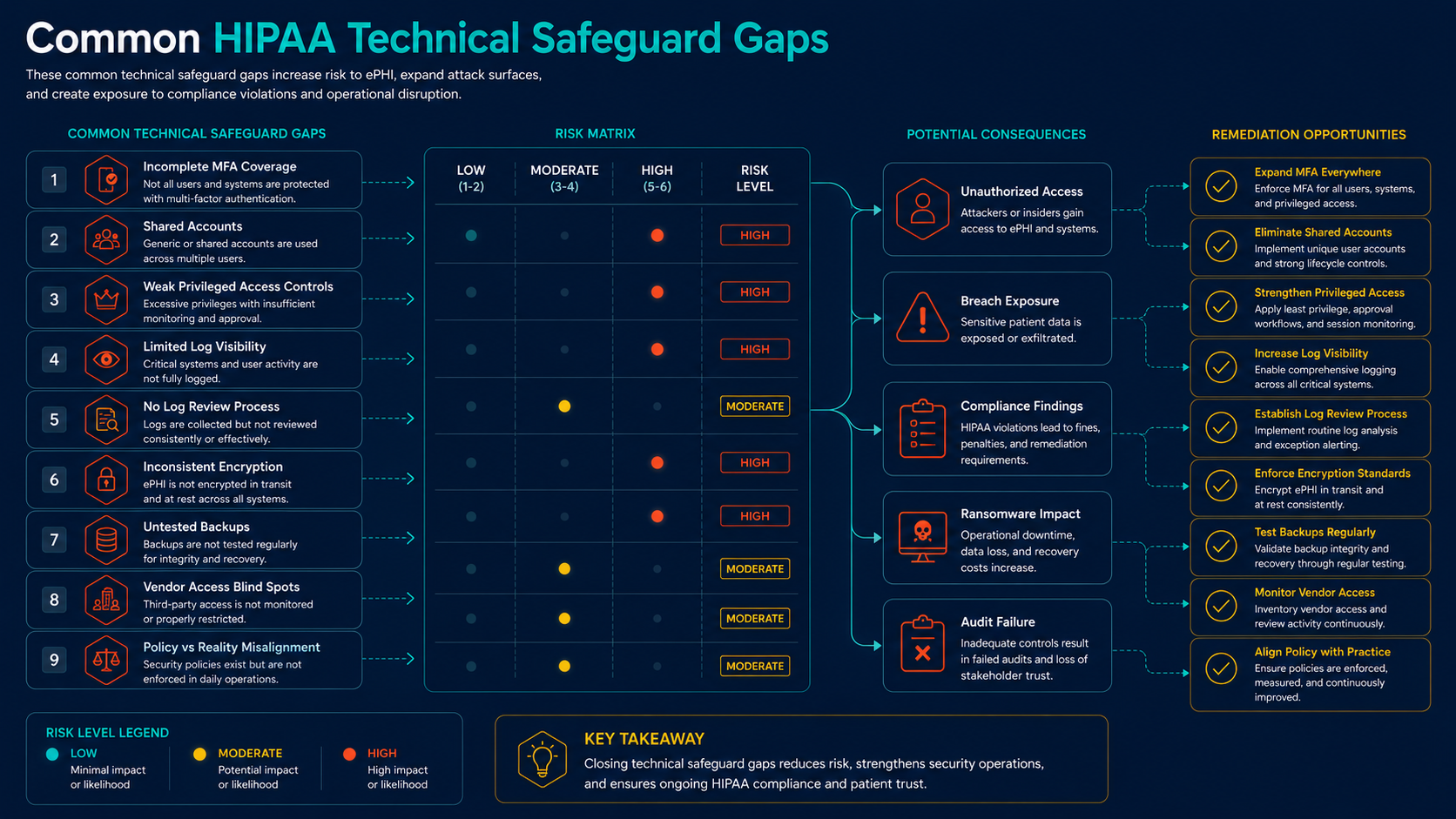
Many HIPAA technical gaps are caused by partial implementation. A control may exist in one system but not another. Logs may be retained but not reviewed. MFA may protect email but not VPN. Backups may run but not be tested. Encryption may be available but not consistently configured.
- Incomplete MFA coverage: MFA protects some users or systems but excludes remote access, privileged users, vendors, or legacy applications.
- Shared or generic accounts: Activity cannot be attributed to a unique user.
- Weak privileged access controls: Administrative accounts are not separated, monitored, or reviewed.
- Limited log visibility: Critical systems generate logs, but logs are not centralized, retained, monitored, or reviewed.
- Unclear audit procedures: The organization cannot show who reviews logs, what is reviewed, or how suspicious activity is escalated.
- Inconsistent encryption practices: ePHI transmission paths are not fully documented or secured.
- Unvalidated backup recovery: Backup jobs exist but restoration capability is not tested.
- Vendor access blind spots: Third-party access is not authenticated, limited, monitored, or removed consistently.
- Policies do not match technical reality: Written requirements are stronger than the actual implementation.
How Managed Security Services Support Technical Safeguards
Managed IT and managed security services can help healthcare organizations operationalize Technical Safeguards by implementing controls, monitoring activity, improving visibility, preserving evidence, and supporting recurring review. The goal is not to outsource compliance responsibility. The goal is to strengthen the operational security capabilities that support HIPAA readiness.
| Technical Safeguard Need | Supporting Managed Service Capability | Compliance-Ready Output |
|---|---|---|
| Access Control | Identity review, MFA deployment, privileged access management, account lifecycle support | Access review records, MFA coverage reports, disabled account evidence, privileged access reports |
| Audit Controls | Managed SIEM, log management, alert triage, security monitoring | Log source inventory, alert reports, escalation tickets, investigation timelines |
| Integrity Controls | Endpoint detection and response, patch management, vulnerability management, backup validation | EDR reports, remediation tickets, scan reports, backup test evidence |
| Authentication | MFA, passwordless authentication, conditional access, privileged account protection | Authentication policy evidence, coverage reports, access logs, exception records |
| Transmission Security | Secure remote access, VPN or ZTNA support, email security, encryption readiness review | Configuration records, remote access reports, secure transmission procedures |
| Evidence Collection | Reporting, ticketing, security documentation, recurring control review | Executive reports, remediation status, control evidence, governance updates |
Executive and Board-Level Considerations
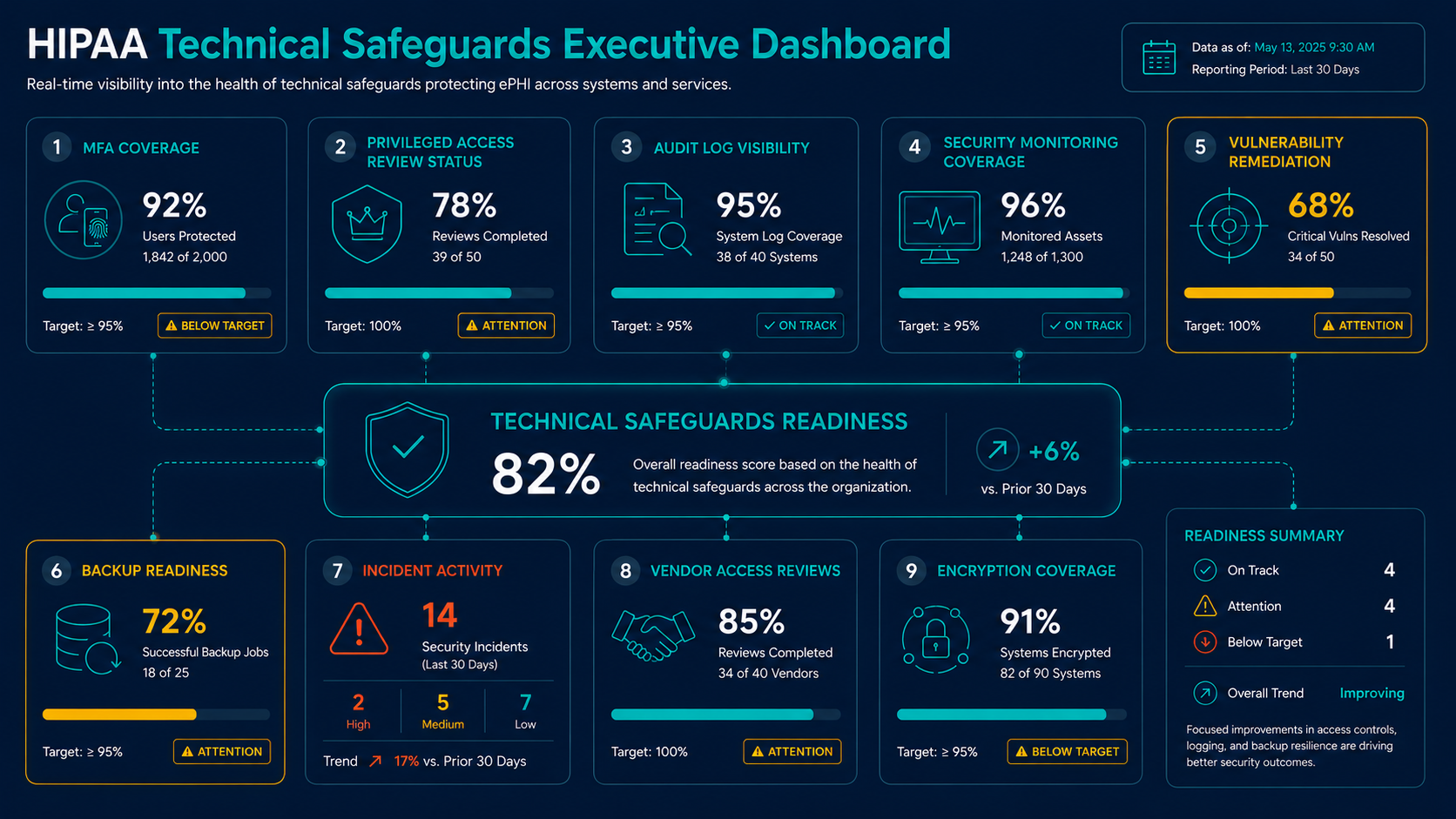
Technical Safeguards should be visible to leadership because they affect breach risk, ransomware resilience, patient trust, audit readiness, cyber insurance expectations, and the organization’s ability to detect and respond to incidents. Executives do not need to manage the technical details, but they should understand whether critical controls are implemented and producing evidence.
Useful leadership questions include:
- Do we know which systems contain or provide access to ePHI?
- Is MFA enforced for remote access, cloud access, privileged accounts, and vendors?
- Are shared or generic accounts still used in systems that access ePHI?
- Are audit logs collected, retained, monitored, and reviewed?
- Can we investigate suspicious access to patient information?
- Are backups protected and restoration procedures tested?
- Are transmission paths for ePHI documented and secured?
- Are technical control gaps assigned to owners with target dates?
- Can we produce evidence that safeguards are operating?
- How are technical safeguard improvements reported to leadership over time?
How DBT Helps Healthcare Organizations
DBT helps healthcare organizations strengthen the cybersecurity controls and operating evidence that support HIPAA Technical Safeguards. We focus on practical implementation, visibility, monitoring, reporting, and remediation support.
DBT can support Technical Safeguard readiness through:
- Identity and access security assessment
- MFA and passwordless authentication implementation
- Managed SIEM, log management, and security monitoring
- MXDR and incident response support
- Endpoint detection and response
- Vulnerability management and patch visibility
- Privileged access and vendor access review
- Backup and recovery readiness review
- Remote access and cloud security improvement
- Security reporting and evidence collection
DBT does not replace legal counsel or the healthcare organization’s internal compliance ownership. We help build, operate, monitor, and document the cybersecurity controls that support HIPAA readiness.
Related DBT Resources
For the governance side of the HIPAA Security Rule, review HIPAA Administrative Safeguards Explained. For a broader readiness overview, review HIPAA Security Rule Readiness. For practical service alignment, review HIPAA Security Controls Mapped to Managed Services.
Healthcare organizations evaluating authentication modernization should also review Passwordless Authentication Compliance Considerations, Phishing-Resistant MFA Explained, and DBT’s Identity & Access Security services. For operational support, review Cybersecurity Operations, Compliance & Risk Management, and Healthcare Cybersecurity Services.
Final Thoughts
HIPAA Technical Safeguards turn compliance expectations into operational security controls. They help healthcare organizations control access to ePHI, verify user identity, monitor activity, protect data integrity, secure transmission paths, and preserve evidence for investigations and audits.
The strongest healthcare organizations do not treat Technical Safeguards as isolated IT settings. They connect them to risk analysis, administrative governance, incident response, vendor oversight, executive reporting, and continuous improvement.
When Technical Safeguards are implemented well, healthcare leaders gain better visibility, stronger access control, improved incident readiness, reduced breach exposure, and a more defensible approach to protecting the confidentiality, integrity, and availability of ePHI.