
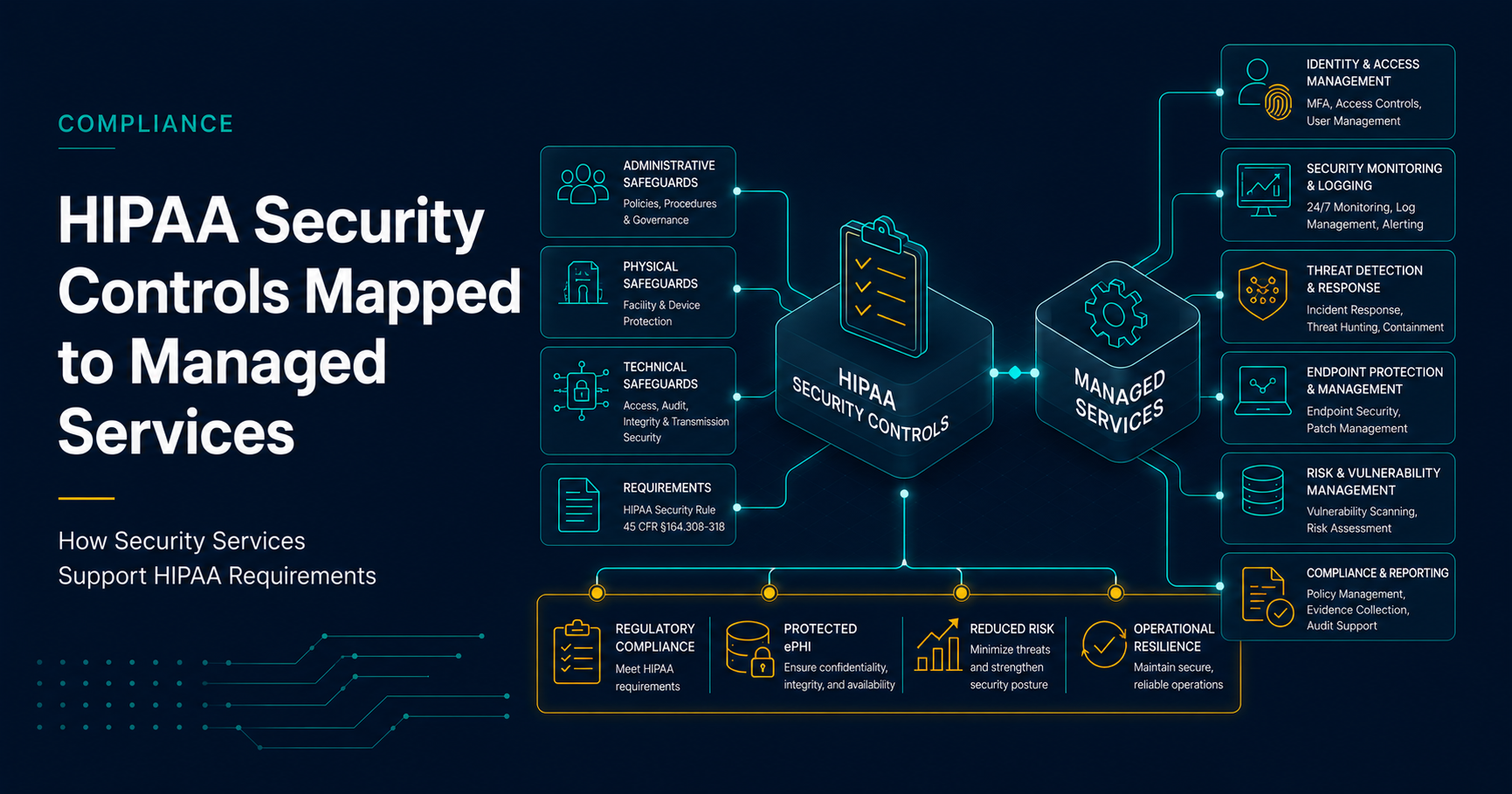
Why HIPAA Needs to Be Mapped to Operational Security Controls
The HIPAA Security Rule requires covered entities and business associates to protect electronic protected health information, commonly called ePHI, through administrative, physical, and technical safeguards. For healthcare organizations, the practical challenge is translating those regulatory standards into real security operations.
HIPAA does not say, “buy this exact product” or “use this specific vendor.” Instead, it requires organizations to implement reasonable and appropriate safeguards based on risk, environment, size, complexity, and the nature of the ePHI they create, receive, maintain, or transmit.
That is why a control mapping is useful. It helps connect HIPAA Security Rule standards to the managed IT, managed security, identity, logging, monitoring, incident response, and compliance activities that organizations can actually operate.
Important Clarification
HIPAA compliance is not achieved by purchasing a single tool or outsourcing one service. Compliance requires a combination of governance, documentation, risk analysis, technical safeguards, policies, procedures, evidence, and ongoing review.
Managed security services can support HIPAA readiness, but the covered entity or business associate remains responsible for maintaining an appropriate compliance program.
The HIPAA Security Rule Structure
The Security Rule is organized around three major safeguard categories:
- Administrative Safeguards: Policies, procedures, governance, workforce controls, risk management, incident response, contingency planning, and evaluations.
- Physical Safeguards: Facility access, workstation use, workstation security, and device or media controls.
- Technical Safeguards: Access control, audit controls, integrity controls, authentication, and transmission security.
Organizations should also account for documentation requirements under 45 CFR § 164.316, because policies, procedures, evidence, and retained documentation are essential to demonstrating that safeguards are implemented and maintained.
Important Compliance Disclaimer
This control mapping is provided for educational and operational planning purposes only and does not constitute legal advice, regulatory interpretation, or a formal HIPAA compliance assessment.
HIPAA compliance obligations vary based on organizational structure, business associate relationships, technology environments, state laws, and risk analysis outcomes. Organizations should consult qualified legal counsel and compliance professionals when evaluating regulatory obligations.
HIPAA Security Rule Controls Mapped to Managed Security Services
The HIPAA Security Rule establishes administrative, physical, technical, and documentation safeguards designed to protect electronic protected health information (ePHI). While the Security Rule does not prescribe specific technologies or vendors, many managed security services directly support implementation of required and addressable safeguards.
The following mapping illustrates how common cybersecurity services align with specific HIPAA Security Rule requirements and operational objectives.
| HIPAA Rule Reference | Classification | Requirement Area | Supporting DBT Services |
|---|---|---|---|
| Administrative Safeguards (45 CFR § 164.308) | |||
| 164.308(a)(1)(ii)(A) | Required | Risk Analysis | Compliance Consulting, Risk Assessments, Vulnerability Assessments, Asset Discovery |
| 164.308(a)(1)(ii)(B) | Required | Risk Management | Managed Security Services, Vulnerability Management, Patch Management, Security Program Reviews |
| 164.308(a)(1)(ii)(D) | Required | Information System Activity Review | Managed SIEM, Log Management, MXDR, SOC Monitoring |
| 164.308(a)(3) | Required | Workforce Security | Identity Security, Access Reviews, Onboarding & Offboarding Controls |
| 164.308(a)(4) | Required | Information Access Management | MFA, Passwordless Authentication, RBAC, Conditional Access |
| 164.308(a)(5) | Required | Security Awareness & Training | Security Awareness Training, Phishing Simulations |
| 164.308(a)(6) | Required | Security Incident Procedures | MXDR, SOC Services, Incident Response Support |
| 164.308(a)(7) | Required | Contingency Planning | Backup & Recovery, Disaster Recovery Planning, Business Continuity Planning |
| 164.308(a)(8) | Required | Periodic Evaluation | Compliance Assessments, Penetration Testing, Vulnerability Scanning |
| Physical Safeguards (45 CFR § 164.310) | |||
| 164.310(b) | Required | Workstation Use | Managed IT Services, Endpoint Management, Secure Configuration Standards |
| 164.310(c) | Required | Workstation Security | Endpoint Hardening, Device Access Controls, Conditional Access Policies |
| 164.310(d) | Required | Device & Media Controls | Asset Management, Device Lifecycle Controls, Encryption Management |
| Technical Safeguards (45 CFR § 164.312) | |||
| 164.312(a)(1) | Required | Access Control | MFA, Passwordless Authentication, Identity Security, Privileged Access Management |
| 164.312(a)(2)(i) | Required | Unique User Identification | Identity Governance, Active Directory, Entra ID, User Lifecycle Management |
| 164.312(a)(2)(iii) | Addressable | Automatic Logoff | Endpoint Configuration Management, Device Policies, Secure Baselines |
| 164.312(a)(2)(iv) | Addressable | Encryption & Decryption | Endpoint Encryption, Secure Email, Microsoft 365 Security Configuration |
| 164.312(b) | Required | Audit Controls | Managed SIEM, Centralized Logging, Compliance Reporting, SOC Monitoring |
| 164.312(c)(1) | Required | Integrity | EDR, NGAV, Vulnerability Management, Backup & Recovery |
| 164.312(d) | Required | Person or Entity Authentication | MFA, Passwordless Authentication, Phishing-Resistant Authentication |
| 164.312(e)(1) | Required | Transmission Security | ZTNA, SASE, Secure Remote Access, Encryption Controls |
| Policies, Procedures & Documentation (45 CFR § 164.316) | |||
| 164.316 | Required | Policies & Documentation | Compliance Consulting, Governance Documentation, Evidence Collection, GRC Programs |
Managed Services by HIPAA Safeguard Category
A practical HIPAA security program usually requires multiple services working together. The following sections explain how common DBT services support specific Security Rule safeguard areas.
MFA, Passwordless Authentication, and Identity Security
Identity controls are central to HIPAA security because unauthorized access to ePHI is one of the most important risks healthcare organizations must address.
MFA, passwordless authentication, privileged access controls, conditional access, and access reviews can support:
- 45 CFR § 164.308(a)(3) Workforce Security
- 45 CFR § 164.308(a)(4) Information Access Management
- 45 CFR § 164.308(a)(5)(ii)(D) Password Management
- 45 CFR § 164.312(a)(1) Access Control
- 45 CFR § 164.312(a)(2)(i) Unique User Identification
- 45 CFR § 164.312(d) Person or Entity Authentication
Identity Security Takeaway
HIPAA does not require one specific MFA product. The practical objective is to verify identity, limit access to authorized users, and reduce the likelihood that stolen credentials can be used to access ePHI.
Managed SIEM, Log Management, and Audit Controls
HIPAA requires organizations to review system activity and implement audit controls for systems that contain or use ePHI. In practice, this often requires centralized log collection, alerting, retention, and review workflows.
Managed SIEM and log management can support:
- 45 CFR § 164.308(a)(1)(ii)(D) Information System Activity Review
- 45 CFR § 164.308(a)(5)(ii)(C) Log-in Monitoring
- 45 CFR § 164.308(a)(6) Security Incident Procedures
- 45 CFR § 164.312(b) Audit Controls
For many small and mid-sized healthcare organizations, centralized logging is one of the most important maturity improvements because it provides visibility into user activity, authentication events, endpoint alerts, administrative changes, and potential security incidents.
SOC Monitoring and MXDR
Log collection alone is not enough. Healthcare organizations also need the ability to investigate alerts, respond to suspicious activity, document incidents, and escalate meaningful events.
SOC monitoring and MXDR can support:
- 45 CFR § 164.308(a)(1)(ii)(D) Information System Activity Review
- 45 CFR § 164.308(a)(5)(ii)(B) Protection from Malicious Software
- 45 CFR § 164.308(a)(6) Security Incident Procedures
- 45 CFR § 164.312(b) Audit Controls
- 45 CFR § 164.312(c)(1) Integrity
This is especially important for organizations that do not have a dedicated internal security operations team.
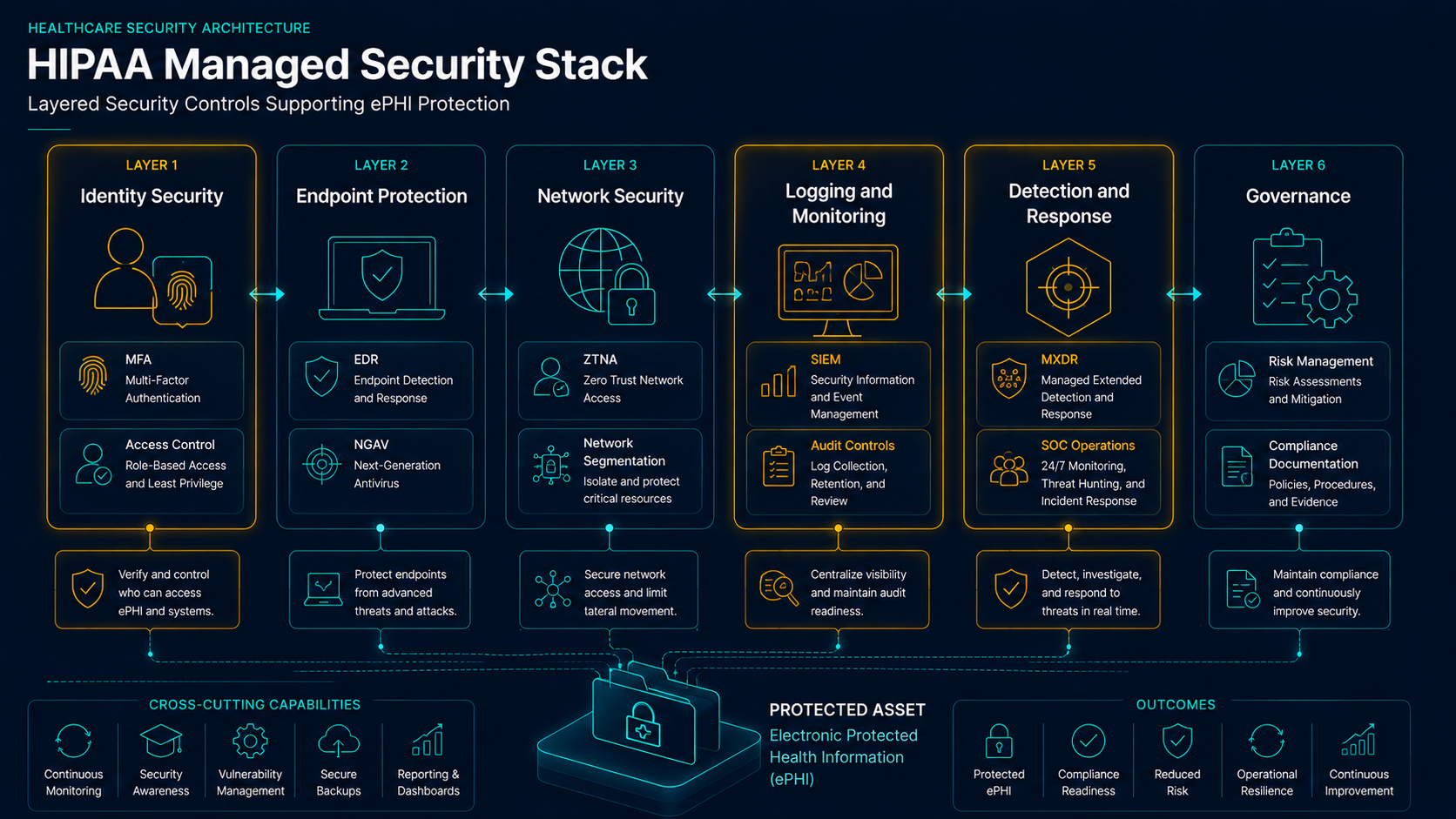
EDR, Endpoint Security, and Malware Protection
Healthcare environments are frequently targeted by ransomware, credential theft, and malware campaigns. EDR and managed endpoint security help protect systems that access or store ePHI.
Endpoint security can support:
- 45 CFR § 164.308(a)(5)(ii)(B) Protection from Malicious Software
- 45 CFR § 164.310(b) Workstation Use
- 45 CFR § 164.310(c) Workstation Security
- 45 CFR § 164.312(c)(1) Integrity
A mature endpoint strategy typically includes malware prevention, behavioral detection, endpoint visibility, alert response, device hardening, and patch management coordination.
Vulnerability Management and Patch Management
HIPAA risk management requires organizations to identify and reduce risks to ePHI. Known vulnerabilities, unsupported software, weak configurations, and unpatched systems can materially increase that risk.
Vulnerability management and patch management can support:
- 45 CFR § 164.308(a)(1)(ii)(A) Risk Analysis
- 45 CFR § 164.308(a)(1)(ii)(B) Risk Management
- 45 CFR § 164.308(a)(8) Evaluation
- 45 CFR § 164.312(c)(1) Integrity
For compliance purposes, the process matters as much as the scan. Organizations should be able to show how vulnerabilities are identified, prioritized, assigned, remediated, and tracked over time.
Backup, Disaster Recovery, and Contingency Planning
Healthcare organizations must plan for emergencies and disruptions that affect systems containing ePHI. Backup and recovery capabilities support both security resilience and compliance readiness.
Backup and disaster recovery services can support:
- 45 CFR § 164.308(a)(7) Contingency Plan
- 45 CFR § 164.312(c)(1) Integrity
- 45 CFR § 164.316 Documentation
Effective contingency planning should include backups, recovery procedures, emergency mode operations, critical application prioritization, and periodic testing.
SASE, ZTNA, VPN Security, and Network Segmentation
Healthcare organizations often need to secure remote access, vendor access, cloud application access, and internal network access. SASE, ZTNA, secure VPN, firewall, and segmentation strategies can help reduce unnecessary exposure.
Network and access services can support:
- 45 CFR § 164.308(a)(4) Information Access Management
- 45 CFR § 164.312(a)(1) Access Control
- 45 CFR § 164.312(d) Person or Entity Authentication
- 45 CFR § 164.312(e)(1) Transmission Security
The practical goal is to make sure access to ePHI systems is limited, verified, monitored, and aligned to business need.
GRC, Documentation, and Compliance Evidence
Many HIPAA readiness gaps are not purely technical. They involve incomplete policies, missing evidence, unclear responsibility, or inconsistent review processes.
GRC and documentation support can assist with:
- 45 CFR § 164.308(a)(1)(ii)(A) Risk Analysis
- 45 CFR § 164.308(a)(1)(ii)(B) Risk Management
- 45 CFR § 164.308(a)(2) Assigned Security Responsibility
- 45 CFR § 164.308(a)(8) Evaluation
- 45 CFR § 164.308(b) Business Associate Contracts
- 45 CFR § 164.316 Policies, Procedures, and Documentation
Documentation should not be treated as a one-time audit exercise. It should reflect how security controls are actually implemented, reviewed, and maintained.
HIPAA Service Mapping Summary
| DBT Service | HIPAA Areas Supported | Primary Compliance Value |
|---|---|---|
| MFA / Passwordless Authentication | Access Control, Person or Entity Authentication, Password Management | Reduces credential risk and strengthens identity verification |
| Managed SIEM / Log Management | Information System Activity Review, Log-in Monitoring, Audit Controls | Centralizes logs and supports audit trail review |
| MXDR / SOC Monitoring | Security Incident Procedures, Malicious Software Protection, Audit Controls | Provides monitoring, investigation, escalation, and incident response support |
| EDR / Endpoint Security | Malicious Software Protection, Workstation Security, Integrity | Protects endpoints that access, process, or store ePHI |
| Vulnerability Management | Risk Analysis, Risk Management, Evaluation | Identifies and tracks technical risk over time |
| Patch and Configuration Management | Risk Management, Workstation Security, Integrity | Reduces exposure from known vulnerabilities and weak configurations |
| Backup and Recovery | Contingency Plan, Integrity, Documentation | Supports availability, resilience, and recovery planning |
| SASE / ZTNA / Secure Remote Access | Access Control, Transmission Security, Authentication | Protects remote and network access to ePHI systems |
| GRC / Compliance Consulting | Risk Analysis, Documentation, Evaluation, Business Associate Oversight | Supports governance, evidence, policies, and recurring compliance operations |
Addressable Does Not Mean Optional
One of the most misunderstood parts of the HIPAA Security Rule is the difference between required and addressable implementation specifications.
When an implementation specification is addressable, an organization must still evaluate whether it is reasonable and appropriate in its environment. If it is not implemented as written, the organization should document why and implement an equivalent alternative measure when reasonable and appropriate.
For example, encryption and automatic logoff may be listed as addressable in certain contexts, but that does not mean organizations can ignore them. They must make a documented risk-based decision.
Operational Rule of Thumb
If a control protects access to ePHI, supports auditability, reduces credential risk, improves incident detection, or strengthens recovery, it should be evaluated carefully even if the implementation specification is addressable.
How to Use This Mapping
A HIPAA control mapping should be used as a planning and validation tool. It can help leadership, IT, security, compliance teams, and service providers understand how existing capabilities align to Security Rule expectations.
A practical workflow looks like this:
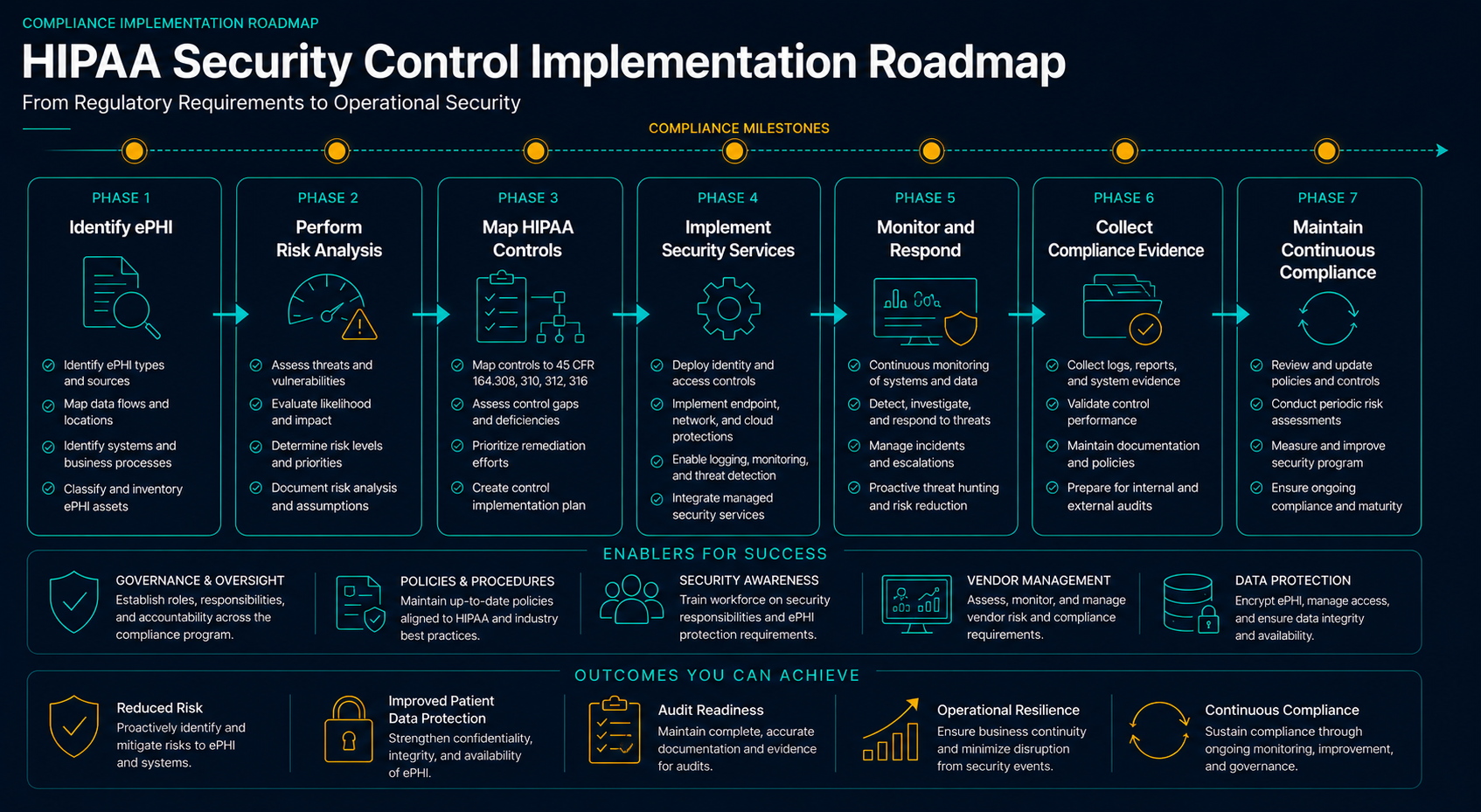
- Step 1 – Identify ePHI systems: Determine where ePHI is created, received, maintained, or transmitted.
- Step 2 – Map applicable safeguards: Identify which HIPAA standards apply to the environment.
- Step 3 – Inventory existing services: Document current security tools, providers, processes, and control owners.
- Step 4 – Identify gaps: Compare current controls to required and addressable safeguard expectations.
- Step 5 – Prioritize remediation: Focus first on high-risk areas such as identity, logging, endpoint protection, backups, and incident response.
- Step 6 – Collect evidence: Maintain reports, tickets, policies, screenshots, logs, and review records that demonstrate control operation.
- Step 7 – Review continuously: Update the mapping when systems, services, risks, vendors, or regulations change.
Common Gaps This Mapping Helps Reveal
Healthcare organizations often discover that they have several security services in place but have not mapped them clearly to HIPAA safeguards.
Common gaps include:
- MFA exists for email but not for remote access or administrative systems.
- Endpoint protection is deployed but not actively monitored.
- Logs exist locally but are not centralized or reviewed.
- Security incidents are handled informally without documentation.
- Backups exist but recovery testing is inconsistent.
- Vulnerability scans are performed but remediation is not tracked.
- Policies exist but do not reflect current systems or workflows.
- Business associate responsibilities are not clearly documented.
These are not just audit concerns. They are operational security concerns that can increase breach risk.
How DBT Helps Healthcare Organizations Operationalize HIPAA Security
DBT helps healthcare organizations build practical security programs that support HIPAA readiness without turning compliance into an abstract paperwork exercise.
Depending on the environment, DBT can help with:
- HIPAA security readiness reviews
- Risk analysis and remediation planning
- Managed SIEM and log management
- MXDR and SOC monitoring
- Endpoint protection and EDR
- MFA and passwordless authentication
- Vulnerability management and patching
- Backup and recovery planning
- SASE, ZTNA, and secure remote access
- Policy, evidence, and governance support
Final Thoughts
HIPAA security readiness is strongest when regulatory requirements are translated into operational controls that can be implemented, monitored, documented, and improved over time.
MFA, SIEM, SOC monitoring, EDR, vulnerability management, backup, secure remote access, and GRC support all play a role, but the real value comes from aligning those capabilities to risk and maintaining evidence that they are operating.
For healthcare organizations, the question is not simply whether a tool exists. The better question is whether the organization can show that the right safeguards are in place, working as intended, and continuously reviewed.