
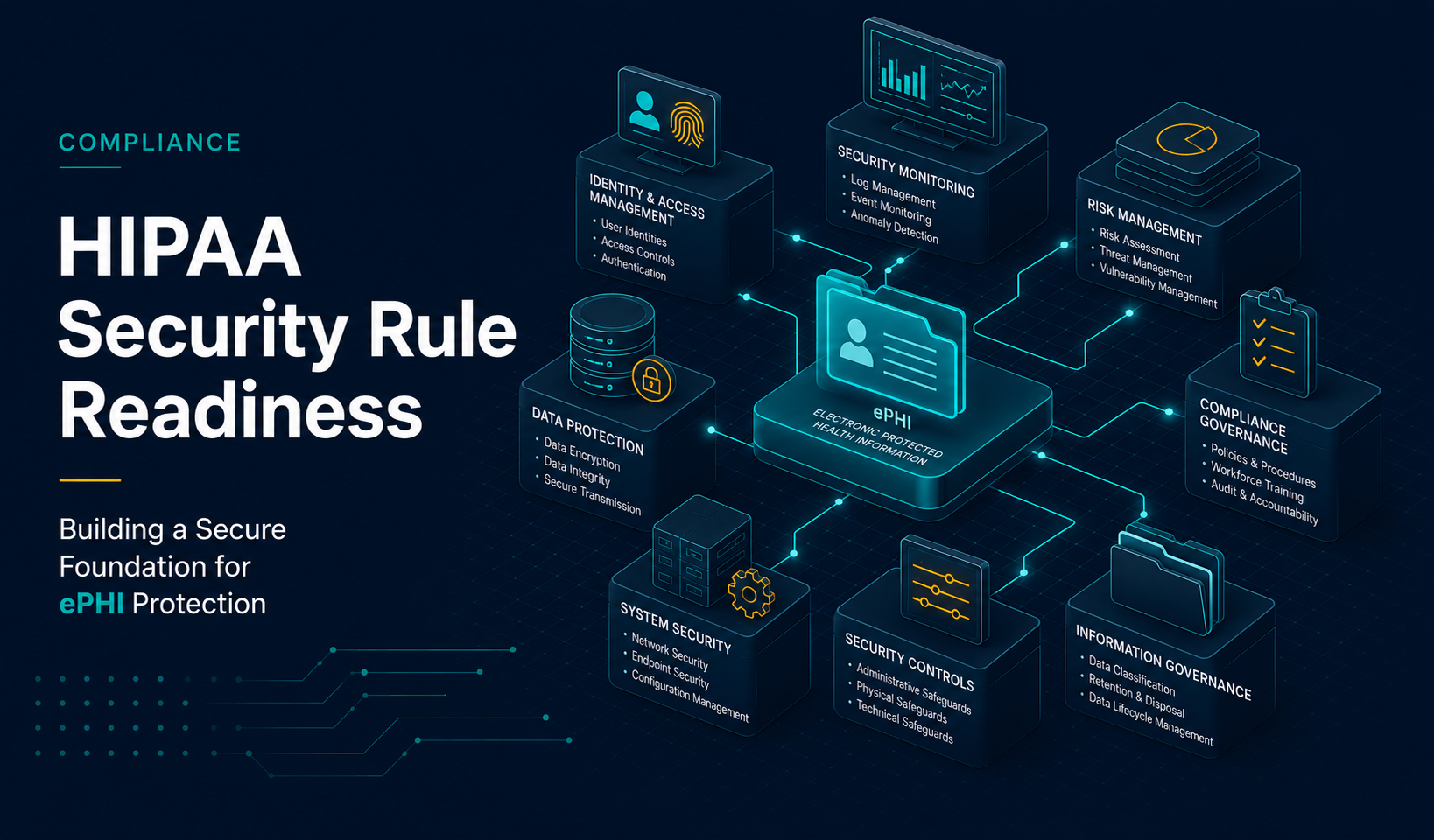
Why HIPAA Security Rule Readiness Matters
Healthcare organizations depend on electronic systems for patient care, scheduling, billing, clinical documentation, communication, imaging, pharmacy workflows, laboratory operations, and administrative processes. As those systems become more connected, the security of electronic protected health information becomes a core operational risk.
The HIPAA Security Rule establishes national standards for protecting electronic protected health information, commonly referred to as ePHI. It applies to covered entities and business associates that create, receive, maintain, or transmit ePHI.
Security Rule readiness is not simply a documentation exercise. It requires practical safeguards, risk analysis, workforce awareness, access control, monitoring, incident response, and ongoing governance.
Key Takeaways
- The HIPAA Security Rule focuses on protecting the confidentiality, integrity, and availability of ePHI.
- Healthcare organizations need administrative, physical, and technical safeguards.
- Risk analysis is foundational to Security Rule readiness.
- Documentation and evidence matter as much as technical configuration.
- HIPAA readiness should be maintained continuously, not prepared only after an incident or audit request.
What the HIPAA Security Rule Protects
The Security Rule applies to electronic protected health information. This includes protected health information that is created, received, maintained, or transmitted in electronic form.
In practical terms, ePHI may exist in:
- Electronic health record systems
- Practice management platforms
- Billing systems
- Email and collaboration platforms
- File shares and cloud storage
- Endpoint devices
- Medical applications and connected systems
- Backups and archives
- Logs and reports containing patient identifiers
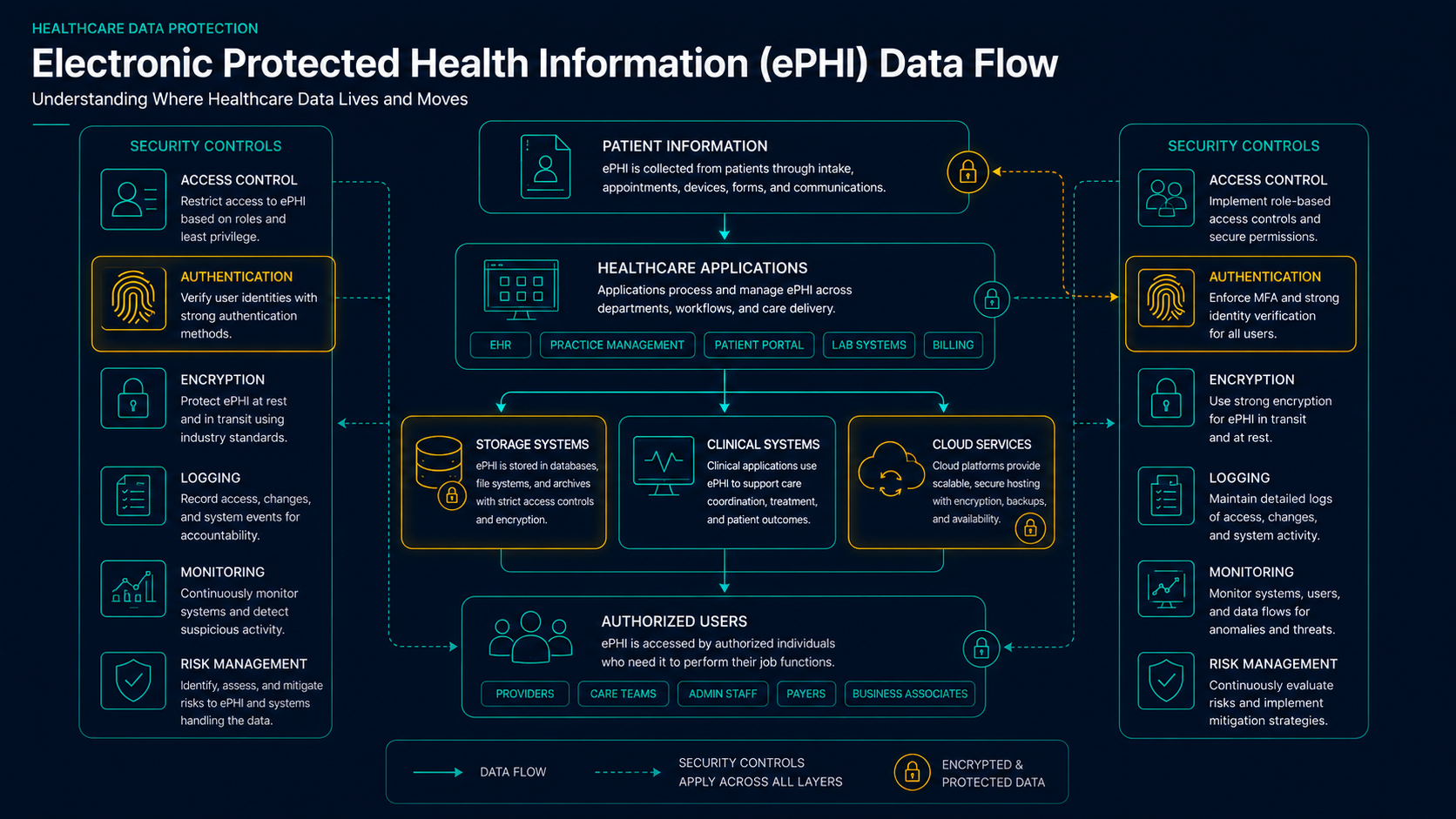
A healthcare organization cannot secure what it has not identified. Understanding where ePHI lives, how it moves, and who can access it is one of the first steps in building a practical HIPAA security program.
The Three HIPAA Safeguard Categories
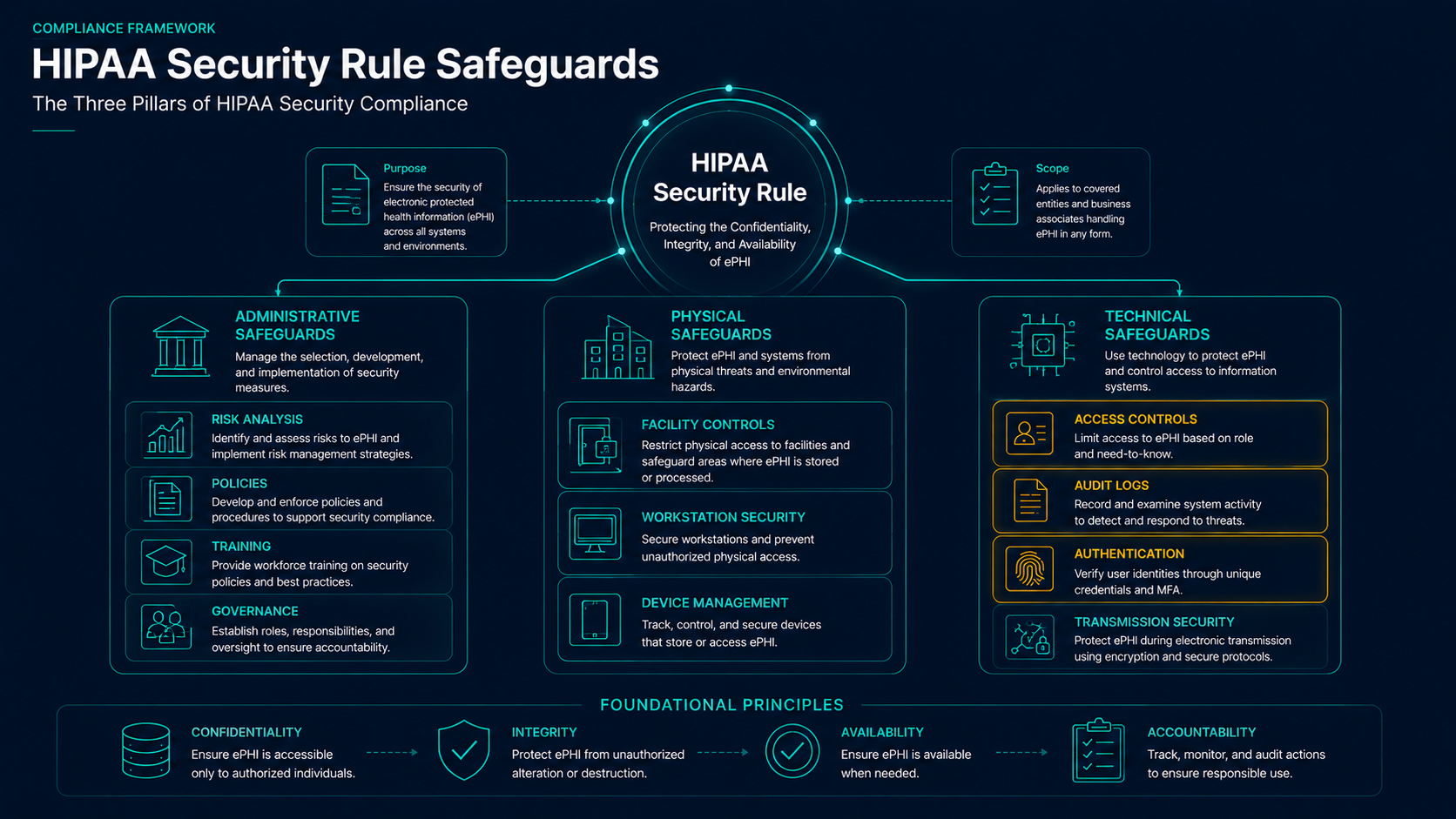
The HIPAA Security Rule is commonly organized around three safeguard categories: administrative safeguards, physical safeguards, and technical safeguards.
A strong readiness program needs all three. Technical controls are important, but they cannot replace governance, workforce training, policies, procedures, vendor oversight, and physical protections.
Administrative Safeguards
Administrative safeguards focus on governance, policies, procedures, workforce management, risk analysis, risk management, training, contingency planning, and security program oversight.
Physical Safeguards
Physical safeguards focus on protecting facilities, workstations, devices, and media that store or access ePHI.
Technical Safeguards
Technical safeguards focus on access controls, audit controls, integrity controls, authentication, and transmission security.
| Safeguard Category | Primary Focus | Examples |
|---|---|---|
| Administrative Safeguards | Security governance and operational processes | Risk analysis, workforce training, policies, access management, contingency planning |
| Physical Safeguards | Facility, workstation, device, and media protections | Facility access controls, workstation security, device handling, media disposal |
| Technical Safeguards | Technology controls protecting ePHI | Access controls, audit logs, authentication, integrity controls, transmission security |
Risk Analysis Is the Foundation
A HIPAA Security Rule readiness effort should begin with a risk analysis. Without a meaningful risk analysis, it is difficult to determine whether safeguards are reasonable and appropriate for the organization’s environment, size, complexity, systems, and threat exposure.
A practical risk analysis should identify:
- Where ePHI is created, received, maintained, or transmitted
- Which systems and users interact with ePHI
- Threats that could affect confidentiality, integrity, or availability
- Vulnerabilities in systems, processes, or controls
- Existing safeguards and control maturity
- Potential impact to patients, operations, and the organization
- Risk levels and remediation priorities
Readiness Principle
A risk analysis should be specific to the organization. A generic checklist may help start the conversation, but it does not replace a thoughtful review of actual systems, workflows, users, data flows, vendors, and operational risks.
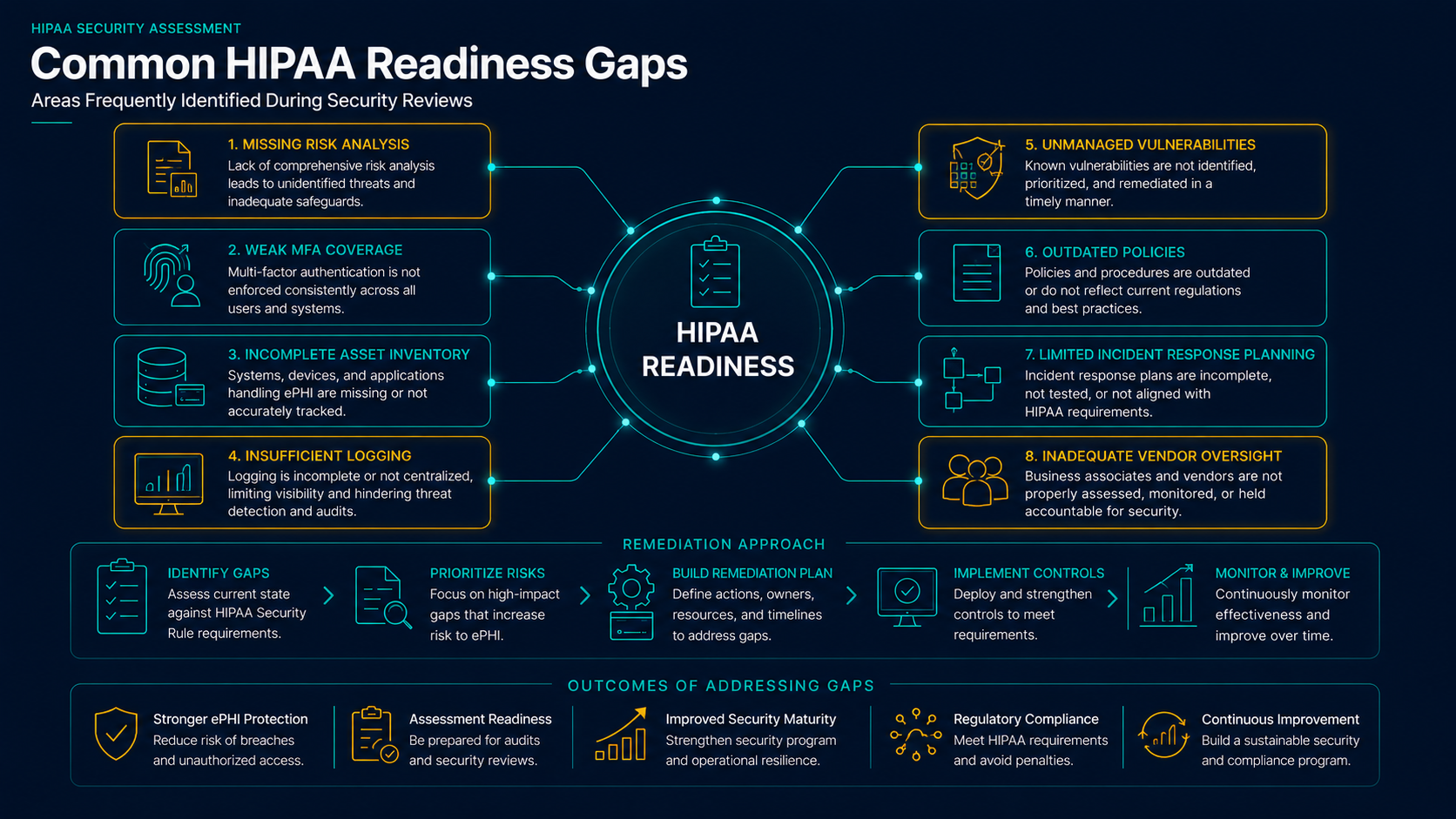
Common HIPAA Security Readiness Gaps
Many healthcare organizations have security tools in place but still struggle with consistency, documentation, visibility, and operational maturity.
- Incomplete ePHI inventory: The organization has not clearly mapped where ePHI lives or how it moves.
- Outdated risk analysis: Risk analysis has not been updated after system, workflow, vendor, or threat changes.
- Weak access governance: User access reviews, privileged access controls, and termination processes are inconsistent.
- Limited MFA coverage: Remote access, administrative access, and cloud applications are not consistently protected.
- Poor logging and monitoring: Systems generate logs, but alerts are not centralized, reviewed, or retained effectively.
- Unclear vendor responsibility: Business associate and service provider responsibilities are not documented clearly.
- Missing incident response evidence: Incident response plans exist but have not been tested or updated.
- Inconsistent patching: Endpoints, servers, applications, and network devices are not remediated consistently.
Access Control and Identity Security
Access control is one of the most important areas of HIPAA security readiness. Healthcare environments often include employees, providers, contractors, billing staff, administrators, vendors, third-party support teams, and shared clinical workflows.
Organizations should evaluate whether access to ePHI is appropriate, limited, reviewed, and removed when no longer needed.
Important identity security practices include:
- Unique user accounts
- Role-based access control
- Privileged access restrictions
- Multi-factor authentication
- Passwordless or phishing-resistant authentication where appropriate
- Timely account deactivation
- Recurring access reviews
- Vendor and third-party access governance
Identity controls are especially important for remote access, cloud applications, administrative access, and systems containing large volumes of ePHI.
Logging, Monitoring, and Audit Readiness
Healthcare organizations need visibility into security events that may affect ePHI. This does not mean every small organization needs the same tooling as a large hospital network, but it does mean logging and monitoring should be intentional.
Useful logging sources may include:
- Identity provider logs
- Remote access logs
- Endpoint security alerts
- Email security events
- Firewall and network logs
- Cloud application logs
- Electronic health record access logs
- Administrative activity logs
Centralized logging, alerting, and managed security monitoring can help organizations detect suspicious access, compromised accounts, malware activity, unauthorized data movement, and other security events.
Operational Evidence Matters
Audit readiness depends on more than having security tools deployed. Organizations should be able to show that logs are collected, alerts are reviewed, incidents are tracked, and remediation activities are documented.
Incident Response and Contingency Planning
Healthcare organizations need practical response plans for security incidents that could affect ePHI, clinical operations, billing operations, patient communication, or system availability.
A HIPAA-ready incident response program should address:
- Incident detection
- Internal escalation
- Containment and eradication
- Forensic preservation
- Communication responsibilities
- Vendor involvement
- Legal and compliance coordination
- Recovery procedures
- Post-incident review
Contingency planning is equally important. Healthcare operations are highly dependent on system availability, and downtime can affect patient care, revenue cycle workflows, and clinical decision-making.
Vendor and Business Associate Oversight
Healthcare organizations frequently rely on vendors, cloud providers, billing partners, EHR platforms, IT providers, managed security providers, consultants, and other business associates.
Vendor oversight should include:
- Business associate agreement review
- Security responsibility mapping
- Access control expectations
- Incident notification requirements
- Data handling requirements
- Logging and monitoring responsibilities
- Backup and recovery expectations
- Evidence and reporting requirements
The organization should understand which responsibilities remain internal and which responsibilities are supported by vendors or service providers.
Technical Controls That Commonly Need Attention
Every healthcare environment is different, but HIPAA readiness frequently involves strengthening several recurring technical areas.
- Multi-factor authentication for remote access and privileged accounts
- Endpoint detection and response
- Email security controls
- Patch management
- Vulnerability scanning
- Data backup and recovery
- Security awareness training
- Encryption where appropriate
- Firewall and network segmentation
- Centralized logging and alerting
- Mobile device security
- Cloud application security configuration
HIPAA Security Rule Readiness Roadmap
Most healthcare organizations make better progress when readiness work is organized into a phased roadmap rather than treated as a one-time checklist.
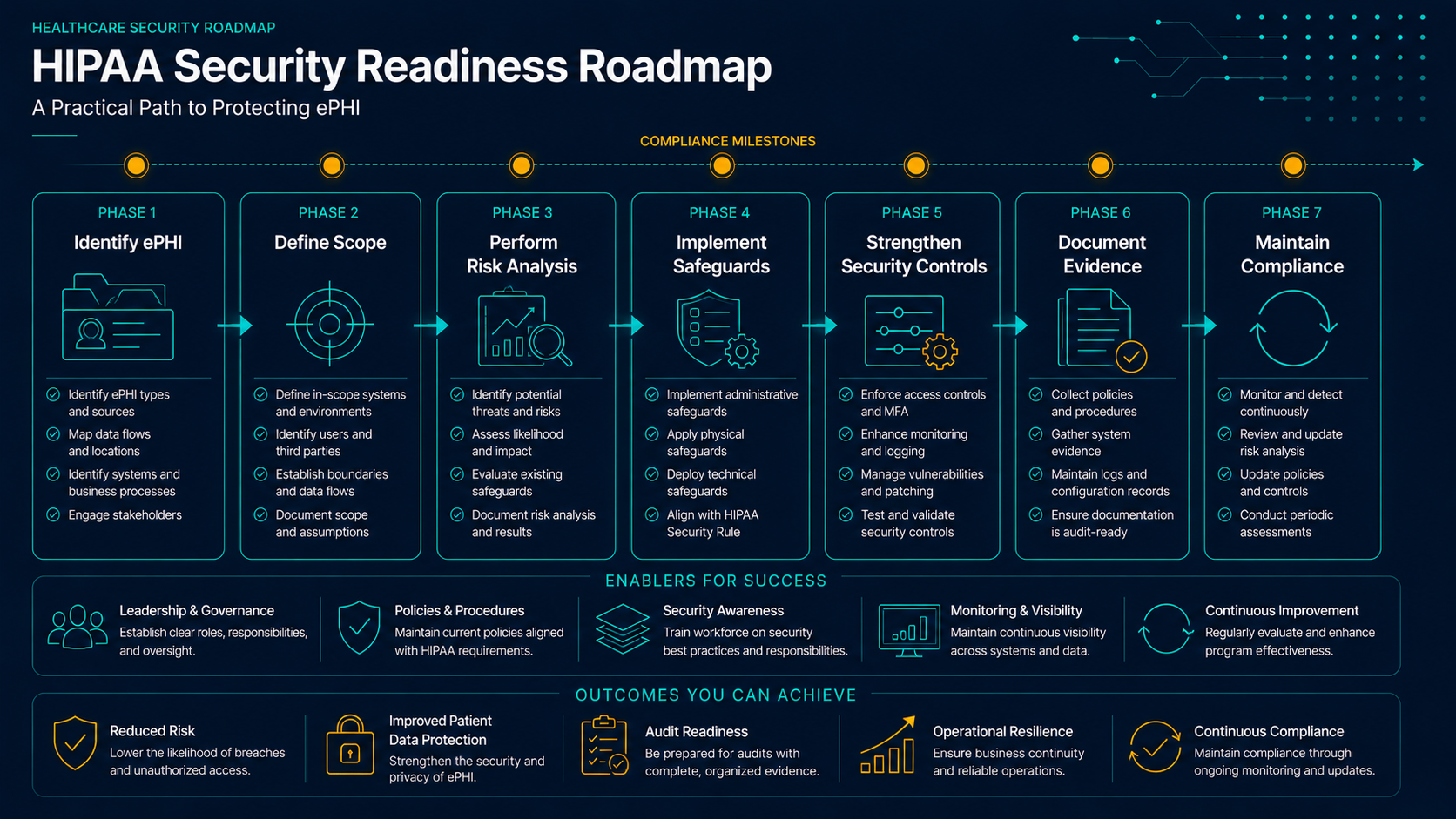
- Phase 1 – Identify ePHI: Map systems, users, workflows, vendors, and data flows involving ePHI.
- Phase 2 – Perform Risk Analysis: Evaluate threats, vulnerabilities, safeguards, likelihood, and impact.
- Phase 3 – Prioritize Safeguards: Determine which administrative, physical, and technical controls need improvement.
- Phase 4 – Remediate Gaps: Implement corrective actions across identity, endpoint, logging, backup, training, and governance.
- Phase 5 – Document Evidence: Maintain policies, reports, tickets, configurations, reviews, and monitoring records.
- Phase 6 – Test Response: Validate incident response, contingency planning, backup recovery, and escalation procedures.
- Phase 7 – Maintain Readiness: Review risks, controls, vendors, and evidence on a recurring basis.
HIPAA Readiness and Modern Cybersecurity Expectations
The healthcare threat landscape has changed significantly since the original Security Rule was published. Ransomware, credential theft, cloud misconfiguration, third-party compromise, phishing, and data extortion now create substantial risk for healthcare organizations.
In response, regulators, insurers, customers, and business partners increasingly expect healthcare organizations to demonstrate stronger security maturity.
Modern readiness efforts often focus on:
- More complete risk analysis
- Better asset and data inventory
- Stronger authentication
- Encryption and transmission protection
- Vendor oversight
- Incident response testing
- Backup and disaster recovery
- Continuous monitoring
- Security governance and leadership visibility
Important Note on Regulatory Change
HHS has proposed updates intended to strengthen HIPAA Security Rule cybersecurity requirements. Organizations should monitor official guidance and legal counsel for final requirements and effective dates.
Even where proposed requirements are not yet final, the direction is clear: healthcare organizations are expected to improve security maturity, visibility, access control, and operational resilience.
How Managed IT and Managed Security Providers Can Help
Many healthcare organizations do not have enough internal staff to operate every security control alone. Managed IT and managed security providers can help implement and maintain safeguards while giving leadership better visibility into risk.
A provider may help with:
- Security risk assessments
- Endpoint protection
- Managed detection and response
- Managed SIEM and log monitoring
- Patch management
- Vulnerability management
- Microsoft 365 security hardening
- Backup and recovery strategy
- Incident response planning
- Security documentation support
- Ongoing reporting and evidence collection
The strongest model combines internal ownership with external technical support, clear responsibility mapping, and repeatable reporting.
What Leadership Should Ask
Executives and compliance leaders do not need to manage every technical detail, but they should ask practical questions that reveal whether the security program is operating effectively.
- Do we know where ePHI exists across our environment?
- When was our last meaningful risk analysis?
- Are remote access and privileged accounts protected by MFA?
- Are logs reviewed or only collected?
- Can we prove that vulnerabilities are tracked and remediated?
- Have we tested incident response and recovery processes?
- Are vendor responsibilities documented?
- Do we have current evidence showing that safeguards are operating?
Final Thoughts
HIPAA Security Rule readiness is best viewed as an ongoing security operations discipline. Policies, risk analysis, access controls, monitoring, incident response, vendor oversight, and documentation all need to work together.
Healthcare organizations that invest in practical security maturity are better positioned to protect ePHI, reduce breach risk, support operational resilience, and respond confidently to audits, incidents, and customer security questions.
The strongest programs do not treat HIPAA as a checkbox. They use HIPAA readiness as a framework for building a more resilient healthcare security program.