
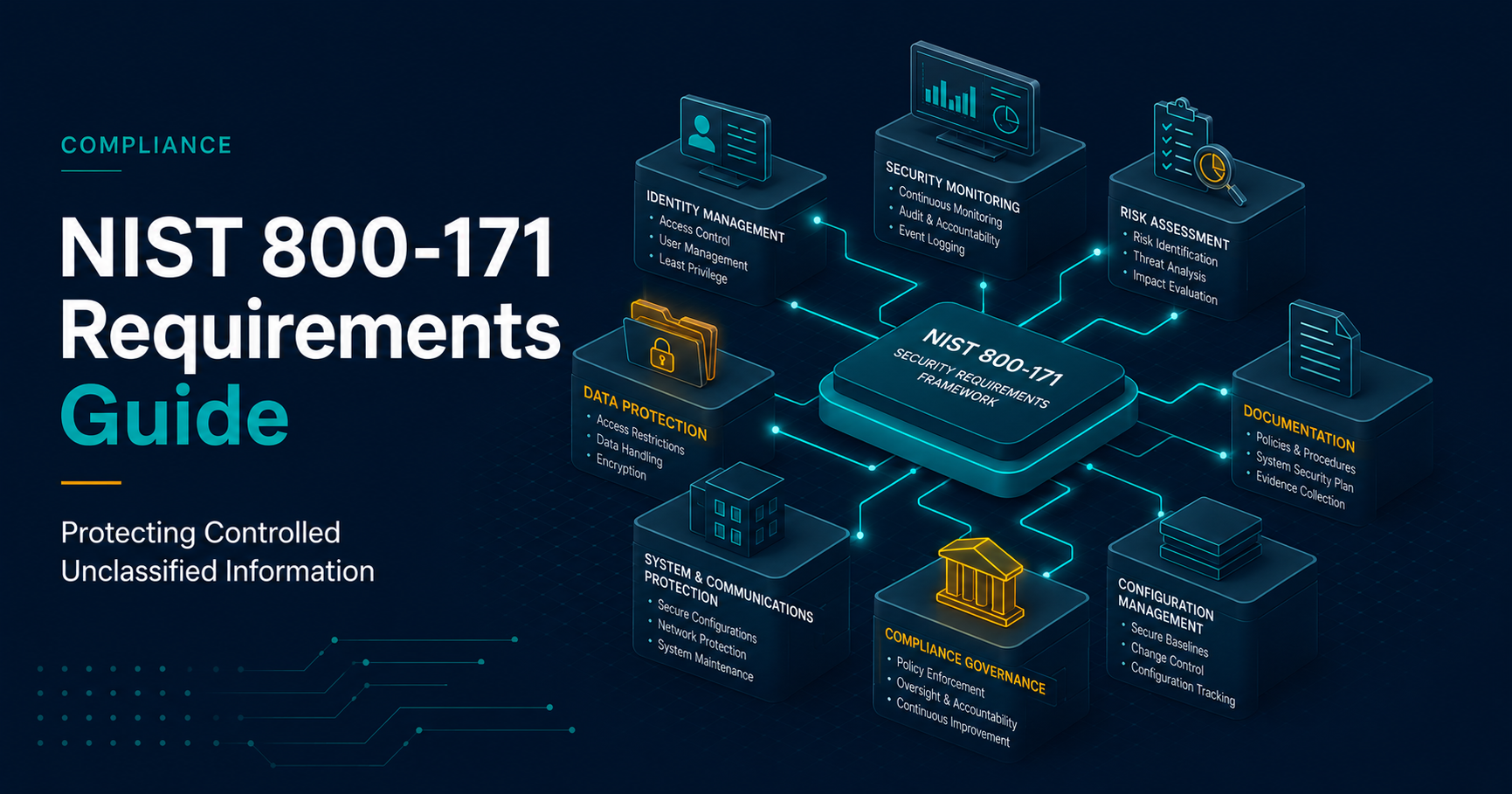
What Is NIST SP 800-171?
NIST Special Publication 800-171 is a cybersecurity framework focused on protecting Controlled Unclassified Information, commonly called CUI, when that information is stored, processed, or transmitted in nonfederal systems and organizations.
In practical terms, NIST 800-171 matters when sensitive government information moves outside of federal systems and into contractor, subcontractor, supplier, or service provider environments.
For many organizations in the defense industrial base, NIST 800-171 is the foundation of cybersecurity compliance work. It is closely connected to CMMC readiness, DFARS obligations, customer security expectations, and broader supply chain risk management.
Key Takeaways
- NIST 800-171 focuses on protecting Controlled Unclassified Information in nonfederal environments.
- Many defense contractors and subcontractors need to understand how NIST 800-171 applies to their systems.
- CMMC Level 2 is closely tied to NIST 800-171 requirements.
- Compliance requires more than technical tools; documentation, evidence, ownership, and governance are essential.
- Organizations should define CUI scope before investing heavily in remediation.
Why NIST 800-171 Exists
Government agencies frequently rely on contractors and suppliers to perform work that involves sensitive but unclassified information. That information may include technical drawings, engineering data, contract deliverables, specifications, research, operational data, or other information that should not be publicly released.
When CUI resides in a contractor environment, the government still expects appropriate safeguards to be in place. NIST 800-171 provides a structured set of cybersecurity requirements to help protect that information.
The framework exists because security failures in contractor environments can create serious downstream risk, including intellectual property theft, supply chain compromise, operational disruption, and exposure of sensitive government information.
Who Needs to Understand NIST 800-171?
NIST 800-171 is especially important for organizations that support federal or defense-related work and may handle CUI.
This commonly includes:
- Defense contractors
- Subcontractors to prime contractors
- Manufacturers
- Engineering firms
- Technology providers
- Professional services organizations
- Research organizations
- Managed IT or managed security providers supporting covered environments
Some organizations discover that NIST 800-171 applies only after a customer asks about CUI, a prime contractor flows down requirements, or a solicitation includes cybersecurity language. Waiting until that point can create unnecessary urgency and cost.
Important Scoping Question
Before beginning a NIST 800-171 project, answer this question first:
Where does CUI live, and which systems, users, applications, networks, and service providers touch it?
A poor scoping decision can make the compliance effort too broad, too expensive, or incomplete.
Understanding Controlled Unclassified Information
Controlled Unclassified Information is information that requires safeguarding or dissemination controls under applicable laws, regulations, or governmentwide policies, but is not classified national security information.
For compliance planning, the most important question is not simply whether the organization has a contract with the government. The more important question is whether the organization stores, processes, transmits, or has access to CUI.
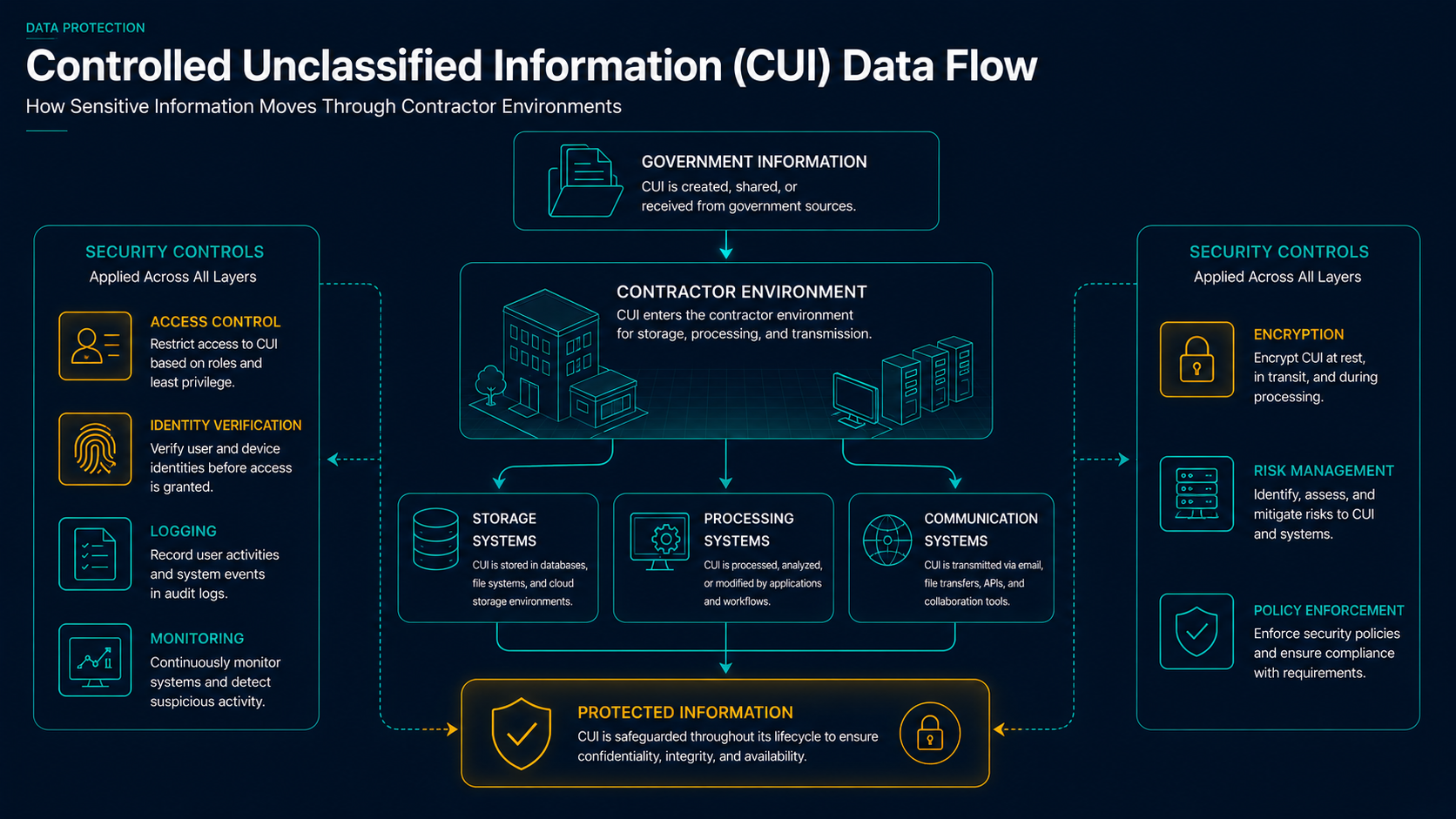
Common CUI scoping areas include:
- Email and collaboration platforms
- File shares and document repositories
- Engineering and design systems
- ERP or production systems
- Cloud storage platforms
- Backup systems
- Endpoint devices
- Remote access systems
- Managed service provider tools
- Security monitoring platforms
NIST 800-171 Revision 2 and Revision 3
One source of confusion is that organizations may hear different numbers when discussing NIST 800-171. NIST SP 800-171 Revision 2 organized requirements into 14 families and included 110 security requirements. NIST SP 800-171 Revision 3 updated the structure and now organizes requirements into 17 families with 97 requirements.
From a practical readiness perspective, organizations should understand both versions. Many CMMC Level 2 conversations continue to reference the 110 requirements in NIST 800-171 Revision 2, while NIST has finalized Revision 3 for the underlying publication.
This article focuses on the practical compliance concepts organizations need to understand: CUI scope, control implementation, documentation, evidence, remediation, and ongoing governance.
Implementation Note
Before starting remediation, confirm which requirements apply to your organization based on contracts, customer obligations, CMMC requirements, assessment expectations, and current regulatory guidance.
Do not assume that every NIST publication update automatically changes contractual obligations the same day.
NIST 800-171 Control Families
NIST 800-171 organizes cybersecurity requirements into families. These families help organizations group related security activities and assign ownership across IT, security, operations, leadership, and service providers.
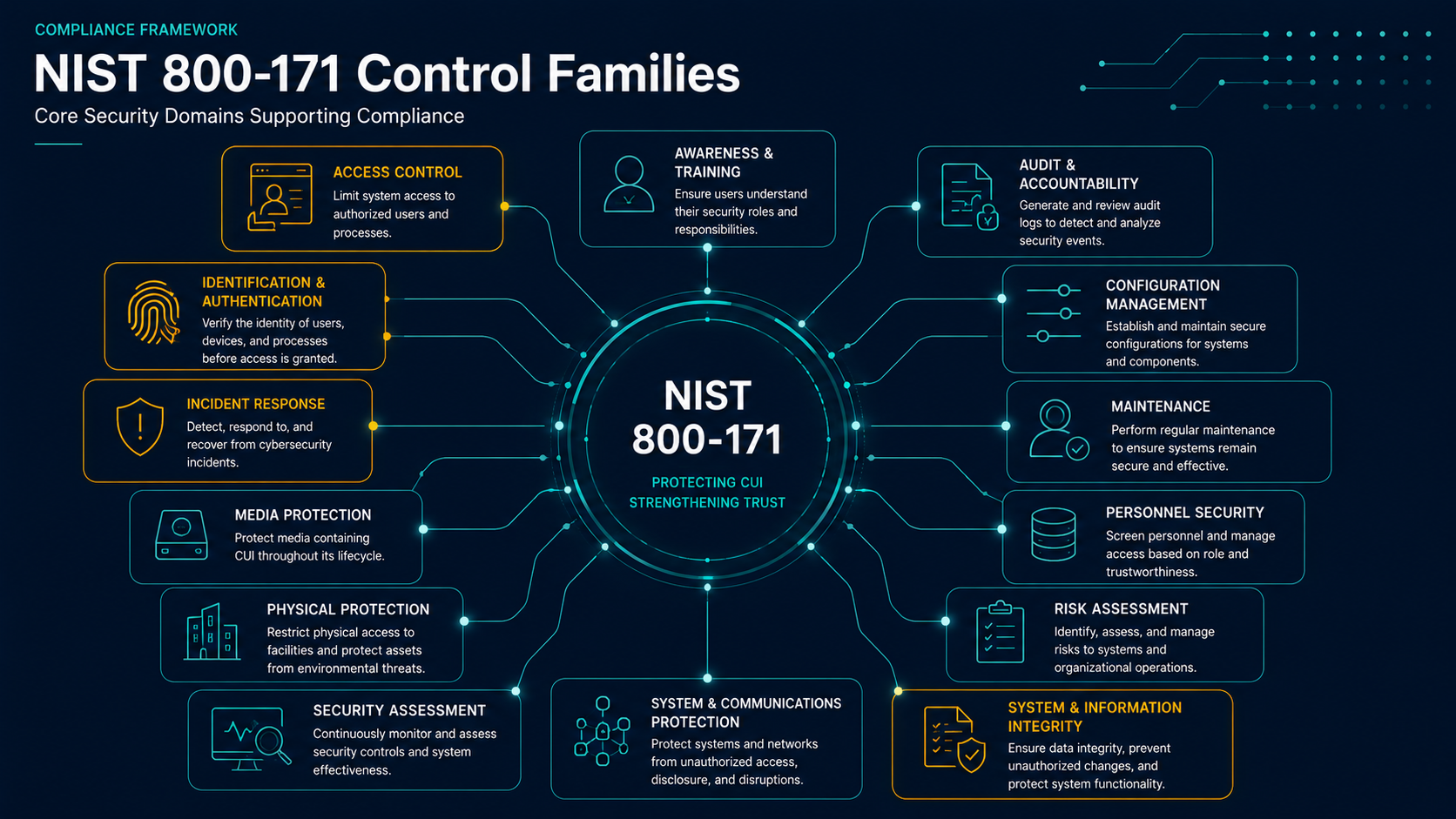
The following table summarizes the traditional NIST 800-171 Revision 2 control families that many organizations still encounter in CMMC Level 2 readiness discussions.
| Control Family | Primary Focus | Common Implementation Examples |
|---|---|---|
| Access Control | Limit system and data access to authorized users and processes. | Least privilege, remote access controls, session management, access reviews. |
| Awareness and Training | Ensure users understand security responsibilities. | Security awareness training, role-based training, phishing education. |
| Audit and Accountability | Create and retain records of system activity. | Centralized logging, audit trails, log review, alerting. |
| Configuration Management | Establish and maintain secure system configurations. | Configuration baselines, change control, hardening standards. |
| Identification and Authentication | Verify user and device identities before access is granted. | MFA, password controls, privileged identity management. |
| Incident Response | Prepare for and respond to cybersecurity incidents. | Incident response plans, tabletop exercises, escalation procedures. |
| Maintenance | Control and monitor system maintenance activities. | Maintenance authorization, remote maintenance controls, documentation. |
| Media Protection | Protect storage media containing sensitive information. | Encryption, disposal procedures, removable media restrictions. |
| Personnel Security | Manage personnel risk before and after access is granted. | Screening, termination procedures, access removal. |
| Physical Protection | Limit physical access to systems and facilities. | Facility access controls, visitor management, device protection. |
| Risk Assessment | Identify and manage cybersecurity risk. | Risk assessments, vulnerability scanning, risk tracking. |
| Security Assessment | Assess control effectiveness and maintain plans. | Control reviews, System Security Plan updates, POA&M tracking. |
| System and Communications Protection | Protect communications and system boundaries. | Network segmentation, encryption, boundary protections. |
| System and Information Integrity | Identify, report, and correct system flaws. | Patch management, malware protection, vulnerability remediation. |
NIST 800-171 Revision 3 Families
Revision 3 adds additional family structure to better align with modern security control organization. Organizations beginning new readiness work should pay attention to how requirements evolve across revisions and how customers, contracts, and assessors interpret those changes.
The three additional family areas introduced into the Revision 3 structure are:
- Planning: Formalizing security planning and program-level expectations.
- System and Services Acquisition: Addressing security considerations in system and service procurement.
- Supply Chain Risk Management: Managing cybersecurity risk introduced through suppliers, vendors, and service providers.
These areas reflect a broader shift in compliance programs: organizations are expected to understand not just their own technical controls, but also the governance, acquisition, and supplier relationships that affect security outcomes.
NIST 800-171 and CMMC
NIST 800-171 and CMMC are closely related, but they are not the same thing.
NIST 800-171 defines cybersecurity requirements for protecting CUI in nonfederal systems. CMMC is the Department of Defense assessment program used to verify whether contractors are implementing required cybersecurity practices at the appropriate level.
| Area | NIST 800-171 | CMMC |
|---|---|---|
| Primary Purpose | Defines security requirements for protecting CUI. | Provides an assessment and certification model for defense contractors. |
| Common Audience | Organizations handling CUI in nonfederal systems. | Defense contractors and subcontractors subject to DoD requirements. |
| Control Relationship | Provides the underlying security requirements. | Uses NIST 800-171-aligned requirements for Level 2. |
| Assessment Model | Requires evaluation but is not itself a certification program. | Defines self-assessment, third-party assessment, or government-led assessment paths. |
| Operational Focus | Implementation of safeguards. | Verification that required safeguards are implemented and evidenced. |
Simple Way to Think About It
NIST 800-171 describes the security requirements.
CMMC defines how certain defense contractors are assessed against cybersecurity expectations.
Organizations pursuing CMMC readiness usually need a strong understanding of NIST 800-171.
Common NIST 800-171 Readiness Gaps
Most organizations do not fail readiness efforts because they lack a single product. They struggle because compliance requires consistent process, clear ownership, complete documentation, and evidence that controls are operating.
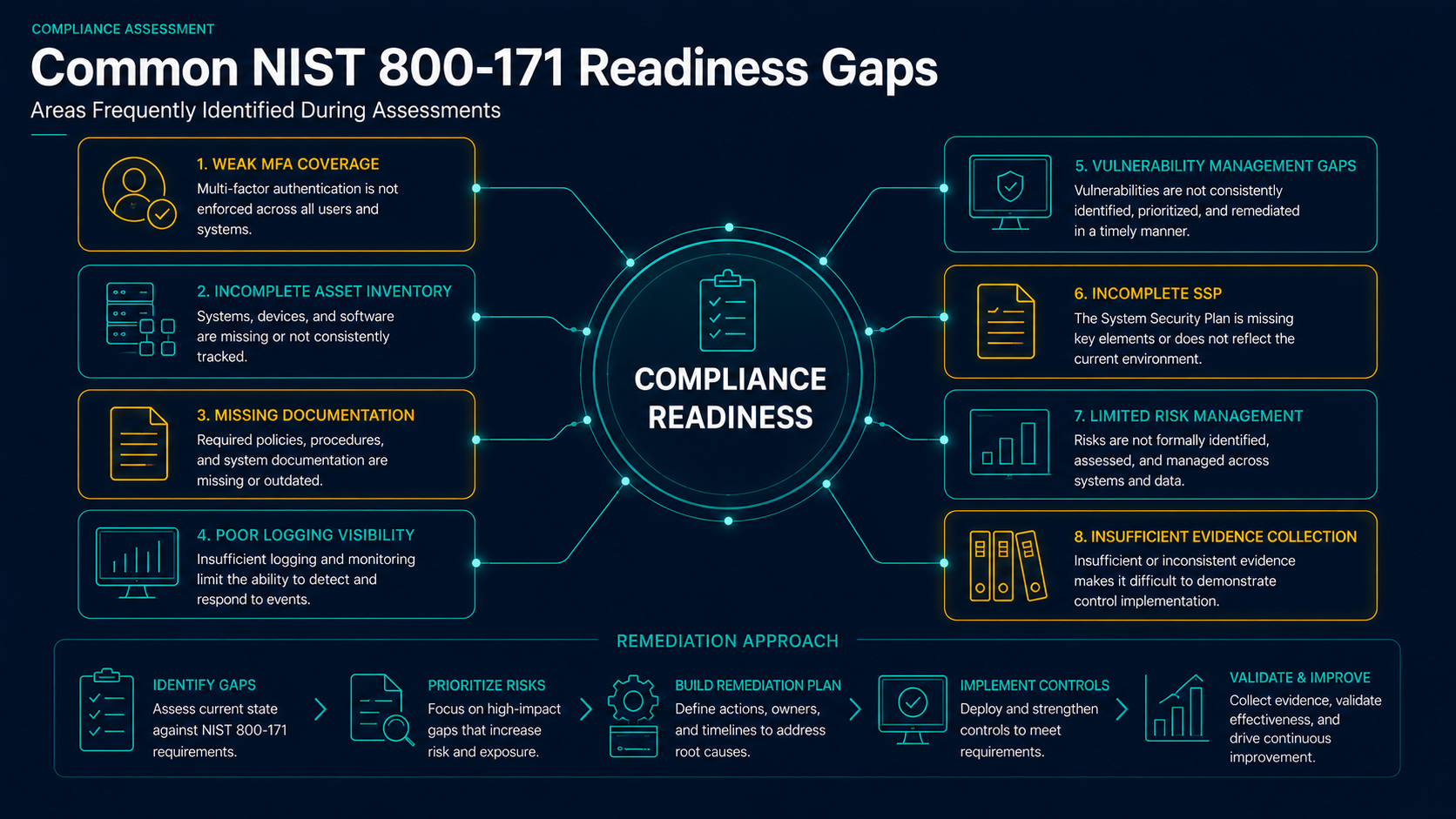
- Unclear CUI scope: The organization does not know which systems or workflows are in scope.
- Incomplete asset inventory: Devices, users, applications, data flows, and service providers are not fully documented.
- Weak MFA coverage: Multi-factor authentication does not consistently protect required accounts or access paths.
- Insufficient logging: Logs are not collected, retained, reviewed, or correlated effectively.
- Inconsistent patch management: Patching is reactive and not supported by reporting or remediation tracking.
- Missing policies and procedures: Security practices exist informally but are not documented.
- Incomplete SSP: The System Security Plan does not accurately describe the environment or control implementation.
- Poor POA&M management: Gaps are identified but not tracked through ownership, milestones, and closure.
- Vendor responsibility gaps: MSP, MSSP, cloud, and internal responsibilities are not clearly defined.
System Security Plans
A System Security Plan, or SSP, is one of the most important documents in a NIST 800-171 compliance program. It explains the system boundary, environment, control implementation, responsible parties, and supporting security architecture.
A practical SSP should describe:
- The system or environment in scope
- Where CUI is stored, processed, and transmitted
- Users, administrators, and privileged roles
- Network and cloud architecture
- Applicable security controls
- How each control is implemented
- Inherited controls from cloud or service providers
- Planned remediation activities
An SSP should not be treated as a static document created only for an assessment. It should evolve as systems, services, responsibilities, and risk decisions change.
Plans of Action and Milestones
A Plan of Action and Milestones, often called a POA&M, is used to track known gaps, remediation actions, owners, target dates, and status.
A strong POA&M helps leadership understand what remains unresolved, what risk exists, what work is underway, and when remediation is expected to be completed.
POA&M Guidance
A useful POA&M should include more than a list of missing controls.
- Describe the gap clearly.
- Assign an accountable owner.
- Document the planned remediation activity.
- Set realistic milestone dates.
- Track progress and closure evidence.
- Review risk with leadership when delays occur.
Building a Practical NIST 800-171 Program
Organizations make better progress when they treat NIST 800-171 as an operating program rather than a one-time documentation project.
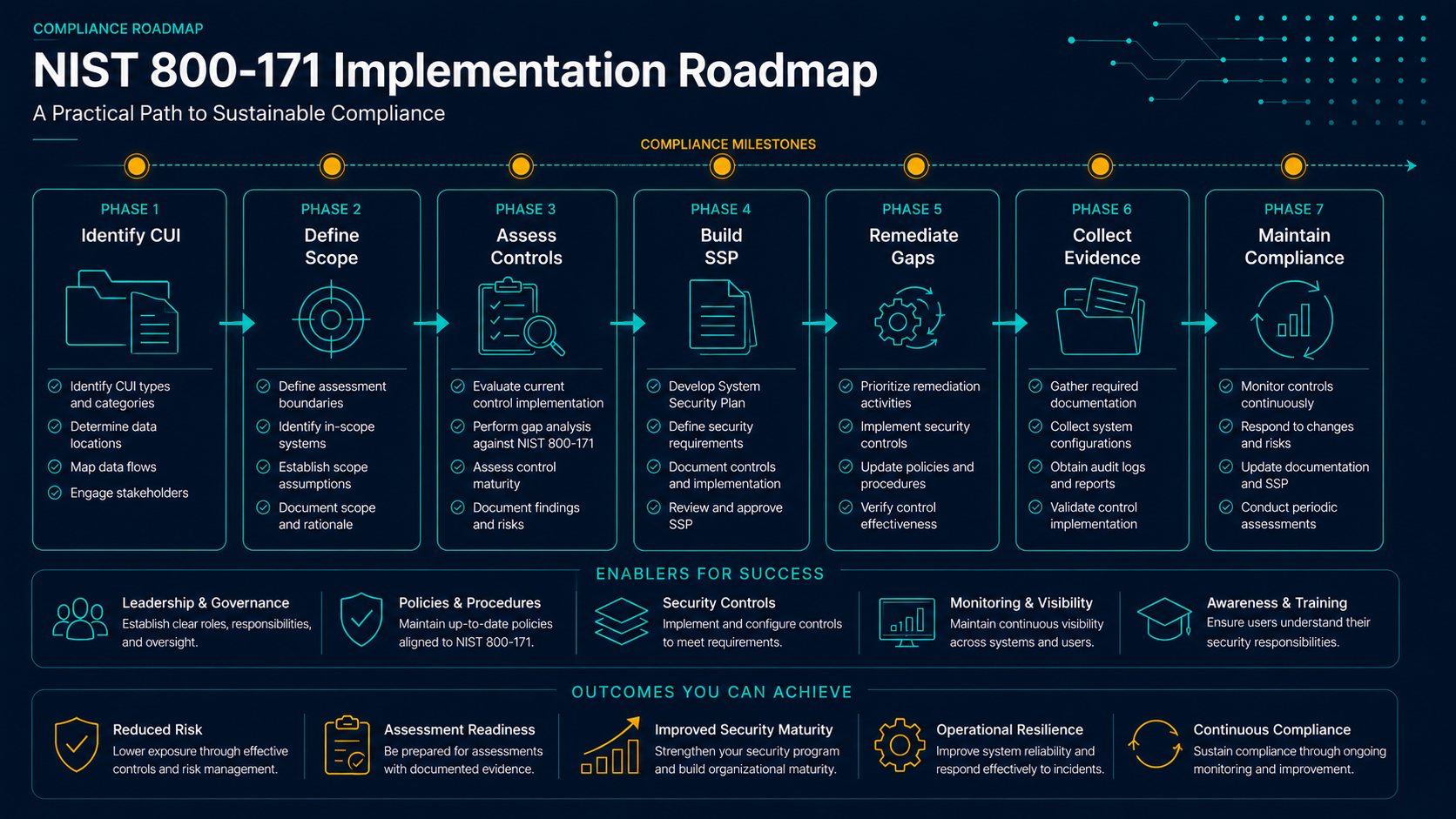
- Phase 1 – Identify CUI: Determine whether CUI exists and where it enters the organization.
- Phase 2 – Define Scope: Identify systems, users, data flows, applications, cloud services, and service providers in scope.
- Phase 3 – Assess Controls: Compare current-state security practices to applicable NIST 800-171 requirements.
- Phase 4 – Build the SSP: Document the environment, control implementation, boundaries, and responsibilities.
- Phase 5 – Remediate Gaps: Prioritize technical and administrative remediation work based on risk and business impact.
- Phase 6 – Collect Evidence: Build repeatable proof that controls are implemented and operating.
- Phase 7 – Maintain Compliance: Establish governance rhythms so readiness does not decay over time.
Technical Controls That Commonly Need Attention
Each organization has a different starting point, but several technical control areas frequently require remediation during NIST 800-171 readiness work.
- Multi-factor authentication: Protect remote access, privileged access, and applicable user workflows.
- Endpoint protection: Deploy and monitor endpoint detection, malware protection, and device controls.
- Patch management: Establish predictable patching, exception tracking, and reporting.
- Vulnerability management: Scan, prioritize, remediate, and verify closure.
- Centralized logging: Collect meaningful logs and review security events.
- Access reviews: Validate user access and remove unnecessary privileges.
- Secure configuration: Apply baseline hardening and control configuration drift.
- Backup and recovery: Protect critical data and test recovery processes.
- Incident response: Prepare plans, roles, escalation paths, and exercises.
- Remote access security: Protect VPN, ZTNA, RDP, administrator access, and third-party connectivity.
Administrative Controls Matter Too
NIST 800-171 is not only a technical checklist. Many requirements depend on people, process, policy, and recurring governance.
Administrative control work may include:
- Security policies and procedures
- Risk assessment processes
- Security training programs
- Incident response planning
- Vendor management
- Configuration management procedures
- Change management documentation
- Access approval processes
- Leadership review and risk acceptance
Organizations that focus only on tools often discover that they still lack the documentation and evidence needed to support assessment readiness.
Evidence Collection
Compliance evidence demonstrates that controls are implemented and operating. Good evidence is current, accurate, repeatable, and tied to the specific control or requirement being evaluated.
Examples include:
- MFA configuration exports
- Access review records
- Vulnerability scan reports
- Patch compliance reports
- Endpoint protection dashboards
- SIEM alert review records
- Incident response exercise documentation
- Training completion reports
- Change management records
- Backup test results
- Policy approval records
- Tickets showing remediation activity
Evidence Collection Tip
Evidence should be collected throughout normal operations, not assembled only when an assessment is scheduled. When evidence collection becomes routine, compliance readiness becomes easier to maintain.
Our platform here at DBT is designed to help organizations be audit ready. Our customers continuously upload evidence to our portal and we automatically collect and parse evidence from the SIEM, all mapped out to various compliance framework controls.
How Managed IT and Managed Security Providers Fit In
External service providers can play an important role in NIST 800-171 readiness, but their responsibilities must be clearly documented.
A provider may help with:
- Managed endpoint security
- Patch and configuration management
- Vulnerability scanning
- Managed SIEM and log monitoring
- Incident response support
- Microsoft 365 security configuration
- Backup and recovery services
- Policy and procedure support
- Readiness assessments
- Remediation planning
However, outsourcing a service does not automatically transfer compliance accountability. Organizations still need to understand which controls are performed internally, which are inherited from providers, and which remain unaddressed.
How to Start a NIST 800-171 Readiness Effort
The best starting point is not buying a tool. The best starting point is understanding applicability and scope.
- Review contracts and customer requirements.
- Determine whether the organization handles CUI.
- Map where CUI is received, stored, processed, transmitted, and backed up.
- Identify users and systems with access to CUI.
- Document service providers and inherited controls.
- Assess current security practices against applicable requirements.
- Prioritize gaps based on risk, effort, and business impact.
- Build an implementation roadmap and governance cadence.
This approach helps avoid over-scoping, under-scoping, and wasted remediation effort.
Why NIST 800-171 Improves Security Beyond Compliance
While NIST 800-171 is often discussed in the context of compliance, many of its practices reduce real-world cyber risk.
Organizations that improve identity security, patch management, logging, incident response, vulnerability management, secure configuration, and access control are also better positioned to defend against ransomware, credential theft, business email compromise, insider risk, and supply chain attacks.
A strong NIST 800-171 program should improve both compliance readiness and operational cybersecurity maturity.
Final Thoughts
NIST 800-171 is one of the most important cybersecurity frameworks for organizations that support federal and defense-related work. It provides the foundation for protecting CUI and plays a central role in CMMC readiness.
The strongest programs begin with clear scoping, realistic gap assessment, documented responsibilities, technical remediation, evidence collection, and ongoing governance.
Organizations that start early are better positioned to respond to customer expectations, reduce assessment pressure, and build a stronger security foundation.