
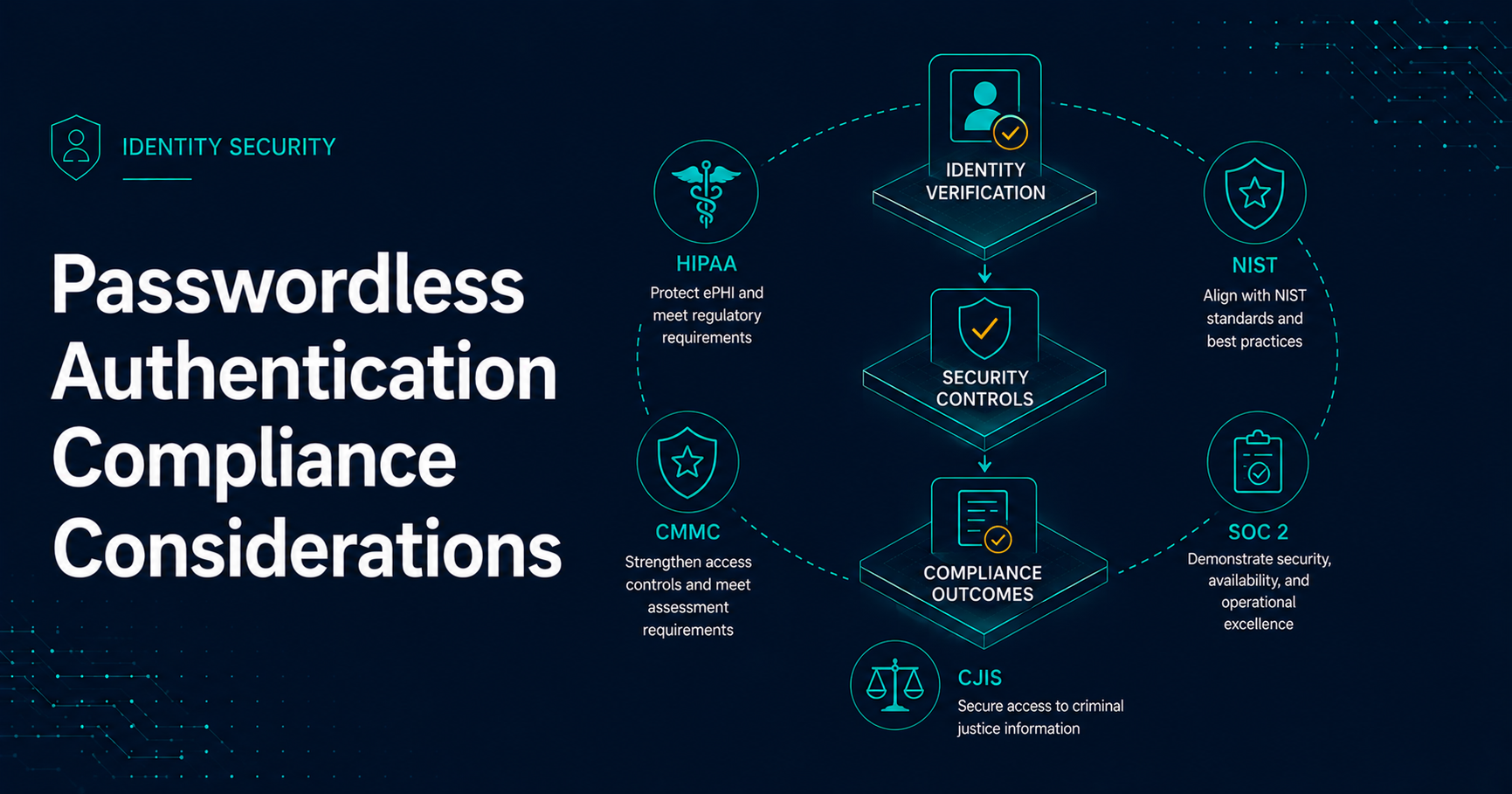
Why Passwordless Authentication Supports Compliance Initiatives
Passwordless authentication is frequently discussed as a way to improve security and user experience. However, many organizations are surprised to discover that modern authentication strategies can also help support regulatory, contractual, and cyber insurance requirements.
While most compliance frameworks do not explicitly require passwordless authentication, they increasingly emphasize strong identity verification, phishing-resistant authentication, multi-factor authentication, and reduced credential exposure.
As organizations modernize identity security, passwordless authentication often becomes a practical way to strengthen compliance readiness while reducing operational risk.
Key Compliance Benefits
- Reduce Credential Risk: Limit password exposure and credential theft opportunities.
- Improve Identity Assurance: Strengthen user verification and authentication confidence.
- Support Audit Objectives: Demonstrate stronger authentication controls.
- Align With Modern Guidance: Support evolving security recommendations.
Why Authentication Matters for Compliance
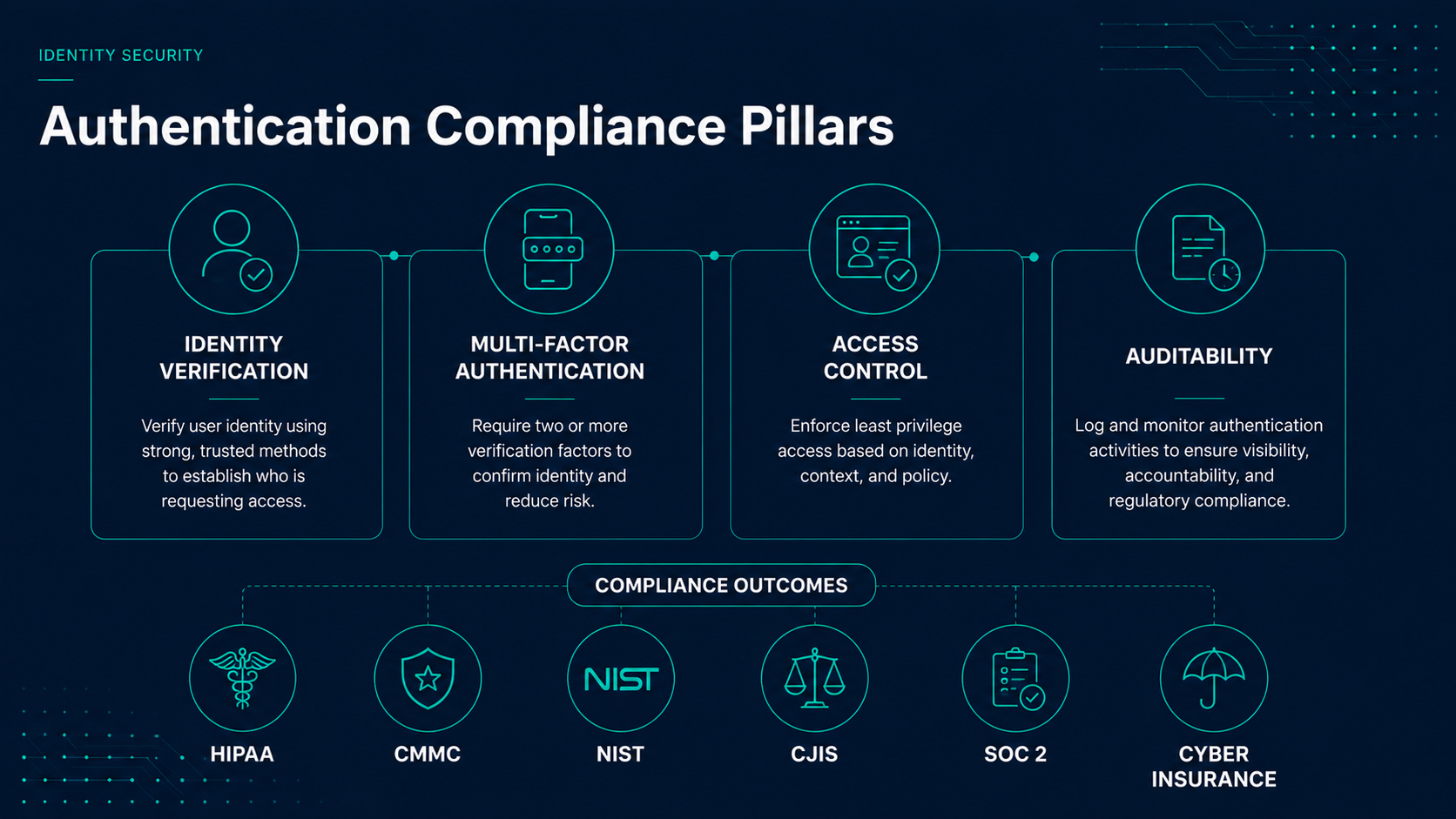
Authentication controls play a central role in nearly every security framework. If organizations cannot reliably verify user identities, many other security controls become significantly less effective.
Modern compliance frameworks increasingly focus on:
- Identity verification
- Multi-factor authentication
- Privileged access protection
- Access control
- Credential protection
- Auditability
Passwordless authentication supports these objectives by reducing reliance on passwords while strengthening authentication assurance.
HIPAA Considerations
HIPAA does not explicitly require passwordless authentication, but it does require covered entities and business associates to implement reasonable and appropriate safeguards to protect electronic protected health information (ePHI).
Passwordless authentication can support:
- User authentication requirements
- Access control safeguards
- Reduced credential theft risk
- Improved protection of privileged accounts
Healthcare organizations increasingly evaluate passwordless authentication as part of broader identity security initiatives.
CMMC and NIST 800-171
Organizations pursuing CMMC compliance or implementing NIST 800-171 controls often focus heavily on identity security and authentication controls.
Relevant areas include:
- Identification and authentication
- Multi-factor authentication
- Privileged access protection
- Access control enforcement
Passwordless authentication can strengthen authentication assurance while reducing exposure to phishing and credential theft attacks.
NIST Digital Identity Guidance
NIST SP 800-63 emphasizes authentication assurance levels and increasingly recognizes phishing-resistant authentication methods as stronger forms of identity verification.
Examples include:
- FIDO2 security keys
- Passkeys
- Certificate-based authentication
- Passwordless authentication platforms
Organizations seeking higher assurance levels frequently evaluate these technologies.
| Authentication Method | Phishing Resistant | Passwordless | Compliance Alignment |
|---|---|---|---|
| SMS MFA | No | No | Moderate |
| Authenticator Apps | No | No | Good |
| Push MFA | Partial | No | Good |
| FIDO2 | Yes | Yes | Strong |
| Passkeys | Yes | Yes | Strong |
| Passwordless Platforms | Yes | Yes | Strong |
CJIS Security Policy Considerations
Law enforcement agencies and criminal justice organizations frequently operate under CJIS Security Policy requirements.
Authentication controls, access controls, and identity verification requirements play an important role in protecting Criminal Justice Information (CJI).
Passwordless authentication can help strengthen authentication workflows while reducing password-related risks.
SOC 2 and Security Audits
SOC 2 assessments often evaluate authentication controls, access management processes, and identity security practices.
While passwordless authentication is not specifically required, auditors increasingly view phishing-resistant authentication and stronger identity verification favorably when evaluating security programs.
Cyber Insurance Requirements
Cyber insurance questionnaires increasingly evaluate authentication maturity.
Common questions include:
- Is MFA deployed?
- Are privileged accounts protected?
- Is remote access protected?
- How are administrator accounts secured?
- Are phishing-resistant controls implemented?
Organizations with stronger authentication controls often experience fewer underwriting challenges and may improve their overall cyber risk profile.
Framework Alignment
- HIPAA: Supports stronger access control and user authentication safeguards.
- CMMC: Strengthens identification and authentication controls.
- SOC 2: Supports access management and security objectives.
- Cyber Insurance: Demonstrates authentication maturity and risk reduction.
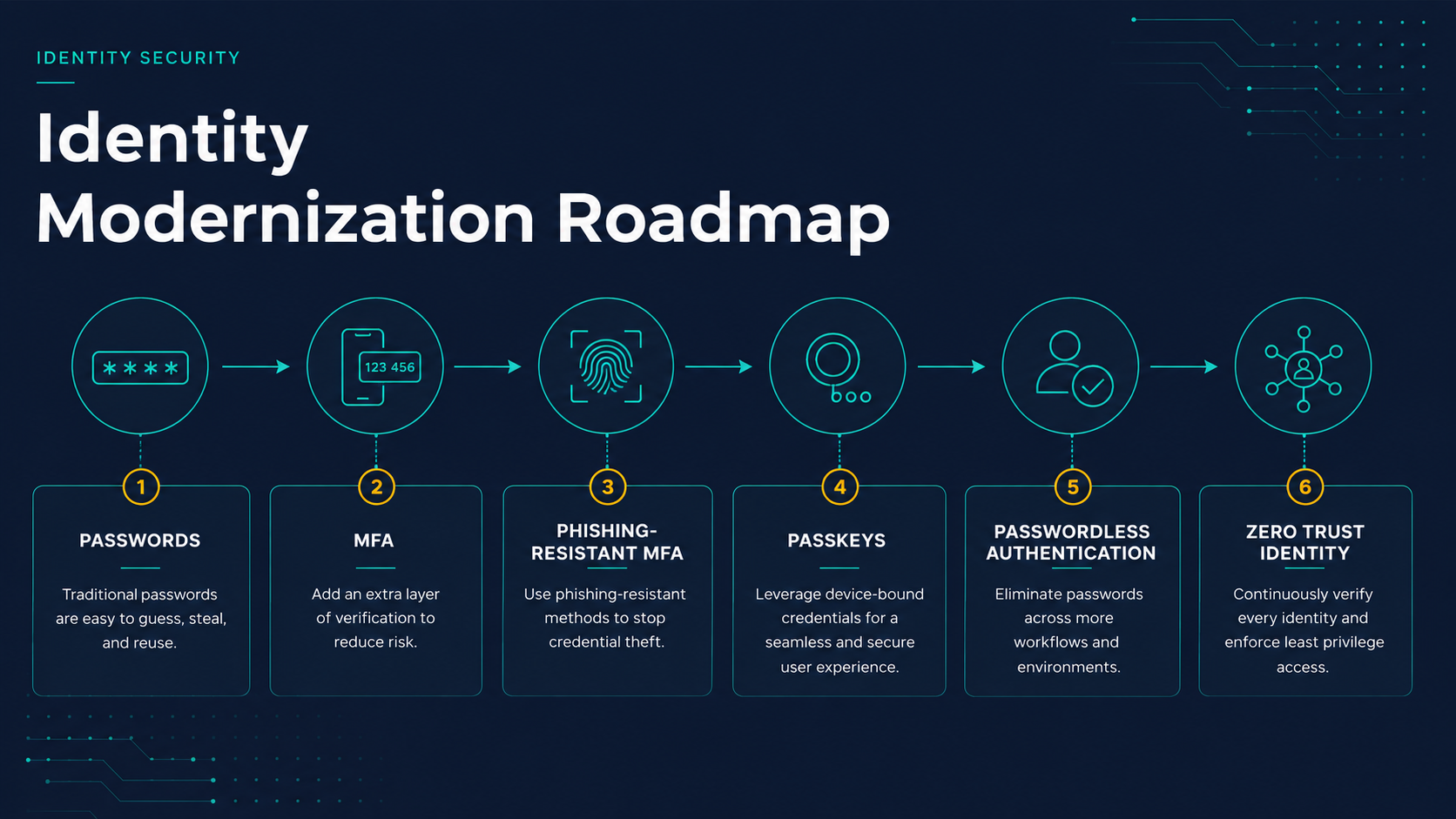
Recommended Authentication Modernization Roadmap
Most organizations achieve the best results by modernizing authentication in stages rather than attempting a complete transformation all at once.
-
Stage 1 – Passwords
Traditional password-based authentication provides the baseline identity control but remains vulnerable to credential theft and phishing attacks. -
Stage 2 – Multi-Factor Authentication (MFA)
Adding a second authentication factor significantly improves security and is often the first modernization step. -
Stage 3 – Phishing-Resistant MFA
FIDO2 security keys and phishing-resistant authentication methods reduce the effectiveness of credential phishing attacks. -
Stage 4 – Passkeys
Passkeys improve user experience while providing phishing-resistant authentication for supported applications. -
Stage 5 – Passwordless Authentication
Organizations begin removing passwords from workstation login, remote access, and application authentication workflows. -
Stage 6 – Zero Trust Identity
Authentication becomes part of a broader Zero Trust architecture with continuous verification, device trust, and least-privilege access controls.
Compliance Is About Outcomes
Most compliance frameworks intentionally avoid prescribing specific products or vendors. Instead, they focus on outcomes such as strong authentication, reduced risk, access control, and auditability.
Passwordless authentication should be viewed as a tool that helps organizations achieve these outcomes rather than as a compliance requirement itself.
When implemented correctly, passwordless authentication can simultaneously improve security, user experience, operational efficiency, and compliance readiness.
Final Thoughts
Identity security continues to play an increasingly important role in regulatory compliance, cyber insurance evaluations, and security audits.
Organizations that modernize authentication through phishing-resistant MFA, FIDO2, passkeys, and passwordless authentication often find that these investments support both security and compliance objectives.
As threats continue to evolve, stronger authentication is becoming one of the most effective ways to reduce risk while demonstrating security maturity.