
What Are HIPAA Administrative Safeguards?
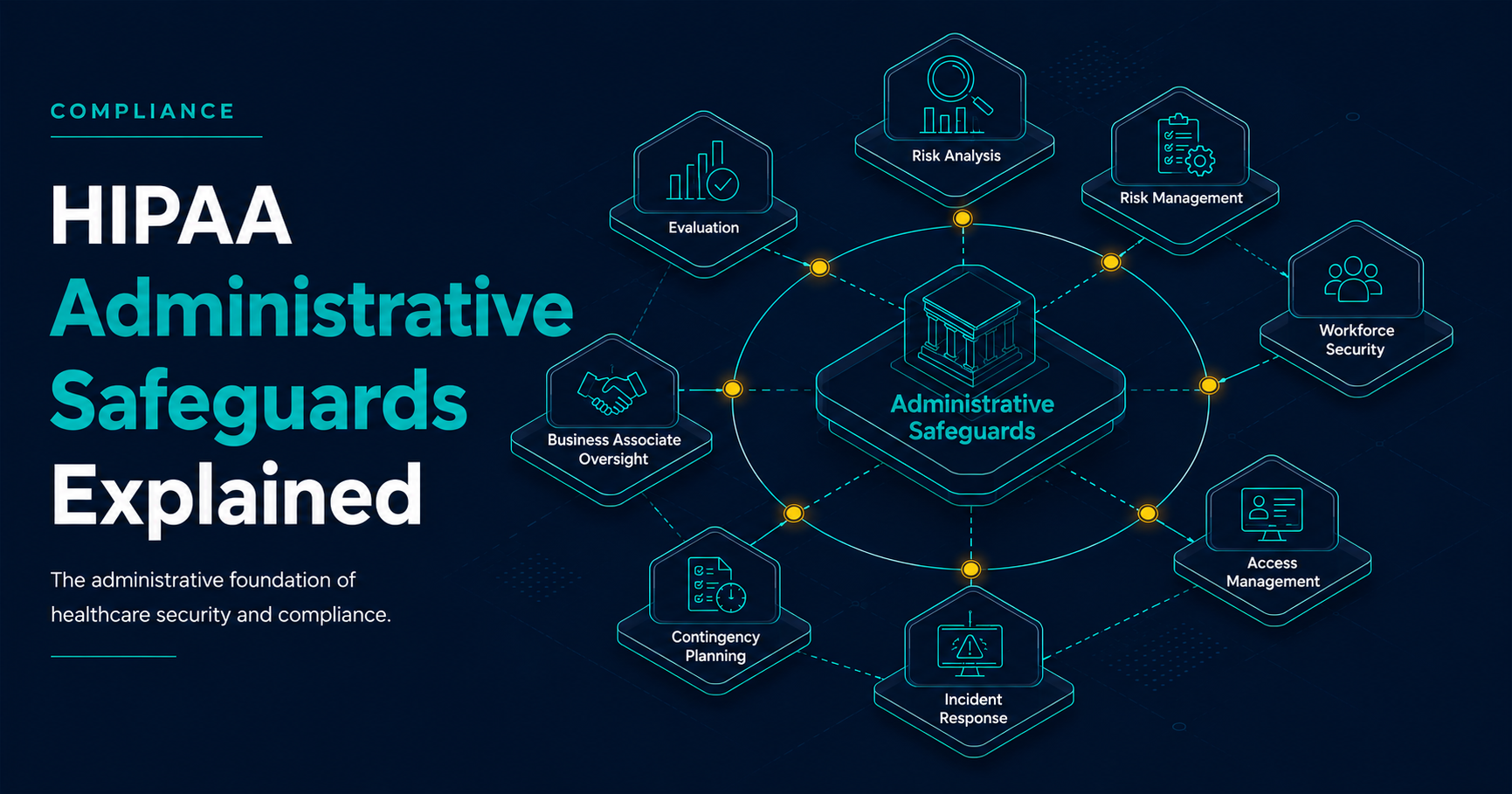
HIPAA Administrative Safeguards are the governance and operational requirements within the HIPAA Security Rule. They address how a healthcare organization manages security responsibility, workforce access, risk analysis, risk management, security awareness, incident response, contingency planning, business associate oversight, and periodic evaluation.
Technical controls are important, but administrative safeguards define the program that tells the organization what to protect, who is responsible, how risk is reviewed, how workforce members are trained, how incidents are handled, and how security decisions are documented over time.
For healthcare executives, administrative safeguards are especially important because they connect compliance obligations to business operations. They help leadership answer whether security risk is being identified, assigned, managed, reviewed, and reported in a defensible way.
Key Takeaways
- Administrative Safeguards are the governance foundation of the HIPAA Security Rule.
- They include risk analysis, risk management, workforce security, access management, awareness training, incident response, contingency planning, and evaluation.
- Policies alone are not enough; organizations need evidence that procedures and controls are operating.
- Administrative Safeguards should connect directly to technical safeguards, vendor oversight, and executive reporting.
- Healthcare organizations should treat Administrative Safeguards as an ongoing operating program, not a one-time compliance checklist.
Administrative Safeguards vs. Technical Safeguards
HIPAA safeguards are often discussed in three groups: administrative, physical, and technical. Administrative Safeguards define the management framework. Technical Safeguards define technology controls such as access control, audit controls, integrity protections, authentication, and transmission security. Physical Safeguards address facilities, workstations, and device controls.
Administrative Safeguards are what make the other safeguards sustainable. Without governance, technical controls may be deployed inconsistently, alerts may go unreviewed, access reviews may not occur, incident response may be improvised, and risk findings may remain unresolved.
| Safeguard Area | Primary Focus | Operational Examples |
|---|---|---|
| Administrative Safeguards | Security governance, risk management, workforce procedures, incident response, evaluation, and oversight | Risk analysis, security officer role, workforce access procedures, training, incident response plans, contingency planning |
| Technical Safeguards | Technology controls that protect ePHI and system access | MFA, access control, audit logs, encryption, integrity controls, authentication, transmission security |
| Physical Safeguards | Physical protection of facilities, workstations, systems, and devices | Facility access controls, workstation use policies, device inventory, media disposal, equipment controls |
The Core Administrative Safeguard Areas
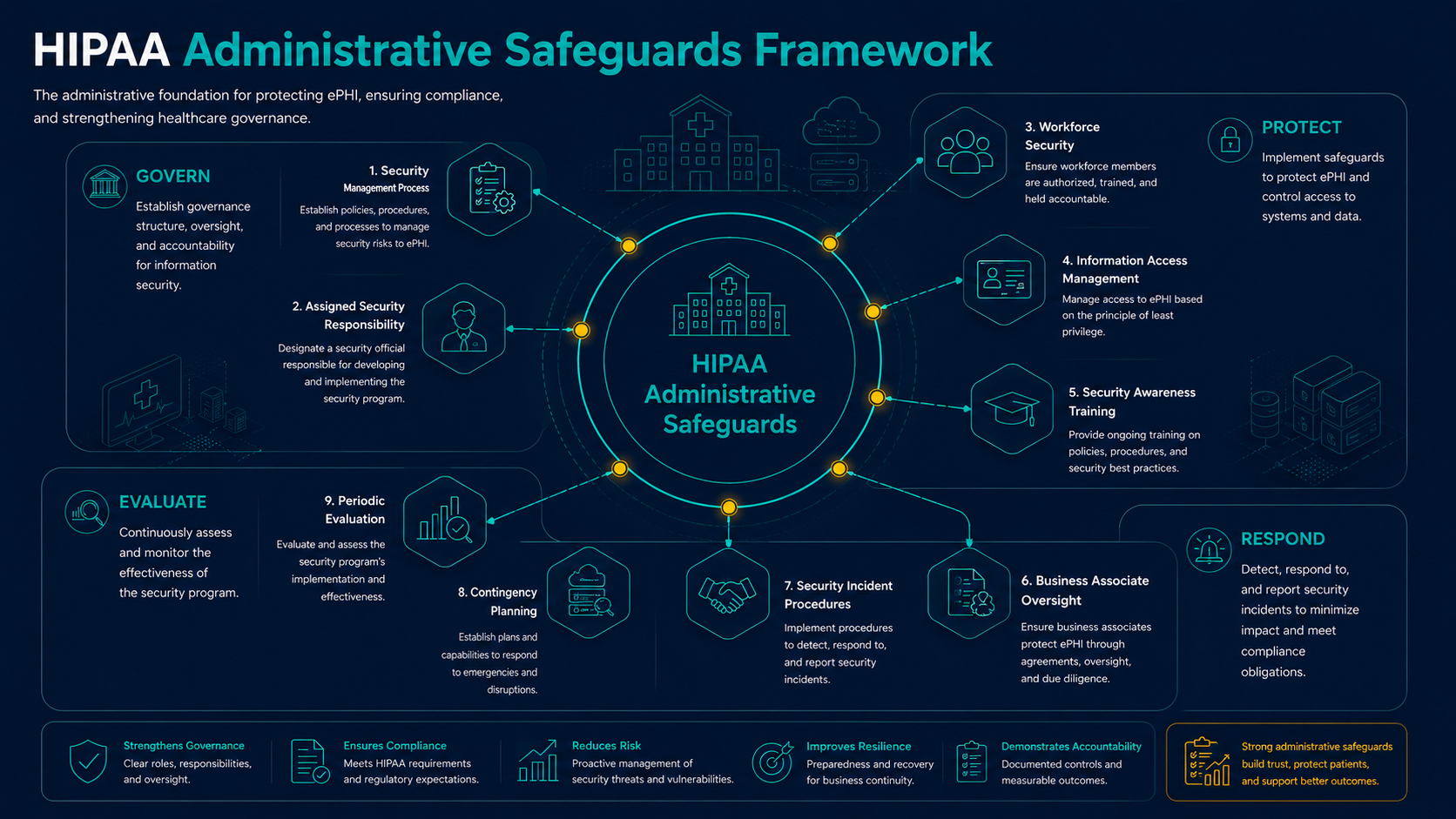
The Administrative Safeguards section of the HIPAA Security Rule includes several standards and implementation specifications. In practical terms, these standards require healthcare organizations to establish security governance, assess risk, manage risk, control workforce access, train users, prepare for incidents, plan for downtime, oversee business associates, and evaluate the effectiveness of their security program.
| Administrative Safeguard Area | What It Requires Operationally | Evidence Healthcare Organizations Should Maintain |
|---|---|---|
| Security Management Process | Identify risks to ePHI, implement risk management activities, apply sanctions, and review system activity | Risk analysis, risk register, remediation plan, sanction policy, log review procedures, security reports |
| Assigned Security Responsibility | Designate responsibility for developing and implementing security policies and procedures | Security officer designation, role description, governance charter, committee notes |
| Workforce Security | Ensure workforce access is appropriate and removed when no longer needed | Onboarding records, access approvals, termination checklists, role changes, access review reports |
| Information Access Management | Authorize access to ePHI based on role and business need | Access request records, role-based access model, privileged access reviews, account inventories |
| Security Awareness and Training | Train workforce members on security expectations and threats | Training records, phishing testing results, security reminders, policy acknowledgements |
| Security Incident Procedures | Identify, respond to, document, and mitigate security incidents | Incident response plan, escalation procedures, incident tickets, tabletop exercises, lessons learned |
| Contingency Plan | Prepare for emergencies that affect ePHI availability, recovery, and operations | Backup procedures, disaster recovery plan, emergency mode operation plan, recovery test results |
| Evaluation | Periodically evaluate security measures in response to environmental or operational changes | Assessment reports, control reviews, audit findings, remediation tracking, executive reports |
Security Management Process
The Security Management Process is one of the most important Administrative Safeguard standards. It includes risk analysis, risk management, sanction policy, and information system activity review. This area requires healthcare organizations to understand risks to ePHI and take reasonable steps to reduce those risks.
This is where compliance becomes operational. The organization should be able to show how it identifies risks, prioritizes findings, assigns responsibility, tracks remediation, reviews system activity, and escalates material issues to leadership.
- Risk analysis: Identify and evaluate risks to the confidentiality, integrity, and availability of ePHI.
- Risk management: Implement security measures sufficient to reduce risks to a reasonable and appropriate level.
- Sanction policy: Apply consequences for workforce members who violate security policies and procedures.
- Information system activity review: Review records such as audit logs, access reports, and security incident tracking.
Compliance Principle
A healthcare organization should be able to connect its risk analysis findings to a risk management plan, assigned owners, remediation status, evidence, and leadership visibility. A report without follow-through creates a governance gap.
Assigned Security Responsibility
HIPAA expects responsibility for security to be assigned. In smaller organizations, this may be one person wearing multiple hats. In larger organizations, responsibility may be shared across compliance, IT, security, privacy, legal, operations, and executive leadership.
The important point is that security responsibility should not be vague. Healthcare organizations should define who owns policy maintenance, risk analysis, incident response coordination, vendor review, access governance, security reporting, and remediation tracking.
Practical evidence may include a named security officer, role descriptions, governance meeting notes, risk committee documentation, executive reporting, and escalation procedures.
Workforce Security and Access Procedures
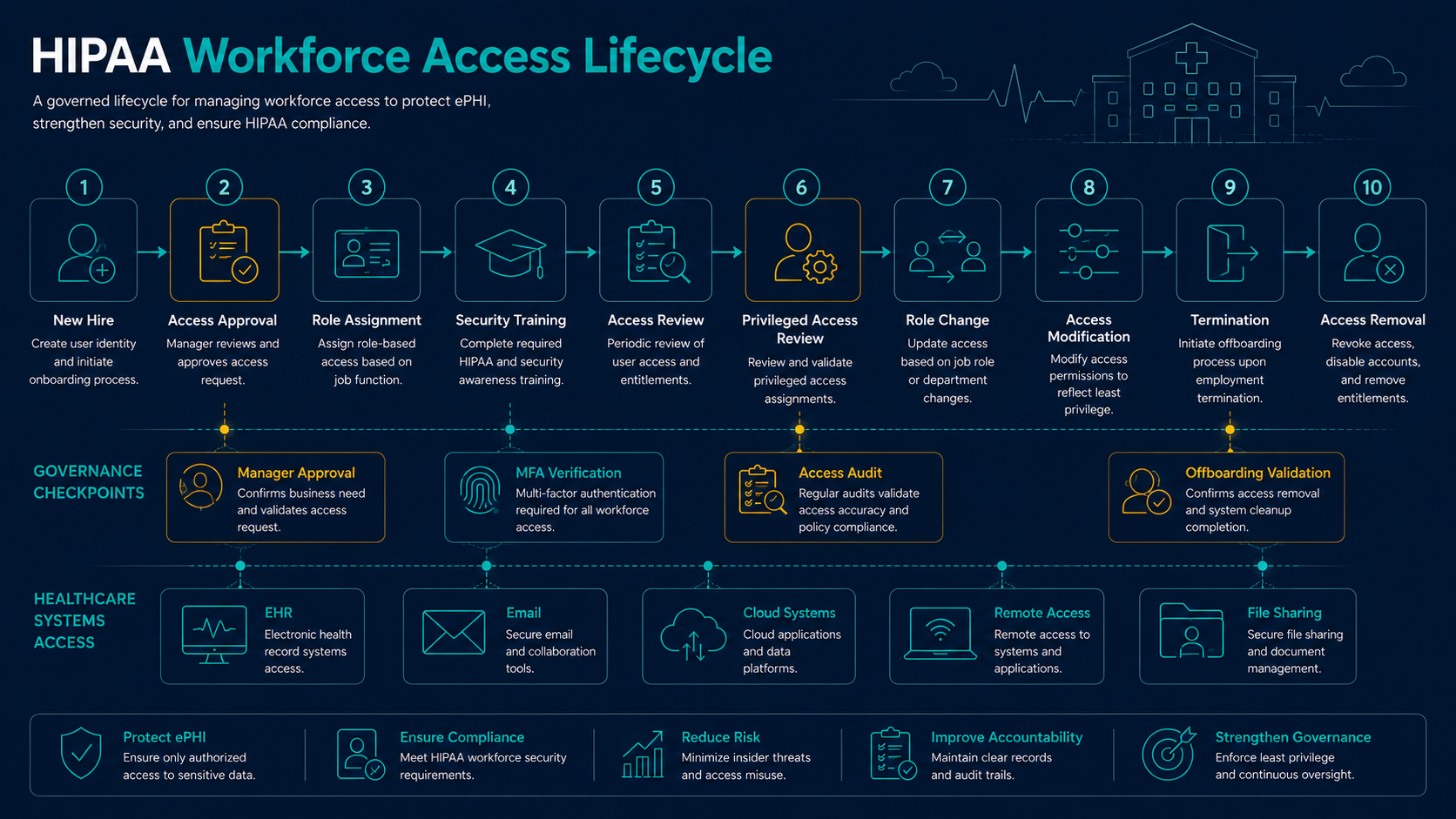
Workforce Security focuses on ensuring that workforce members have appropriate access to ePHI and that access is modified or removed when roles change or employment ends. This includes employees, contractors, temporary workers, interns, and other workforce members under the organization’s control.
Common workforce access failures include accounts that remain active after termination, excessive permissions, shared accounts, privileged access without review, and inconsistent onboarding or offboarding procedures.
| Workforce Event | Access Governance Requirement | Example Evidence |
|---|---|---|
| New Hire | Access should be approved based on job role and minimum necessary need | Access request ticket, manager approval, role assignment, training record |
| Role Change | Access should be updated when responsibilities change | Role change notification, access modification record, removed permissions |
| Termination | Access should be removed promptly across systems, cloud platforms, remote access, and vendor portals | Termination checklist, disabled account record, device return record, access review confirmation |
| Privileged Access | Administrative access should be limited, approved, monitored, and reviewed | Privileged account inventory, approval record, MFA evidence, review report |
| Vendor-Supported Access | Vendor access should be authorized, limited, monitored, and removed when no longer required | Vendor access list, remote access logs, BAA reference, access review notes |
Information Access Management
Information Access Management addresses how access to ePHI is authorized and managed. The organization should define how access is requested, approved, modified, reviewed, and removed. Access should be based on role, business need, and minimum necessary principles.
In modern healthcare environments, access management must include more than the EHR. It should also account for email, file shares, cloud platforms, billing systems, imaging systems, remote access tools, backup systems, security platforms, and third-party portals.
- Maintain an inventory of systems that contain or provide access to ePHI.
- Define standard access roles where possible.
- Require approval before granting access to ePHI systems.
- Review privileged accounts and remote access regularly.
- Use MFA for remote access, cloud access, privileged access, and high-risk workflows.
- Remove access promptly when users change roles or leave the organization.
- Retain evidence of approvals, reviews, and removals.
Security Awareness and Training
Security Awareness and Training requires healthcare organizations to educate workforce members about security responsibilities and common threats. Training should not be limited to a once-per-year slide deck. It should reinforce practical behaviors that reduce risk to ePHI and healthcare operations.
Security awareness topics may include phishing, password and MFA expectations, approved use of systems, remote work practices, reporting suspicious activity, handling patient data, mobile device security, social engineering, and incident escalation.
A mature awareness program should produce evidence. Organizations should retain training completion records, policy acknowledgements, phishing simulation results, security reminders, and records of targeted training after incidents or policy violations.
Practical Training Reminder
Healthcare users do not need abstract security theory. They need clear guidance on how to recognize suspicious activity, protect patient data, use approved systems, report incidents quickly, and avoid common mistakes that create compliance and breach exposure.
Security Incident Procedures
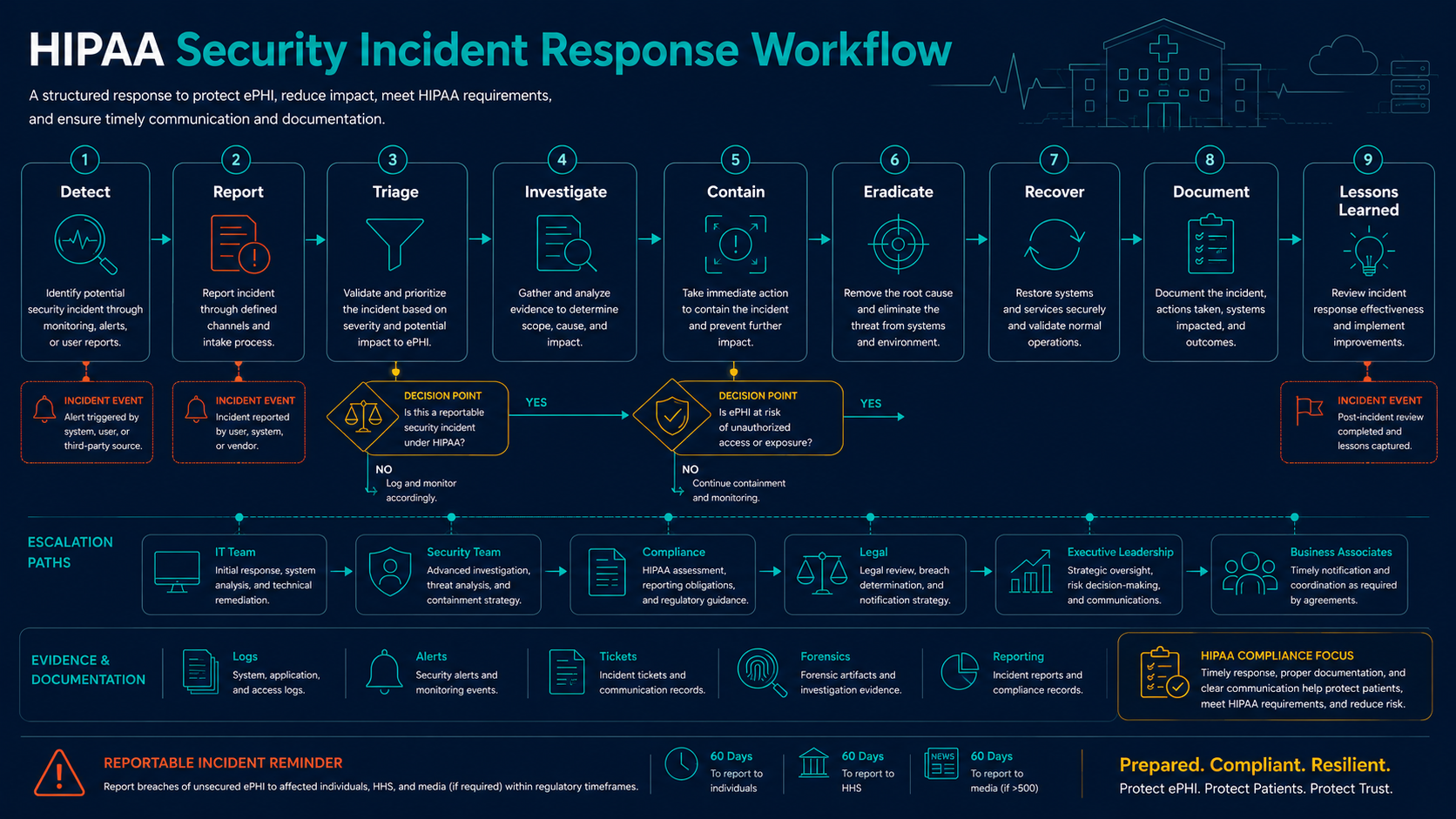
Administrative Safeguards require organizations to identify and respond to suspected or known security incidents. In practice, this means the organization should have a defined process for reporting, triaging, investigating, containing, documenting, and escalating incidents.
Healthcare incident response should be coordinated across IT, security, compliance, privacy, legal, operations, leadership, and outside service providers when needed. The process should also account for business associate notifications and potential breach notification obligations.
- Define what qualifies as a security incident.
- Provide workforce members with a clear reporting path.
- Maintain escalation procedures for suspected ePHI exposure.
- Document investigation steps and decisions.
- Preserve logs and evidence where appropriate.
- Coordinate with legal counsel for breach determination and notification requirements.
- Track corrective actions after the incident.
- Conduct lessons-learned reviews for material events.
Contingency Planning
Contingency Planning addresses how healthcare organizations continue operations and protect ePHI during emergencies, outages, ransomware events, natural disasters, system failures, and other disruptions. This area is especially important because availability is part of the HIPAA Security Rule’s confidentiality, integrity, and availability model.
A practical contingency program should include data backup planning, disaster recovery planning, emergency mode operations, testing, and application or data criticality analysis. The plan should be realistic enough to guide action during an outage.
| Contingency Planning Component | Purpose | Evidence to Maintain |
|---|---|---|
| Data Backup Plan | Ensure retrievable copies of ePHI and critical systems are available | Backup policy, job reports, protected systems list, immutable backup settings where applicable |
| Disaster Recovery Plan | Restore systems and data after a disruption | Recovery procedures, recovery objectives, restoration test records, vendor dependencies |
| Emergency Mode Operation Plan | Continue critical processes during emergency operations | Downtime procedures, alternate workflows, communication plan, leadership contacts |
| Testing and Revision | Validate that plans work and remain current | Tabletop exercises, backup restoration tests, plan updates, lessons learned |
| Application and Data Criticality Analysis | Prioritize systems and data based on operational importance | Critical systems inventory, dependency map, business impact analysis |
Business Associate and Vendor Oversight
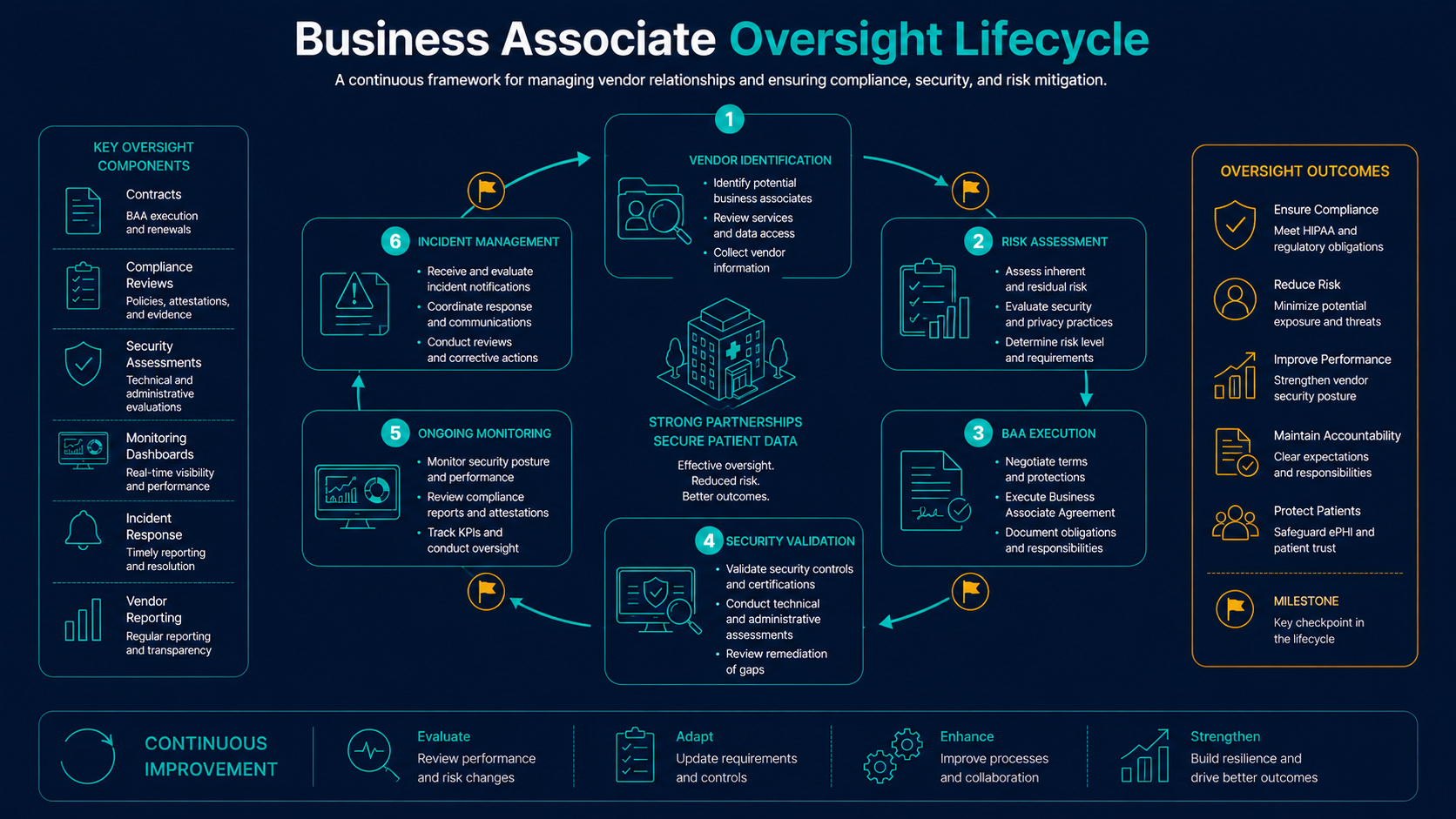
Administrative Safeguards also intersect with vendor governance. Healthcare organizations often depend on EHR vendors, cloud platforms, billing services, IT providers, managed security providers, consultants, backup providers, and other business associates that may create, receive, maintain, or transmit ePHI.
A Business Associate Agreement is important, but it does not replace operational oversight. Organizations should understand what systems vendors support, what ePHI they can access, what security responsibilities they own, how incidents are reported, and how vendor access is reviewed.
- Maintain a vendor and business associate inventory.
- Track which vendors involve ePHI or critical systems.
- Confirm that BAAs are current where required.
- Review vendor security evidence based on risk tier.
- Map shared responsibilities for access, logging, backups, monitoring, and incident response.
- Review vendor access periodically.
- Document vendor offboarding and access removal.
Evaluation and Continuous Improvement
Healthcare environments change constantly. New systems are added, vendors change, workforce roles evolve, cloud services expand, cyber threats shift, and technical controls mature. Administrative Safeguards require evaluation so the organization can determine whether security policies, procedures, and controls remain appropriate.
Evaluation may occur after a major system change, security incident, merger, acquisition, facility expansion, vendor transition, audit finding, or regulatory change. Many organizations also perform recurring annual assessments and quarterly governance reviews.
Evaluation should produce practical outputs: updated risk registers, revised policies, remediation tracking, control improvements, leadership reporting, and evidence that the organization is managing risk over time.
Common Administrative Safeguard Failures
Many HIPAA compliance gaps are not caused by the absence of a security tool. They are caused by missing governance, weak ownership, undocumented procedures, inconsistent follow-through, or lack of evidence.
- Outdated risk analysis: The analysis does not reflect current systems, vendors, workflows, cloud services, or ePHI locations.
- No remediation ownership: Risk findings are documented but not assigned, funded, tracked, or closed.
- Weak access lifecycle controls: Accounts remain active after termination or users retain access after role changes.
- Limited privileged access review: Administrative accounts are not reviewed, justified, monitored, or protected with strong authentication.
- Training without evidence: Training is performed informally but completion records and acknowledgements are missing.
- Incident response not tested: The organization has a plan but has not validated roles, escalation paths, evidence handling, or decision-making.
- Backups not tested: Backup jobs exist but restoration capability, recovery time, and critical system dependencies are not validated.
- Vendor oversight gaps: BAAs, security reviews, access approvals, and incident notification responsibilities are not tied to a recurring process.
- Policies are disconnected from operations: Written policies do not match how systems, users, vendors, and controls actually work.
Important Compliance Note
This article is not legal advice. Healthcare organizations should work with qualified legal counsel when interpreting HIPAA obligations, reviewing policies, evaluating breach notification duties, or responding to regulatory inquiries.
How Managed Services Support Administrative Safeguards
Administrative Safeguards are governance requirements, but many of the supporting activities depend on operational security capabilities. Managed IT and managed security services can help healthcare organizations collect evidence, implement controls, monitor activity, track remediation, and support recurring review.
| Administrative Safeguard Need | Supporting Managed Service Capability | Compliance-Ready Output |
|---|---|---|
| Risk Management | Vulnerability management, endpoint security, patch management, control review, remediation planning | Risk register updates, remediation tickets, scan reports, control improvement evidence |
| Information System Activity Review | Managed SIEM, log management, alert triage, security monitoring | Log review records, alert reports, escalation tickets, investigation timelines |
| Access Management | Identity review, MFA deployment, privileged access review, account lifecycle support | Access review reports, MFA coverage evidence, disabled account records |
| Incident Procedures | MXDR, incident response support, containment coordination, evidence preservation | Incident tickets, response timelines, lessons learned, corrective action tracking |
| Contingency Planning | Backup monitoring, recovery testing, disaster recovery planning support | Backup reports, restoration test evidence, recovery procedure documentation |
| Vendor Oversight | Vendor access review, third-party risk documentation, responsibility mapping | Vendor access inventories, BAA tracking inputs, security evidence requests, responsibility matrices |
Executive and Board-Level Considerations
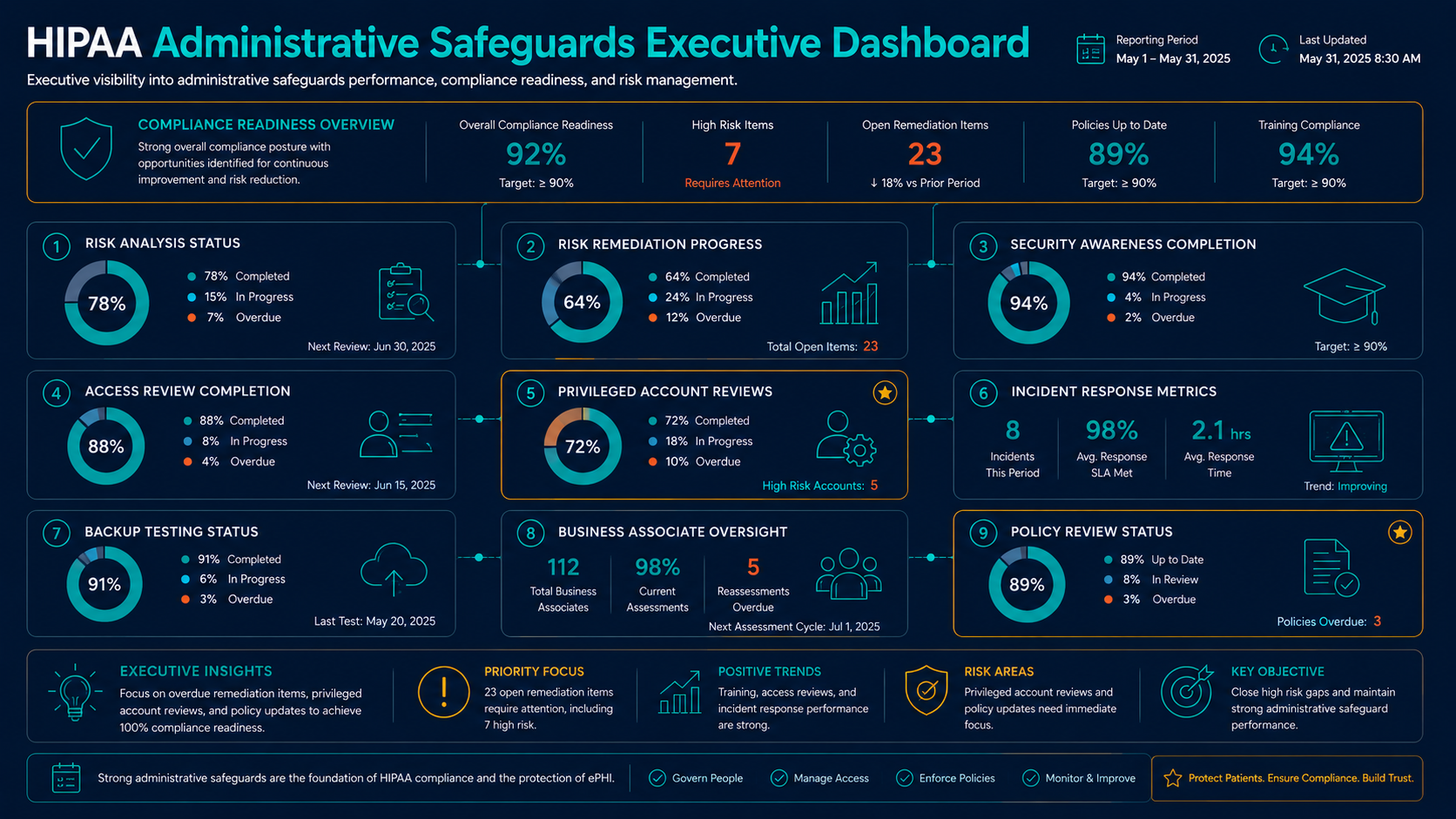
Administrative Safeguards should be visible to leadership because they affect compliance exposure, breach risk, operational resilience, patient trust, cyber insurance expectations, and budget prioritization. Executives do not need to manage every technical control, but they should know whether governance processes are working.
Useful leadership questions include:
- Who is responsible for HIPAA security governance?
- When was the last enterprise-wide risk analysis updated?
- Are high-risk findings assigned to owners with target dates?
- How are access reviews performed for workforce members, privileged users, and vendors?
- Can we produce evidence of security awareness training?
- How are security incidents reported, investigated, documented, and escalated?
- Have backup restoration and emergency operations procedures been tested?
- Do we know which business associates have access to ePHI or critical systems?
- Are policies reviewed and updated when systems, vendors, or workflows change?
- How is progress reported to leadership over time?
How DBT Helps Healthcare Organizations
DBT helps healthcare organizations strengthen the operational security capabilities that support HIPAA Administrative Safeguards. Our role is to help translate governance expectations into practical controls, reporting, evidence, and recurring security operations.
DBT can support Administrative Safeguard readiness through:
- HIPAA-aligned cybersecurity risk assessment support
- Risk remediation planning and tracking
- Managed SIEM, log management, and security monitoring
- MXDR and incident response support
- Identity and access security improvements
- MFA and passwordless authentication support
- Vulnerability management and patch visibility
- Endpoint security and managed detection support
- Backup and recovery readiness review
- Vendor access and business associate responsibility mapping
- Executive risk reporting and evidence collection
DBT does not replace legal counsel or the healthcare organization’s internal compliance ownership. We help build, operate, and document the cybersecurity controls and governance processes that support compliance readiness.
Related DBT Resources
For a broader overview of HIPAA requirements, review HIPAA Security Rule Readiness. For risk assessment detail, review HIPAA Risk Analysis Requirements Explained. For practical control mapping, review HIPAA Security Controls Mapped to Managed Services.
Healthcare organizations evaluating vendor exposure should also review Business Associate Agreements Explained and Third-Party Risk Management for Healthcare. For service support, review DBT’s Compliance & Risk Management, Cybersecurity Operations, Identity & Access Security, and Healthcare Cybersecurity Services pages.
Final Thoughts
HIPAA Administrative Safeguards are the management system behind healthcare security. They define how risk is analyzed, how controls are governed, how workforce access is managed, how users are trained, how incidents are handled, how recovery is planned, and how security is evaluated over time.
The strongest healthcare organizations do not treat Administrative Safeguards as policy paperwork. They turn them into recurring operational processes supported by evidence, technical controls, leadership visibility, and continuous improvement.
When Administrative Safeguards are implemented well, they help healthcare leaders make better security decisions, reduce breach exposure, support audit readiness, and protect the confidentiality, integrity, and availability of ePHI.