
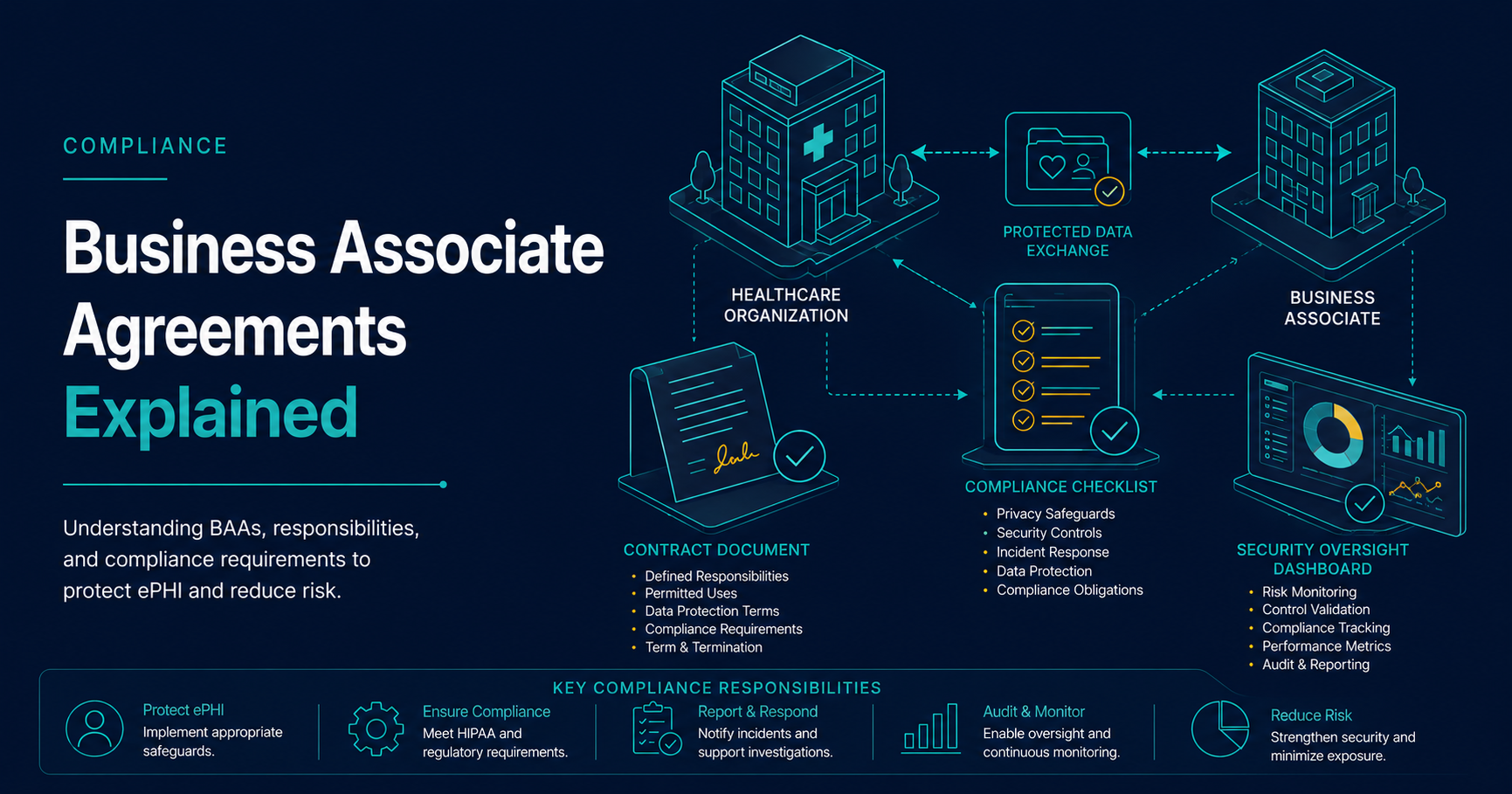
Why Business Associate Agreements Matter
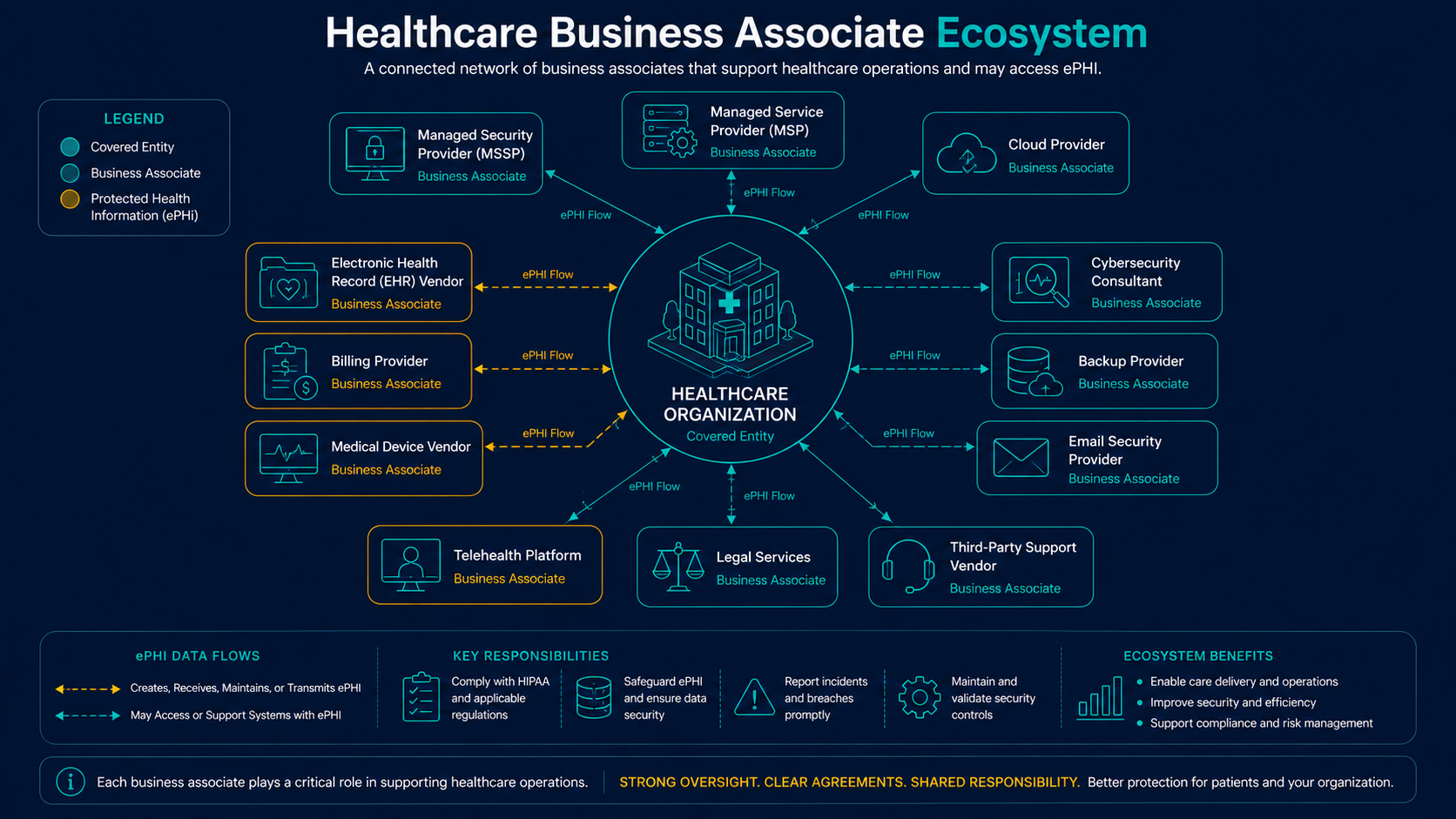
Healthcare organizations rarely operate alone. Electronic health records, billing platforms, cloud services, managed IT providers, managed security providers, consultants, backup providers, legal teams, and other service providers may all create, receive, maintain, or transmit protected health information on behalf of a covered entity.
A Business Associate Agreement, often called a BAA, is the HIPAA contract mechanism used to define responsibilities when a business associate handles protected health information. It helps establish how protected health information may be used, disclosed, safeguarded, reported, and returned or destroyed.
A signed BAA is important, but it is not the full vendor risk management program. Healthcare organizations still need to understand which vendors touch ePHI, what access they have, what controls they operate, how incidents are reported, and which responsibilities remain with the covered entity.
Key Takeaways
- A BAA is required when a vendor or service provider performs functions involving protected health information on behalf of a covered entity or another business associate.
- A BAA does not eliminate the covered entity’s responsibility to understand and oversee vendor risk.
- Business associate risk should be included in HIPAA risk analysis and risk management activities.
- Security responsibilities should be mapped clearly across the healthcare organization, vendor, cloud provider, MSP, MSSP, and other third parties.
- Strong vendor oversight requires evidence, access governance, incident notification expectations, and ongoing review.
What Is a Business Associate?
A business associate is generally a person or organization that performs certain functions or activities for a covered entity that involve the use or disclosure of protected health information. Business associates may also provide services where access to protected health information is necessary to perform the work.
Common examples include:
- Billing and revenue cycle service providers
- Electronic health record vendors
- Cloud hosting and storage providers
- Managed IT service providers
- Managed security service providers
- Backup and disaster recovery providers
- Consultants that access patient data
- Data analytics and reporting vendors
- Legal, accounting, or administrative service providers that handle PHI
- Subcontractors used by another business associate
The important question is not whether a vendor is technical or non-technical. The important question is whether the vendor creates, receives, maintains, or transmits protected health information as part of the services it provides.
What a Business Associate Agreement Should Address
A BAA should clearly define how protected health information may be used and disclosed, what safeguards are required, how incidents are reported, how subcontractors are handled, and what happens to PHI when the relationship ends.
The agreement should not be treated as a generic document that gets signed once and forgotten. It should be reviewed in the context of the vendor’s actual services, access level, systems, data flows, and operational responsibilities.
| BAA Area | What It Should Clarify | Why It Matters |
|---|---|---|
| Permitted Uses and Disclosures | How the business associate may use or disclose PHI while performing services. | Prevents unclear or excessive use of patient information. |
| Safeguards | Administrative, physical, and technical safeguards expected from the business associate. | Connects contractual obligations to real security controls. |
| Incident and Breach Reporting | How quickly incidents must be reported and what information must be provided. | Supports timely investigation, notification, and response. |
| Subcontractors | Whether subcontractors may be used and how downstream obligations are enforced. | Extends protection requirements beyond the direct vendor relationship. |
| Access and Amendment Support | How the business associate supports patient rights and covered entity obligations. | Prevents operational gaps when PHI is held by a third party. |
| Return or Destruction of PHI | How PHI is returned or destroyed when services end. | Reduces residual data exposure after vendor offboarding. |
| Termination Rights | What happens if the business associate violates the agreement. | Creates an enforcement path when obligations are not met. |
BAA vs Vendor Security Review
A BAA and a vendor security review are related, but they are not the same thing. The BAA is a contractual document. A vendor security review evaluates whether the vendor’s security practices are appropriate for the type of data, access, and operational dependency involved.
Healthcare organizations should avoid assuming that a signed agreement means the vendor is secure. Contract language needs to be supported by operational evidence.
Practical Governance Point
A BAA should define obligations, but it does not prove that safeguards are operating effectively. Healthcare organizations should also review access, security controls, incident notification procedures, audit evidence, and operational dependencies.
| Activity | Primary Purpose | Typical Evidence |
|---|---|---|
| Business Associate Agreement | Defines HIPAA-related contractual responsibilities. | Signed agreement, permitted use language, breach reporting terms, subcontractor requirements |
| Vendor Security Review | Evaluates whether the vendor has appropriate security practices. | Security questionnaire, SOC report, penetration test summary, policies, control evidence |
| Access Review | Confirms vendor access is appropriate and limited. | Account list, privileged access review, MFA status, remote access logs |
| Ongoing Monitoring | Validates that risk is reviewed after onboarding. | Annual review, updated attestations, incident reports, risk register updates |
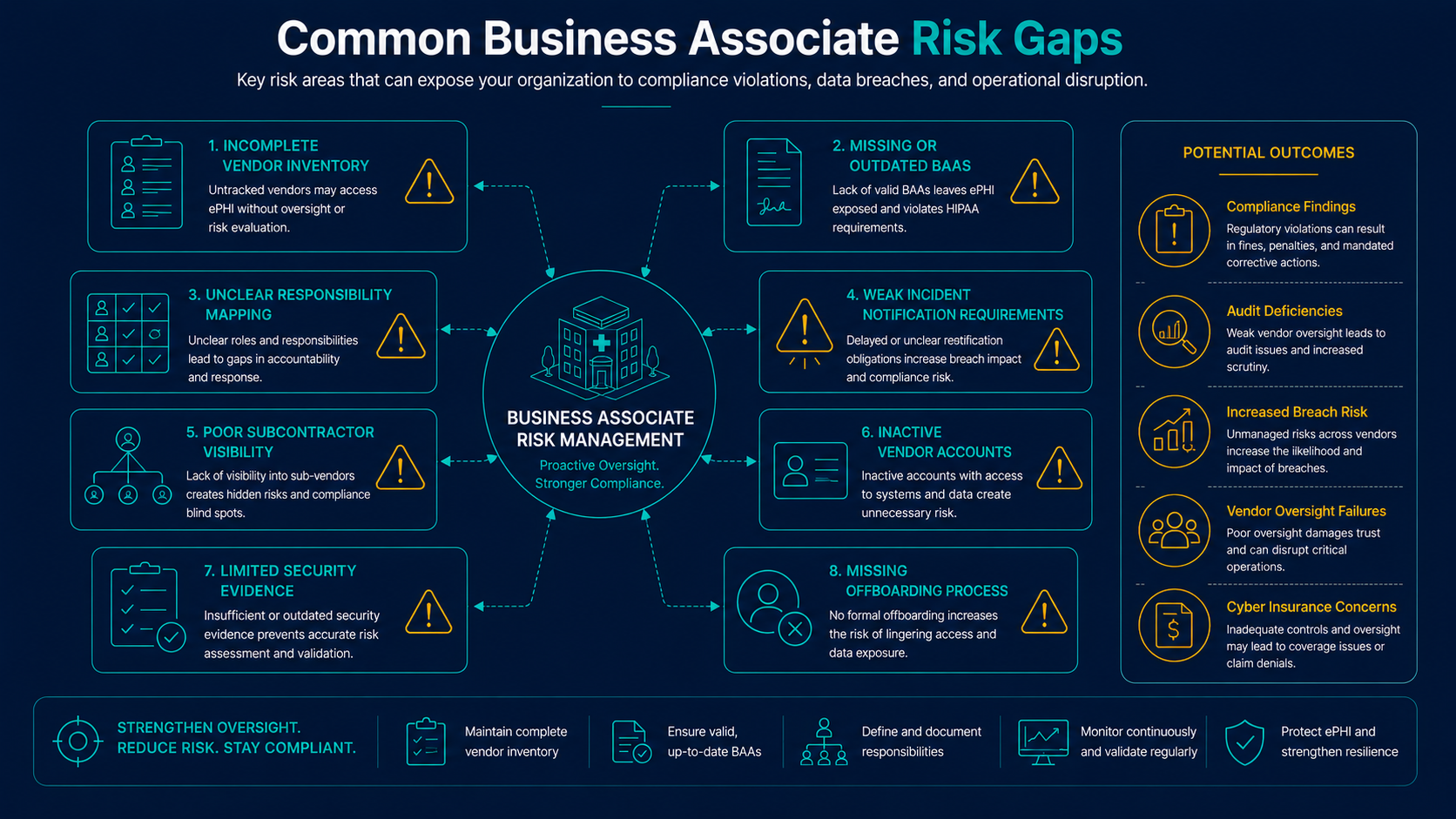
Common Business Associate Agreement Gaps
Many healthcare organizations have BAAs on file but still have gaps in how business associate risk is managed. These gaps often become visible during risk assessments, security incidents, vendor transitions, audits, or cyber insurance reviews.
- Incomplete vendor inventory: The organization cannot identify all vendors that access or support systems containing PHI.
- Missing or outdated BAAs: Agreements were never signed, are stored inconsistently, or do not reflect current services.
- Unclear scope: The agreement does not match the vendor’s actual access, data handling, subcontractors, or system responsibilities.
- Weak incident notification language: The agreement does not provide a clear timeline, escalation path, or required incident details.
- Poor subcontractor visibility: The organization does not understand which downstream providers may support the vendor.
- No access review: Vendor accounts remain active after support changes, contract changes, or termination.
- Limited security evidence: The organization has a signed BAA but no meaningful evidence of vendor security maturity.
- No offboarding process: PHI return, destruction, access removal, and confirmation are not tracked when a relationship ends.
Business Associate Risk Should Be Part of Risk Analysis
HIPAA risk analysis should include systems, workflows, users, and vendors that affect the confidentiality, integrity, and availability of ePHI. Business associates and subcontractors can introduce meaningful risk because they may host data, administer systems, provide remote support, manage backups, operate security tools, or process patient information.
A practical risk analysis should identify:
- Which business associates create, receive, maintain, or transmit PHI
- Which systems each vendor accesses or supports
- Whether vendor access includes administrative or privileged permissions
- Whether MFA is required for vendor access
- Whether remote access is logged and monitored
- Which subcontractors may be involved
- How incidents are reported and escalated
- Whether PHI is encrypted, backed up, retained, returned, or destroyed appropriately
- What evidence supports the vendor’s security claims
This work connects directly to HIPAA risk analysis requirements and broader healthcare cybersecurity risk assessment practices.
Security Responsibility Mapping
One of the most common third-party risk problems is unclear responsibility. A vendor may provide a platform, but the healthcare organization may still be responsible for user access, configuration, monitoring, data classification, or policy enforcement.
Responsibility mapping is especially important when multiple parties are involved, such as a covered entity, EHR vendor, MSP, MSSP, cloud provider, and backup provider.
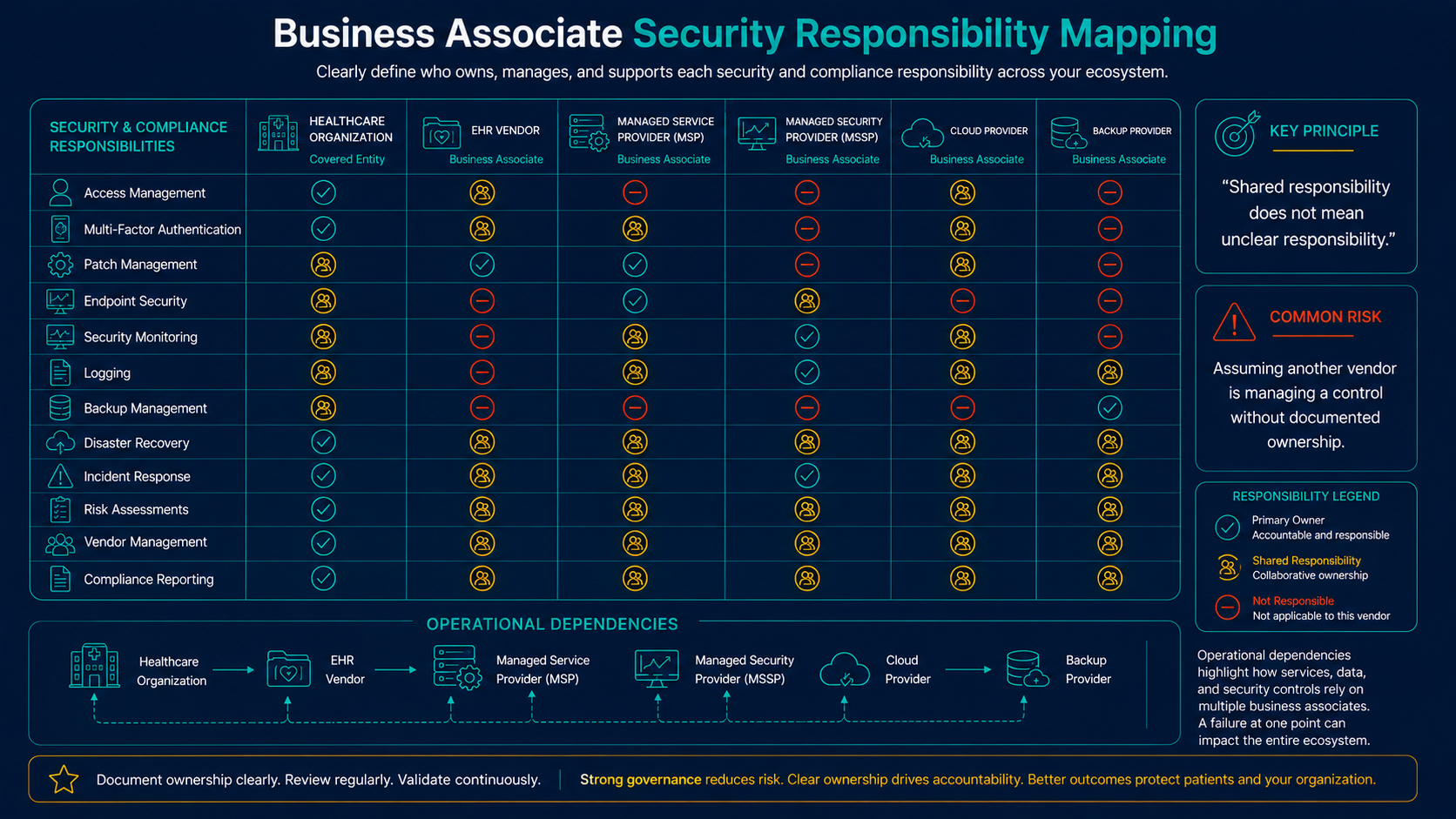
| Control Area | Covered Entity Responsibility | Business Associate Responsibility |
|---|---|---|
| Access Control | Approve users, define roles, review access, remove access when no longer needed. | Enforce approved access, support MFA, limit administrative permissions, provide access logs. |
| Logging and Monitoring | Define monitoring expectations and review reports or alerts. | Generate logs, retain evidence, escalate suspicious activity, support investigations. |
| Patch and Vulnerability Management | Confirm expectations and track risk affecting business operations or ePHI. | Maintain supported systems, remediate vulnerabilities, communicate material risk. |
| Backup and Recovery | Define recovery expectations and validate business continuity requirements. | Operate backups, protect backup data, test recovery where contractually required. |
| Incident Response | Coordinate legal, compliance, operational, and patient notification workflows. | Notify promptly, preserve evidence, support containment and investigation. |
Vendor Access and Identity Controls
Vendor access is one of the highest-value areas to review because third parties often need remote access, administrative rights, service accounts, integration permissions, or support portals.
Healthcare organizations should evaluate whether vendor access is:
- Approved before being granted
- Limited to the systems required for the service
- Assigned to named users rather than shared accounts whenever possible
- Protected by MFA or stronger authentication
- Logged and monitored
- Reviewed periodically
- Removed promptly when no longer needed
For high-risk access, organizations should consider stronger identity security controls, including phishing-resistant MFA, conditional access, privileged access management, session monitoring, and tighter vendor segmentation. This connects directly to identity and access security and cybersecurity operations.
Vendor Access Principle
A vendor should not receive standing administrative access simply because support may be needed later. Access should be appropriate, approved, time-bound where possible, monitored, and removed when no longer required.
Subcontractors and Downstream Risk
Business associates may use subcontractors to deliver hosting, support, analytics, security operations, development, or other services. These subcontractors can create downstream risk if they also access or support PHI.
Healthcare organizations should understand whether subcontractors are permitted, what obligations apply to them, and how the direct business associate manages those downstream relationships.
Important questions include:
- Does the vendor use subcontractors that may access PHI?
- Are subcontractor obligations documented?
- Does the vendor maintain oversight of its subcontractors?
- Are subcontractors included in incident notification and investigation procedures?
- Can the vendor provide assurance that subcontractors follow appropriate safeguards?
Incident Notification Expectations
Incident reporting language is one of the most important operational components of a BAA. If a vendor detects unauthorized access, ransomware activity, data loss, account compromise, system exposure, or suspicious activity affecting PHI, the healthcare organization needs timely information to investigate and respond.
The agreement and supporting procedures should clarify:
- How quickly the vendor must notify the healthcare organization
- Who receives the notification
- What information must be included
- How evidence is preserved
- How updates are provided during investigation
- How subcontractor incidents are reported
- How legal, compliance, and operational teams are engaged
Incident notification should be practical. A vague commitment to report incidents is less useful than a clear escalation process with defined contacts, timelines, and minimum information requirements.
Business Associate Lifecycle Management
Business associate oversight should follow the vendor lifecycle. Risk should be considered before onboarding, during contract review, throughout service delivery, during renewals, after material changes, and during offboarding.
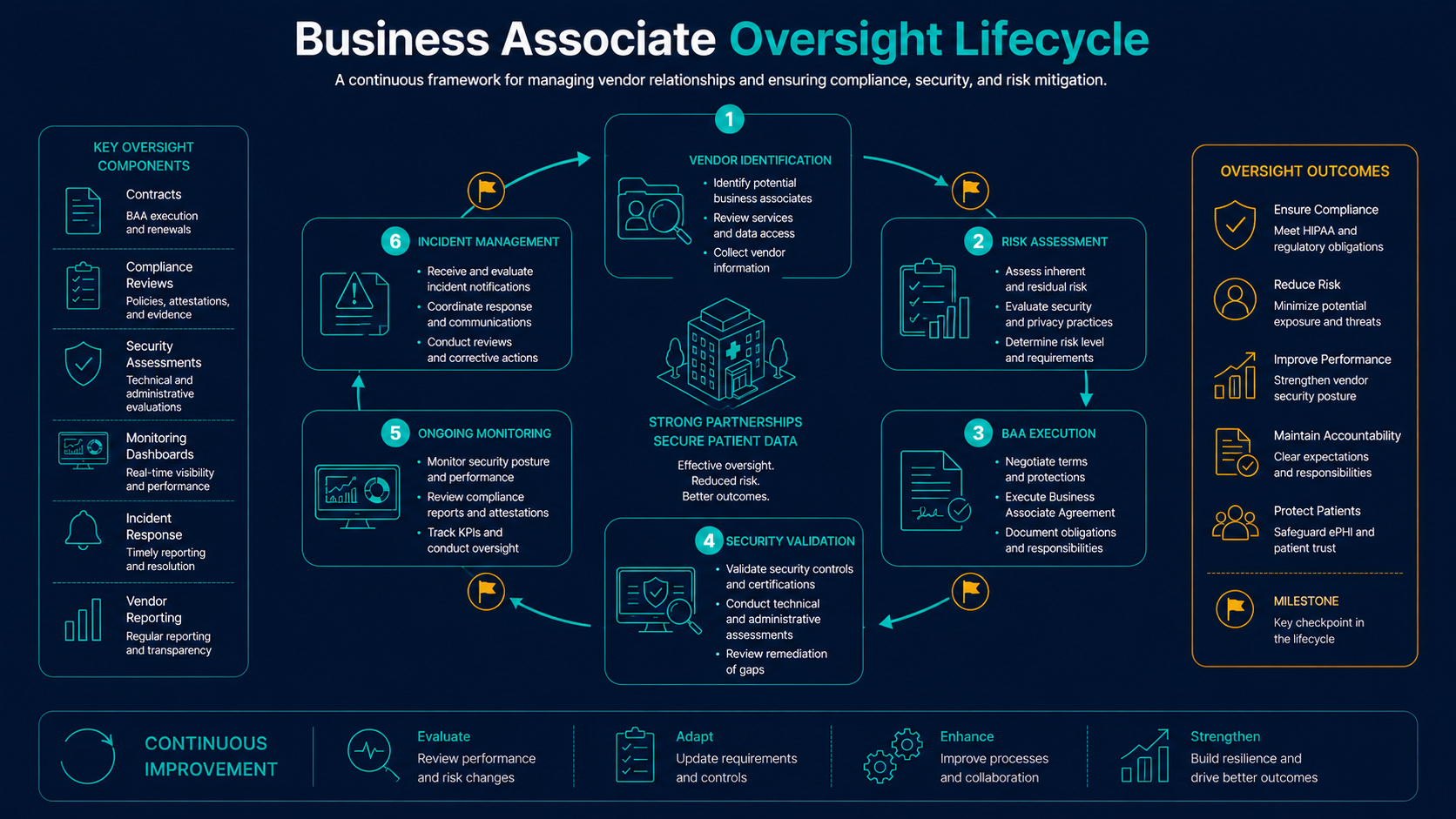
- Discovery: Identify vendors, services, systems, data flows, and whether PHI is involved.
- Classification: Determine whether the vendor is a business associate and assign a risk tier.
- Contracting: Execute a BAA and confirm service-specific security obligations.
- Security Review: Request and evaluate relevant evidence such as SOC reports, policies, insurance, testing summaries, or questionnaires.
- Access Provisioning: Grant only approved access and document ownership.
- Monitoring: Review access, incidents, service changes, control evidence, and risk changes.
- Renewal: Reassess whether the agreement and controls still match the relationship.
- Offboarding: Remove access, confirm PHI return or destruction, and retain evidence.
How Managed Providers Fit Into BAAs
Managed IT and managed security providers may be business associates when they support systems that create, receive, maintain, or transmit PHI, or when their support activity gives them access to PHI. This can include endpoint management, Microsoft 365 administration, backup systems, security monitoring, incident response support, vulnerability management, and infrastructure administration.
A healthcare organization should make sure managed service responsibilities are clearly documented. This includes which security controls the provider operates, which controls remain internal, and what evidence will be available for compliance and security review.
DBT supports healthcare organizations through managed IT services, cybersecurity operations, and compliance and risk management services that can help improve visibility, reduce operational gaps, and support security readiness.
Executive and Board-Level Questions
Healthcare executives and board members do not need to review every contract clause, but they should understand whether business associate risk is governed, measured, and reviewed.
Useful leadership questions include:
- Do we know which vendors are business associates?
- Do we have current BAAs for those relationships?
- Do BAAs reflect the services vendors actually perform today?
- Which vendors have remote or administrative access?
- Are business associate risks included in our risk analysis?
- Do we review vendor security evidence before and after onboarding?
- How quickly must vendors notify us of incidents?
- Do we know which subcontractors may support systems involving PHI?
- Can we prove that vendor access is reviewed and removed when no longer needed?
- What happens to PHI when a vendor relationship ends?
Important Note
This article is an operational guide for healthcare security and compliance planning. It is not legal advice. Healthcare organizations should work with qualified legal counsel when drafting, negotiating, reviewing, or interpreting Business Associate Agreements.
Business Associate Agreement Readiness Checklist
A practical review can help healthcare organizations identify where BAA and vendor oversight practices need improvement.
- Maintain a current inventory of vendors and business associates
- Identify which vendors create, receive, maintain, or transmit PHI
- Confirm that BAAs are signed, current, and stored centrally
- Map vendor services to systems, data, and access levels
- Evaluate vendor security evidence based on risk tier
- Review vendor remote access and administrative permissions
- Confirm MFA and logging expectations for vendor access
- Document subcontractor expectations
- Validate incident notification procedures and contacts
- Define PHI return or destruction expectations
- Include vendor risk in HIPAA risk analysis and risk management activities
- Review high-risk vendors at least annually or after material changes
Final Thoughts
Business Associate Agreements are a critical part of HIPAA compliance, but they should not be treated as a standalone paperwork exercise. A signed agreement is only one piece of a larger vendor risk management process.
Healthcare organizations should understand which vendors handle PHI, what access those vendors have, what safeguards are expected, how incidents are reported, and which responsibilities remain internal.
The strongest programs combine clear agreements, practical security reviews, identity and access governance, responsibility mapping, evidence collection, and recurring oversight. That approach helps reduce third-party risk and improves confidence when responding to audits, incidents, insurance reviews, and executive security questions.