
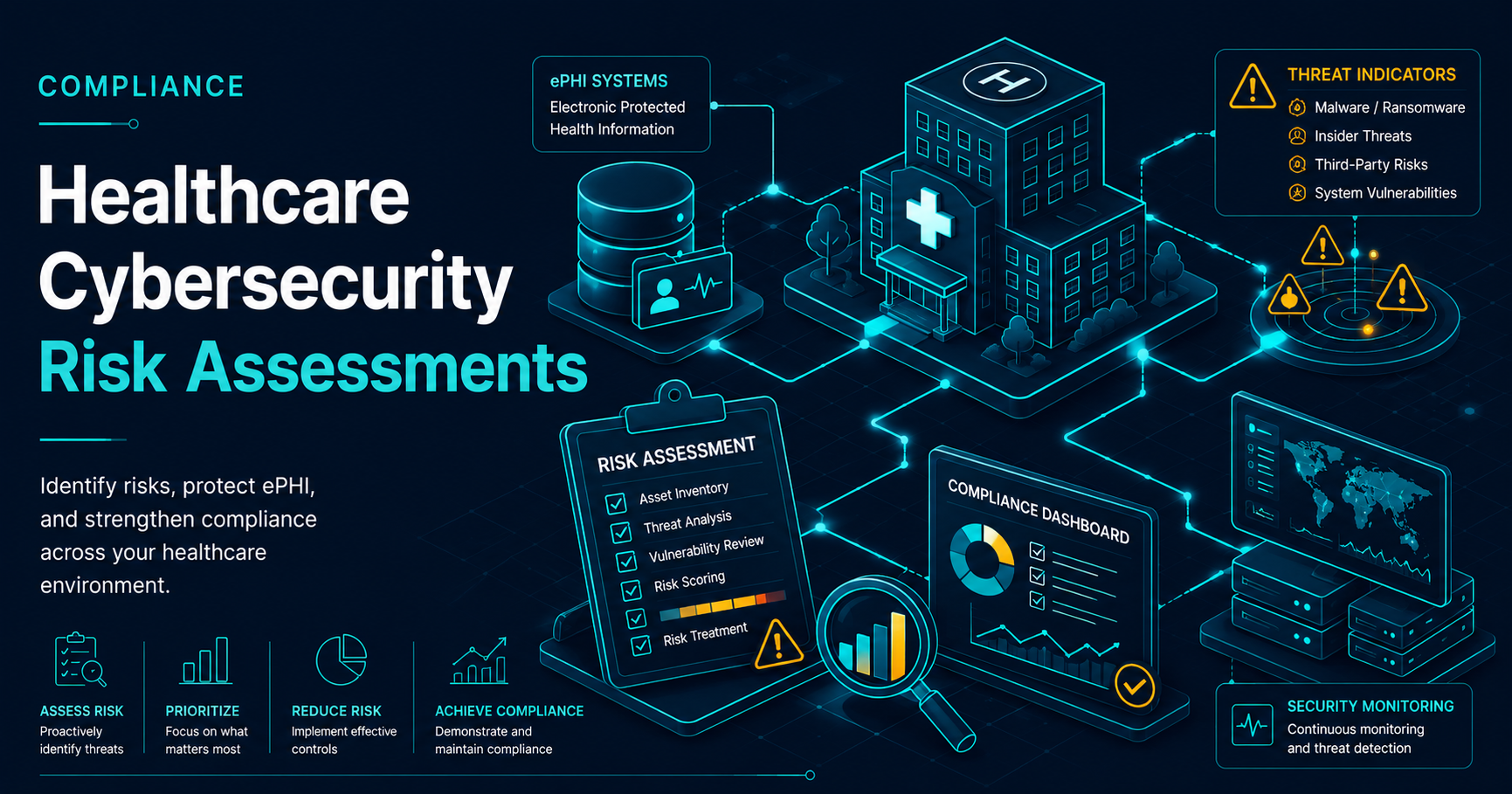
Why Healthcare Cybersecurity Risk Assessments Matter
Healthcare organizations operate complex technology environments that support clinical care, billing, scheduling, imaging, laboratory workflows, remote access, cloud applications, connected devices, and third-party services. Each of these systems can create cybersecurity, privacy, operational, and compliance risk.
A healthcare cybersecurity risk assessment helps leadership understand where the organization is exposed, which systems contain or interact with electronic protected health information, which safeguards are working, and which gaps should be remediated first.
For healthcare executives, a risk assessment is not just a technical exercise. It is a business tool for prioritizing investment, reducing breach likelihood, supporting HIPAA readiness, improving cyber insurance conversations, and giving the board better visibility into operational risk.
Key Takeaways
- Healthcare cybersecurity risk assessments help identify threats, vulnerabilities, control gaps, and operational exposure.
- Risk assessments support HIPAA readiness, but they should also address ransomware, identity compromise, cloud risk, vendor risk, and recovery capability.
- Risk assessment findings should be prioritized by likelihood, impact, patient care dependency, ePHI exposure, and remediation effort.
- Executive reporting should translate technical findings into business risk and actionable decisions.
- The strongest assessments result in a clear remediation roadmap, not just a list of vulnerabilities.
Risk Assessment vs. HIPAA Risk Analysis
The terms risk assessment and risk analysis are often used interchangeably, but they are not always the same in practice. A HIPAA risk analysis is specifically focused on identifying and evaluating risks to the confidentiality, integrity, and availability of ePHI. A broader healthcare cybersecurity risk assessment may include HIPAA risk analysis elements while also evaluating ransomware readiness, identity security, endpoint protection, cloud security, backup resilience, vendor exposure, and security operations maturity.
Healthcare organizations benefit from connecting both efforts. A risk assessment that ignores ePHI may miss compliance obligations. A HIPAA-only review that ignores modern attack paths may miss the practical threats most likely to disrupt operations.
| Assessment Type | Primary Focus | Typical Outcome |
|---|---|---|
| HIPAA Risk Analysis | Risks to the confidentiality, integrity, and availability of ePHI | HIPAA-focused risk register, safeguard priorities, and compliance documentation |
| Cybersecurity Risk Assessment | Broader security risks across identity, endpoints, cloud, network, vendors, and operations | Security roadmap, control maturity review, executive risk summary, and remediation plan |
| Technical Vulnerability Assessment | Known vulnerabilities in systems, applications, and infrastructure | Vulnerability findings ranked by severity, exploitability, and remediation priority |
| Security Program Assessment | Governance, policies, process maturity, documentation, monitoring, and accountability | Maturity scorecard, governance gaps, and program improvement plan |
What a Healthcare Risk Assessment Should Cover
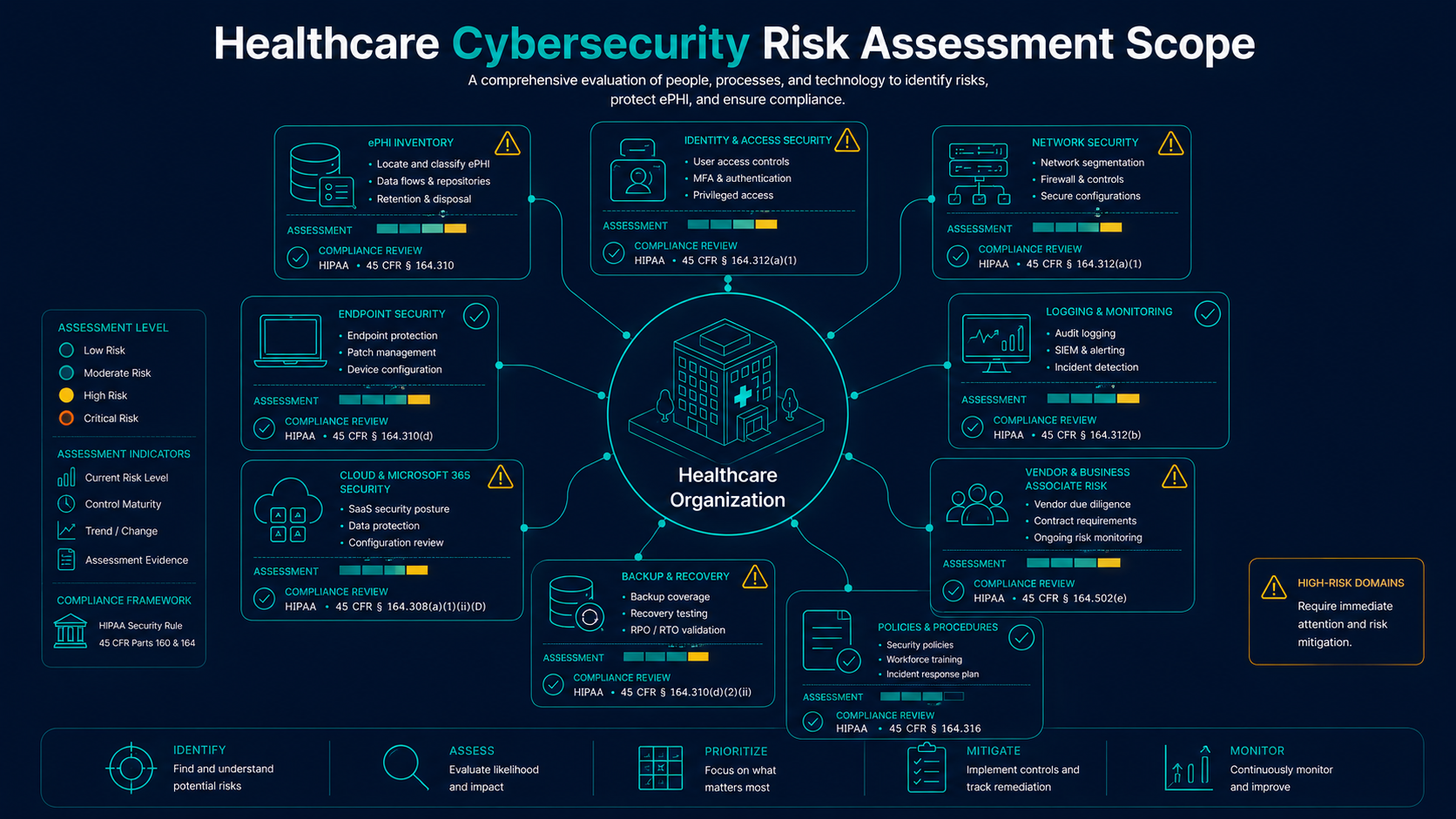
A practical healthcare risk assessment should evaluate the systems, workflows, data, users, vendors, and controls that are most important to patient care and business operations.
Common assessment areas include:
- ePHI inventory: Where sensitive patient information is created, stored, transmitted, accessed, and backed up.
- Identity and access: User accounts, privileged accounts, MFA coverage, remote access, shared accounts, and access reviews.
- Endpoint security: Workstations, laptops, servers, patching, endpoint detection, encryption, and device management.
- Network security: Firewall rules, segmentation, wireless security, remote access, and exposure of critical systems.
- Cloud and Microsoft 365 security: Authentication, conditional access, email security, logging, sharing controls, and administrator permissions.
- Logging and monitoring: Centralized log collection, alert review, security monitoring, and incident escalation.
- Backup and recovery: Backup coverage, immutability, recovery testing, retention, and ransomware recovery capability.
- Vendor and business associate risk: Third-party access, responsibilities, agreements, evidence, and incident notification processes.
- Policies and procedures: Security governance, acceptable use, incident response, access control, risk management, and contingency planning.
Start With ePHI and Critical Operations
Healthcare organizations cannot prioritize risk effectively until they understand where ePHI exists and which systems support critical business or clinical functions. This includes obvious systems such as electronic health records and billing platforms, but it may also include email, file shares, collaboration tools, imaging systems, backups, logs, exports, and vendor-managed applications.
The assessment should identify systems that are important because they contain ePHI, support patient care, process billing, enable communication, or provide identity and access services. A system may create significant risk even if it does not store large volumes of ePHI directly. For example, a compromised identity provider, remote access platform, or administrator workstation can become a pathway to sensitive systems.
Assessment Principle
A healthcare risk assessment should not treat all assets equally. Systems that support patient care, identity, remote access, backups, security monitoring, or large volumes of ePHI should receive greater attention because failure or compromise can create disproportionate impact.
Common Healthcare Cybersecurity Risks
Healthcare risk assessments often reveal recurring patterns. The exact rating of each risk depends on the organization, but many healthcare environments face similar categories of exposure.
- Ransomware exposure: Insufficient endpoint protection, weak segmentation, incomplete backups, and limited incident response testing.
- Credential compromise: Phishing, weak MFA coverage, reused passwords, shared accounts, and excessive permissions.
- Unpatched systems: Aging servers, legacy applications, medical systems, unsupported operating systems, and delayed remediation.
- Cloud misconfiguration: Overly broad sharing, weak administrator controls, insufficient logging, and insecure email configuration.
- Vendor access risk: Third-party remote access, unclear responsibility boundaries, and limited monitoring of business associate activity.
- Logging gaps: Security events are generated but not centrally collected, reviewed, retained, or escalated.
- Backup and recovery weakness: Backups exist but are not tested, isolated, protected from ransomware, or aligned to recovery objectives.
- Policy and evidence gaps: Controls may exist, but documentation, review records, tickets, reports, and ownership are incomplete.
How to Prioritize Findings
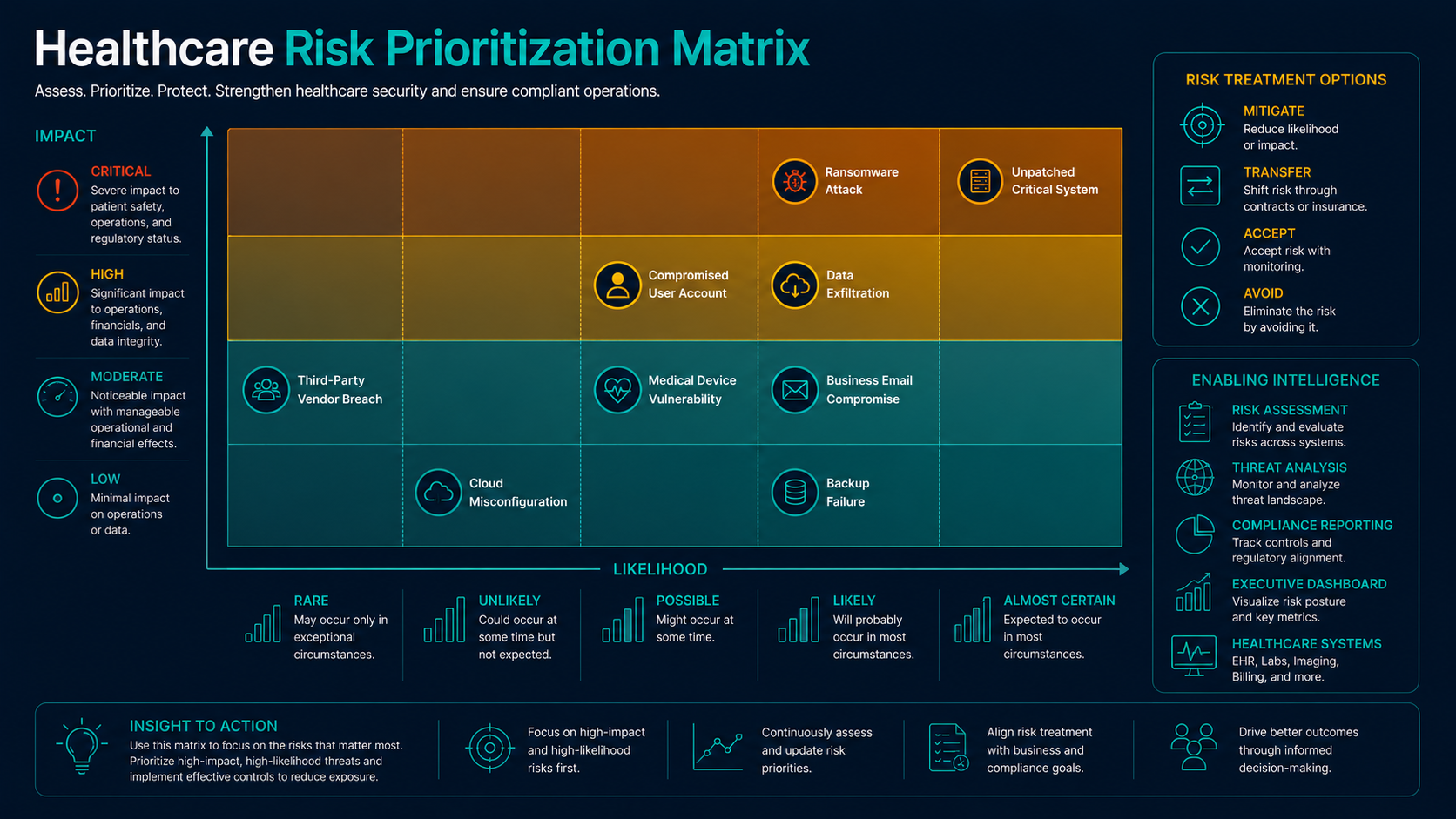
A useful risk assessment does more than identify issues. It helps the organization decide what to fix first. Findings should be prioritized using more than technical severity alone.
Strong prioritization considers:
- Likelihood of exploitation or failure
- Potential impact to patient care, operations, revenue, or compliance
- Volume and sensitivity of ePHI involved
- Exposure to the internet, remote users, vendors, or unmanaged devices
- Current compensating controls
- Ease and cost of remediation
- Dependency on legacy systems or vendors
- Regulatory, insurance, or contractual expectations
| Risk Area | Assessment Question | Why It Matters |
|---|---|---|
| Identity and Access | Are privileged, remote, and cloud accounts protected with strong authentication? | Compromised accounts are one of the most common paths to data access, ransomware, and business email compromise. |
| Endpoint Security | Are workstations and servers patched, monitored, and protected with modern endpoint controls? | Endpoints are frequently used as the first foothold for malware, credential theft, and lateral movement. |
| Backup and Recovery | Can the organization recover critical systems after ransomware or destructive activity? | Healthcare downtime can disrupt patient care, billing, scheduling, and clinical decision-making. |
| Logging and Monitoring | Are security events collected, reviewed, and escalated in a timely manner? | Without visibility, organizations may not detect unauthorized access until after data exposure or operational disruption. |
| Vendor Risk | Are business associate responsibilities, access, and incident notification expectations documented? | Third-party access and outsourced services can create material exposure if responsibilities are unclear. |
Risk Assessment Methodology
A healthcare cybersecurity risk assessment should follow a repeatable process. The goal is to produce findings that are clear, defensible, and actionable.
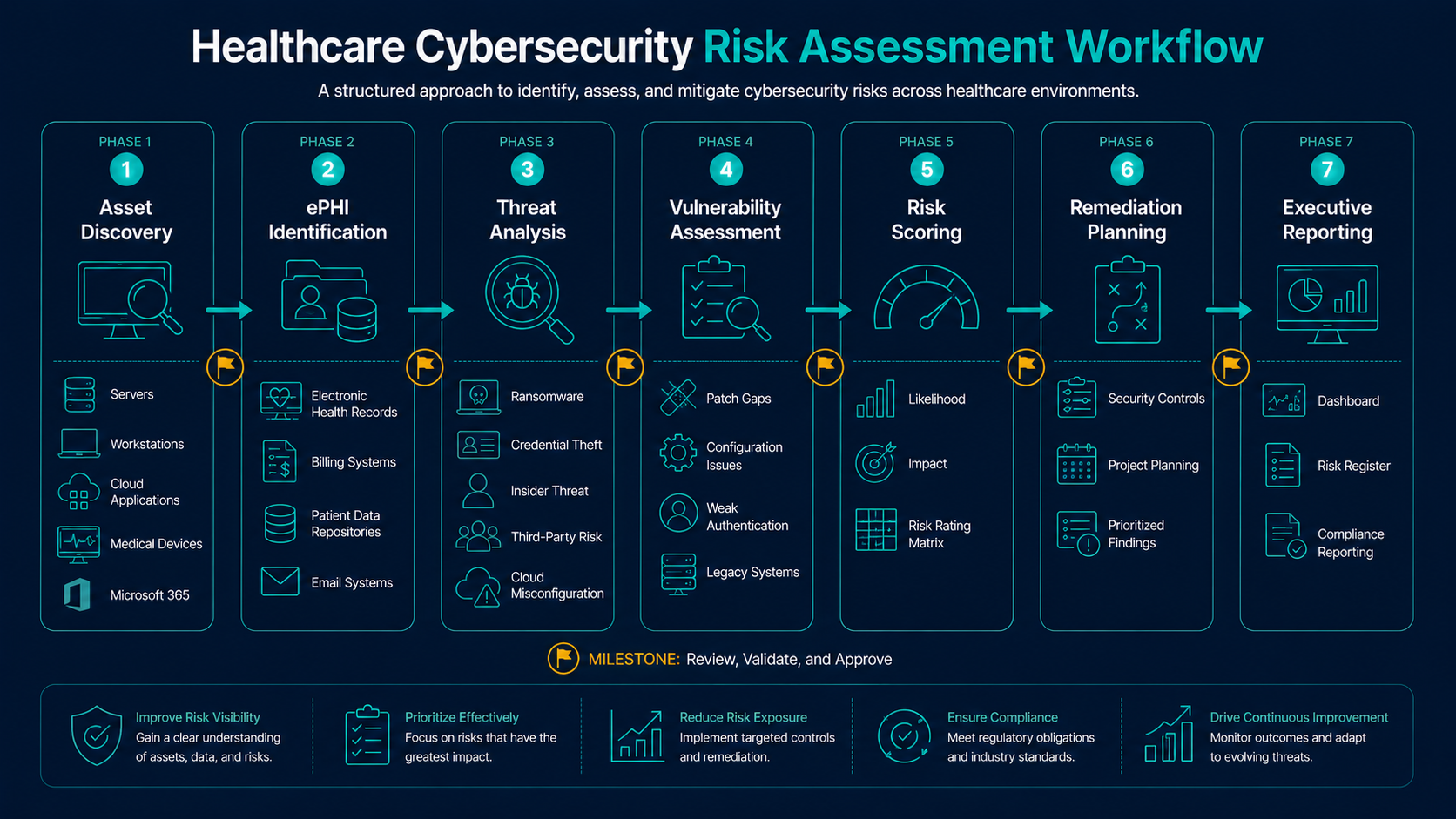
- Step 1 – Define scope: Identify locations, systems, applications, users, departments, vendors, and business processes included in the assessment.
- Step 2 – Identify ePHI and critical systems: Map where sensitive patient data resides and which systems support essential operations.
- Step 3 – Review existing controls: Evaluate administrative, physical, and technical safeguards already in place.
- Step 4 – Identify threats and vulnerabilities: Review realistic events that could affect confidentiality, integrity, availability, or operations.
- Step 5 – Score likelihood and impact: Determine relative risk based on threat probability, weakness severity, exposure, and business effect.
- Step 6 – Prioritize remediation: Build a practical roadmap that addresses high-impact risks first.
- Step 7 – Report to leadership: Translate technical findings into business risk, investment priorities, and accountability.
- Step 8 – Track remediation: Assign owners, timelines, evidence requirements, and recurring review checkpoints.
Evidence and Documentation
Healthcare risk assessments should produce documentation that supports decision-making and readiness. The report should be understandable to both technical teams and executive leadership.
Useful assessment outputs may include:
- Executive summary
- Assessment scope and methodology
- System and ePHI inventory observations
- Risk register
- Control maturity summary
- High-priority findings
- Recommended remediation roadmap
- Responsibility assignments
- Evidence requirements
- Follow-up review schedule
Documentation Matters
A risk assessment should create a record of what was reviewed, what was found, how risk was evaluated, which actions were recommended, and how leadership plans to respond. Documentation is especially important when supporting HIPAA readiness, cyber insurance discussions, vendor due diligence, or board reporting.
Executive and Board-Level Considerations
Executives and board members do not need to manage every technical control, but they should understand whether risk is being identified, measured, prioritized, and reduced. A mature assessment process gives leadership a clearer view of exposure and investment needs.
Leadership should ask:
- Which systems and vendors create the greatest patient data exposure?
- Which risks could disrupt clinical operations or revenue cycle processes?
- What are the top five risks we need to reduce this quarter?
- Are we investing in controls that reduce the most meaningful risk?
- Can we detect unauthorized access or ransomware activity quickly?
- Can we recover critical systems within acceptable timeframes?
- Are business associate responsibilities documented and reviewed?
- What evidence demonstrates that remediation is actually happening?
How Risk Assessments Support Cost Avoidance
Risk assessments help organizations avoid costs by identifying problems before they become incidents. The most expensive healthcare security failures often involve a combination of weak authentication, unpatched systems, inadequate monitoring, poor backup resilience, unclear vendor ownership, and delayed response.
| Control Area | Risk Reduced | Business Value |
|---|---|---|
| Multi-Factor Authentication | Credential theft, unauthorized remote access, and account takeover | Reduces one of the most common breach and ransomware entry points. |
| Patch and Vulnerability Management | Exploitation of known vulnerabilities | Helps reduce preventable compromise of exposed or business-critical systems. |
| Managed Detection and Response | Delayed detection of malware, suspicious access, and lateral movement | Improves response time and reduces the chance that an intrusion becomes a major incident. |
| Backup Resilience | Extended downtime after ransomware or destructive activity | Supports operational continuity and recovery confidence. |
| Vendor Oversight | Third-party access, unclear responsibilities, and delayed incident notification | Improves accountability across business associates and service providers. |
How Managed Security Providers Can Help
Many healthcare organizations have limited internal resources to assess, monitor, and remediate every security risk alone. Managed IT and managed security providers can help by combining technical evaluation with ongoing operational support.
A provider may support:
- Risk assessment planning and documentation
- ePHI discovery support
- Vulnerability scanning and remediation tracking
- Microsoft 365 and cloud security reviews
- Endpoint protection and patch management
- Managed SIEM and security monitoring
- Backup and recovery readiness review
- Incident response planning
- Vendor responsibility mapping
- Executive reporting and remediation roadmaps
The strongest model combines internal ownership with external expertise. Healthcare leadership remains accountable for risk decisions, while technical partners help identify gaps, implement safeguards, monitor activity, and maintain evidence over time.
Related DBT Resources
Healthcare organizations building a broader compliance and security program may also benefit from reviewing HIPAA Risk Analysis Requirements Explained, HIPAA Security Rule Readiness, and HIPAA Security Controls Mapped to Managed Services.
For service-level support, DBT provides Compliance & Risk Management, Cybersecurity Operations, Identity & Access Security, and industry-specific Healthcare Cybersecurity Services.
Final Thoughts
Healthcare cybersecurity risk assessments are most valuable when they connect technical findings to business decisions. A long list of weaknesses is less useful than a prioritized roadmap that explains what matters, why it matters, who owns the remediation, and how progress will be measured.
Healthcare organizations should use risk assessments as part of an ongoing security and compliance discipline. As systems, vendors, threats, regulations, and business operations change, risk should be reassessed and remediation priorities should be updated.
The goal is not to eliminate every risk. The goal is to understand risk clearly, reduce the most meaningful exposure, protect ePHI, support patient care, and give leadership confidence that security investments are aligned with operational and compliance priorities.