
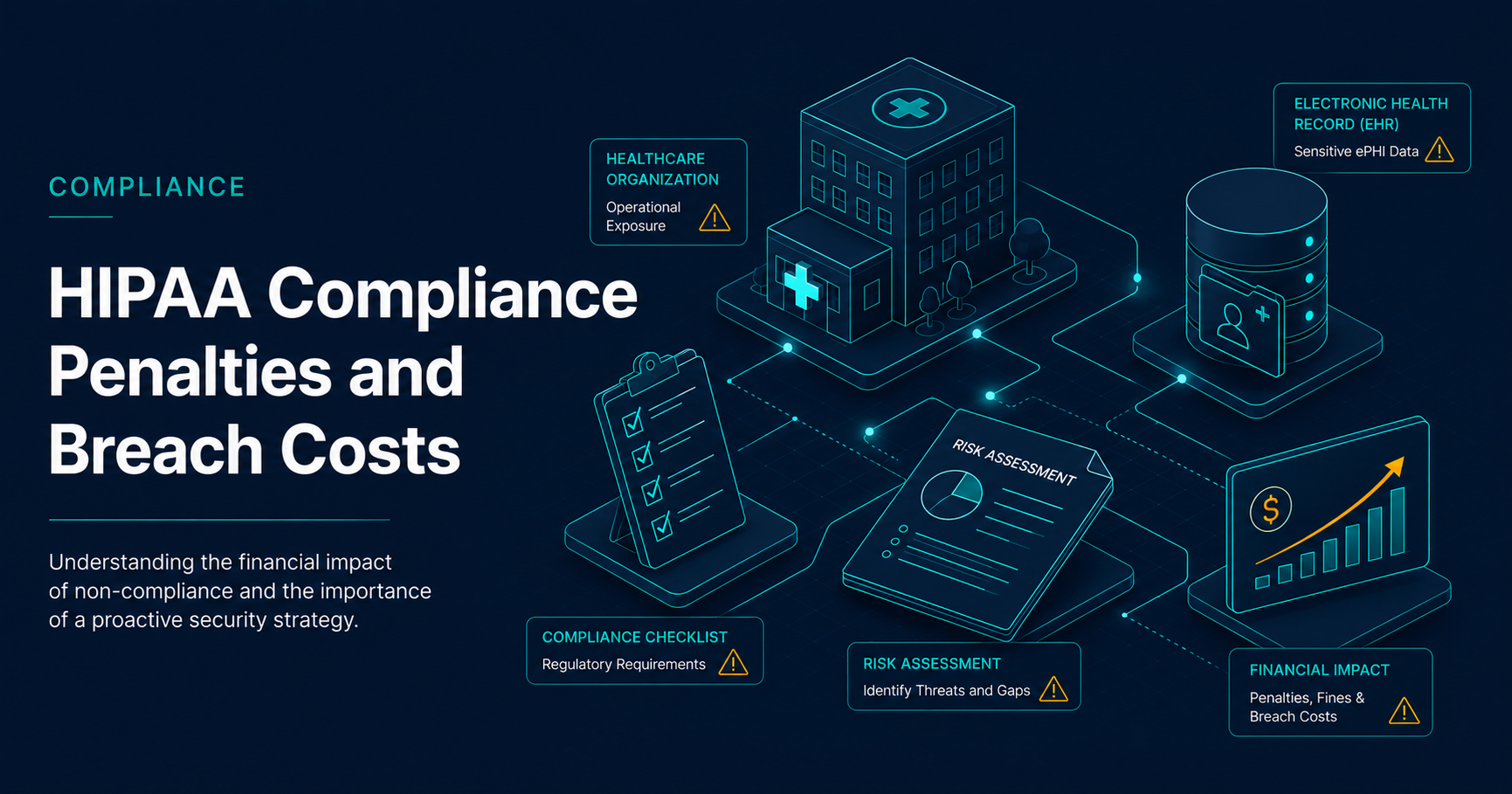
Why HIPAA Penalties and Breach Costs Matter
HIPAA compliance is often discussed as a regulatory requirement, but for healthcare leaders it is also a financial, operational, reputational, and governance issue. A security incident involving electronic protected health information can affect patient trust, clinical operations, revenue cycle workflows, cyber insurance, vendor relationships, legal exposure, and board confidence.
Civil monetary penalties from the Office for Civil Rights are only one possible consequence. The larger business impact often comes from investigation expenses, legal support, breach notification, patient communication, downtime, lost productivity, forensic response, remediation work, increased insurance scrutiny, and long-term reputation damage.
For covered entities and business associates, the practical question is not only “What are the fines?” The better question is: “Can we demonstrate that we understand our risks, have implemented reasonable safeguards, monitor our environment, manage vendors, and respond effectively when something goes wrong?”
Key Takeaways
- HIPAA penalties are only one part of the financial impact of a healthcare breach.
- OCR enforcement frequently focuses on risk analysis, risk management, access control, monitoring, documentation, and timely remediation.
- Covered entities and business associates can both face enforcement exposure.
- Business associate agreements do not eliminate the need for vendor oversight and responsibility mapping.
- Healthcare executives should treat HIPAA readiness as an enterprise risk management issue, not only a compliance checklist.
- Security controls such as MFA, vulnerability management, managed detection and response, backup testing, and centralized logging can help reduce breach likelihood and impact.
HIPAA Penalty Tiers at a Practical Level
HIPAA civil monetary penalties are structured around levels of culpability. The amount can vary depending on the nature of the violation, the level of knowledge, whether reasonable diligence was exercised, whether willful neglect was involved, and whether the organization corrected the issue in a timely manner.
Penalty amounts are adjusted periodically and should always be verified against current HHS guidance and legal counsel. From an operational perspective, the tiers are useful because they show how regulators distinguish between organizations that did not know about a problem, organizations that had reasonable cause, and organizations that demonstrated willful neglect.
| Penalty Tier | General Description | Practical Example |
|---|---|---|
| Tier 1 – Lack of Knowledge | The organization did not know and, by exercising reasonable diligence, would not have known about the violation. | A control failure exists, but the organization had a defensible process for identifying and managing risk. |
| Tier 2 – Reasonable Cause | The violation was due to reasonable cause and not willful neglect. | Policies or controls existed, but they were incomplete, inconsistently applied, or not mature enough for the environment. |
| Tier 3 – Willful Neglect, Corrected | The violation involved willful neglect, but the issue was corrected within the required timeframe. | Leadership became aware of a serious compliance issue and corrected it after discovery. |
| Tier 4 – Willful Neglect, Not Corrected | The violation involved willful neglect and was not corrected within the required timeframe. | Known security gaps, missing risk analysis, or repeated control failures were not addressed. |
The key leadership lesson is that documentation, governance, and timely remediation matter. A healthcare organization that can show risk analysis, prioritized remediation, control implementation, monitoring, and corrective action is in a stronger position than an organization that cannot show evidence of ongoing security management.
Important Note
This article is not legal advice and should not be used as a substitute for advice from qualified legal counsel. HIPAA penalty exposure depends on the facts, circumstances, current regulatory guidance, enforcement discretion, and the organization’s specific compliance posture.
The Full Financial Impact of a Healthcare Breach
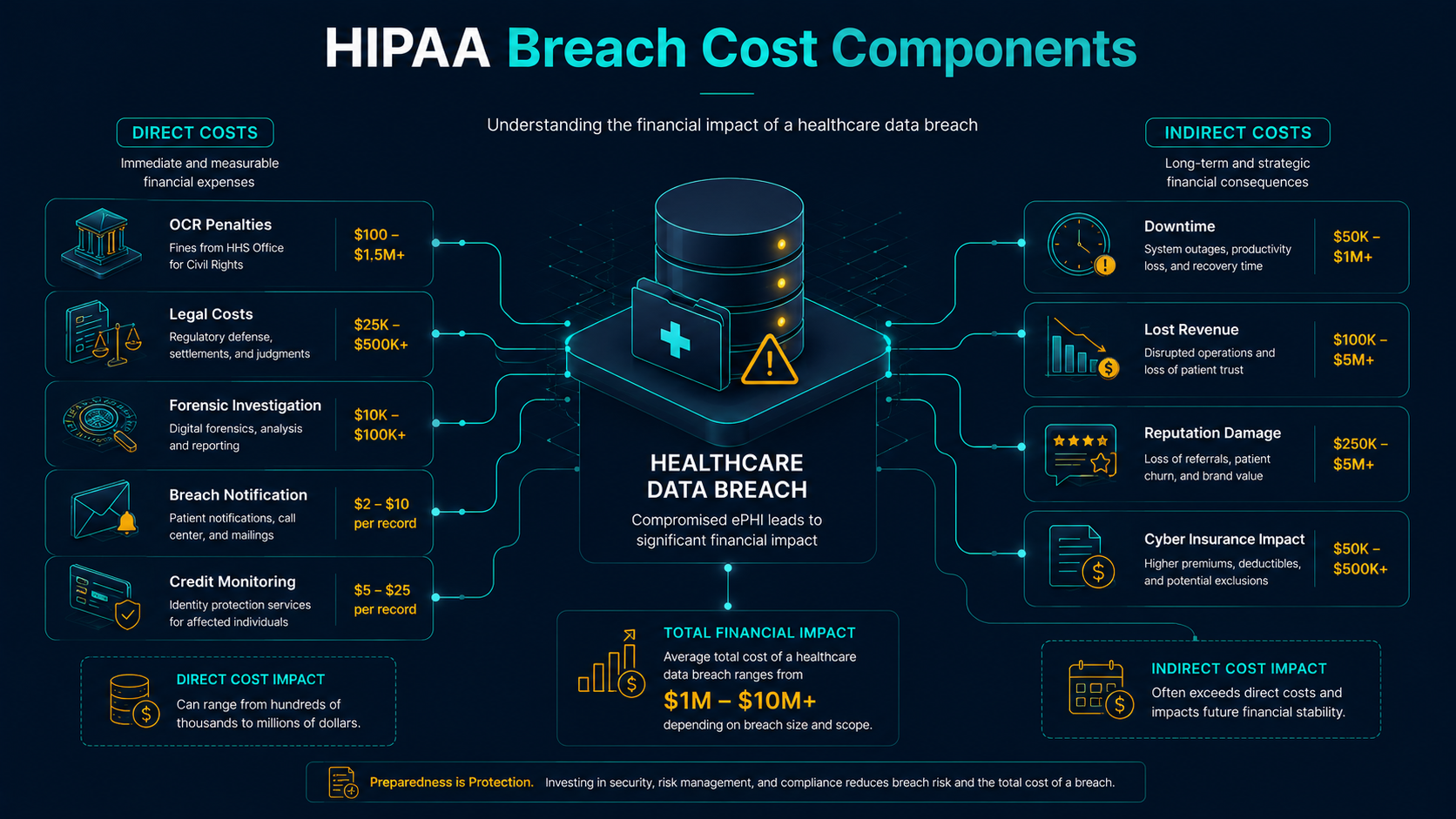
A HIPAA-related breach can create costs across multiple categories. Some costs are direct and measurable, such as legal support, forensic investigation, notification expenses, and remediation projects. Others are indirect, such as patient attrition, operational disruption, staff overtime, lost productivity, vendor disruption, reputational harm, and increased insurance requirements.
Healthcare organizations are especially exposed because outages can affect patient care, billing, scheduling, referral workflows, laboratory operations, pharmacy coordination, imaging access, and communication with patients and providers.
Direct Breach Costs
Direct costs are the expenses most organizations expect after a breach. These may include:
- Legal counsel and regulatory response
- Forensic investigation and incident response support
- Breach notification letters and communication support
- Credit monitoring or identity protection services where appropriate
- Public relations and patient communication support
- Security remediation and emergency technology changes
- Outside consulting and project management
- Potential OCR settlement costs or civil monetary penalties
Indirect Breach Costs
Indirect costs are often harder to estimate but may be more damaging over time. These may include:
- Operational downtime
- Delayed billing and collections
- Staff overtime and productivity loss
- Lost patient confidence
- Provider frustration and workflow disruption
- Contractual consequences with partners
- Higher cyber insurance premiums or stricter renewal requirements
- Long-term reputation damage
OCR Enforcement Trends Healthcare Leaders Should Watch
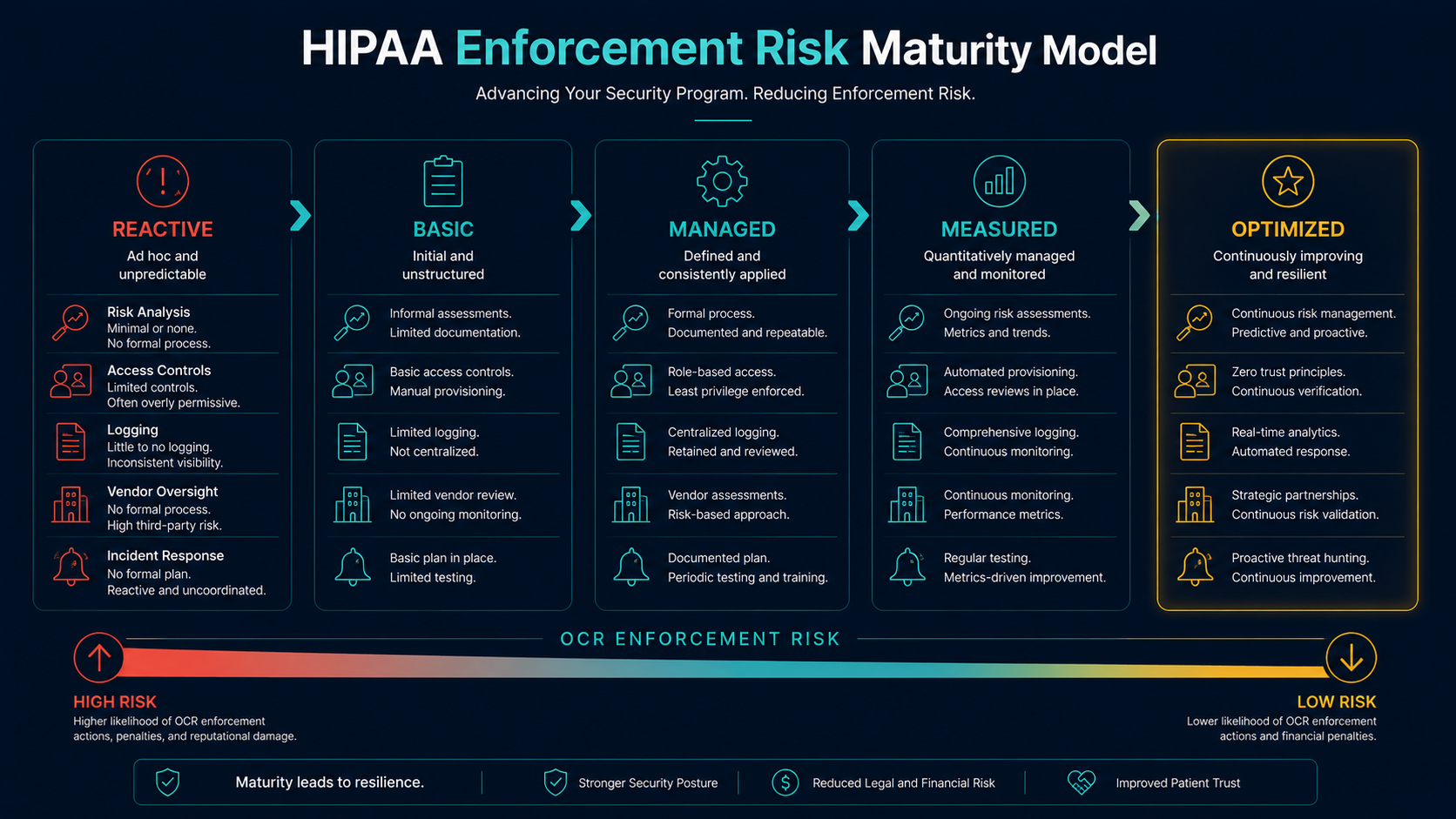
OCR enforcement has historically emphasized core Security Rule obligations such as risk analysis, risk management, access controls, audit controls, incident response, and documentation. Recent enforcement activity and public guidance continue to reinforce the importance of performing an accurate and thorough assessment of risks to electronic protected health information.
For leadership teams, this means HIPAA readiness should not be limited to annual policy review. It should include recurring risk assessment, technical control validation, security monitoring, vulnerability remediation, vendor oversight, workforce training, incident response testing, and evidence collection.
Enforcement Pattern
A recurring theme in HIPAA enforcement is not simply that an incident occurred. The deeper issue is often whether the organization had performed a meaningful risk analysis, implemented appropriate safeguards, addressed known gaps, documented decisions, and maintained evidence that controls were operating.
Common Compliance Failures That Increase Exposure
Many HIPAA enforcement and breach response issues trace back to a small number of recurring weaknesses. These weaknesses are not limited to large health systems. Small and mid-sized healthcare organizations can face the same categories of risk, often with fewer internal resources to manage them.
- Incomplete risk analysis: The organization cannot show a current and accurate review of risks to ePHI.
- Weak risk management: Identified risks are not prioritized, assigned, tracked, or remediated.
- Limited access control: Users have more access than needed, shared accounts exist, or account termination is inconsistent.
- Missing MFA: Remote access, privileged accounts, cloud applications, or administrative tools are not consistently protected.
- Poor logging and monitoring: Security logs are collected inconsistently or are not reviewed in a meaningful way.
- Unpatched systems: Known vulnerabilities remain open across servers, endpoints, network devices, or applications.
- Insufficient backup testing: Backups exist, but recovery has not been validated for ransomware or major outage scenarios.
- Unclear business associate responsibilities: Vendor responsibilities, notification duties, and access controls are not clearly documented.
- Limited incident response preparation: Plans are outdated, untested, or disconnected from actual operational workflows.
- Thin evidence trail: Policies exist, but the organization cannot show current tickets, reports, logs, reviews, decisions, and remediation records.
Business Associate Exposure
Healthcare organizations often rely on business associates for billing, technology support, cloud platforms, electronic health record services, analytics, legal support, consulting, managed IT, managed security, data storage, and other operational functions.
Business associates can create, receive, maintain, or transmit ePHI on behalf of a covered entity. That means business associate risk is not theoretical. A weakness at a vendor or service provider can become a reportable incident, a contractual issue, a patient trust issue, and a regulatory issue.
A business associate agreement is important, but it is not the same as security assurance. Covered entities should still understand how vendors protect ePHI, how they manage access, how quickly they notify customers of incidents, how responsibilities are divided, and what evidence they can provide.
Vendor Oversight Questions
- Which vendors create, receive, maintain, or transmit ePHI?
- Do all applicable vendors have current business associate agreements?
- Which vendors have privileged or remote access into the environment?
- Are vendor accounts protected by MFA or phishing-resistant authentication?
- Are vendor access logs available and reviewed?
- What incident notification timelines are required contractually?
- Can vendors provide security reports, attestations, or control evidence?
- Who owns remediation when a shared control fails?
| Risk Area | Covered Entity Concern | Business Associate Concern |
|---|---|---|
| Access Control | Ensuring internal and vendor access to ePHI is appropriate, limited, and reviewed. | Protecting workforce, administrator, support, and service accounts that may access customer ePHI. |
| Incident Notification | Knowing when and how the organization will be notified of a vendor-related security incident. | Detecting incidents quickly and meeting contractual and regulatory notification expectations. |
| Logging and Evidence | Obtaining enough visibility to investigate suspicious access or vendor-related activity. | Maintaining logs, reports, and audit evidence that support customer and regulator inquiries. |
| Security Responsibility | Understanding which safeguards remain internal and which are supported by vendors. | Clearly documenting responsibilities and avoiding assumptions about shared control ownership. |
Risk Management Expectations
HIPAA security readiness depends on more than identifying risks. Organizations also need a risk management process that translates findings into action.
An effective risk management process should answer:
- Which risks are most likely to affect ePHI confidentiality, integrity, or availability?
- Which risks could materially disrupt patient care or business operations?
- Which systems, users, vendors, and workflows are affected?
- Who owns remediation?
- What is the target remediation date?
- What compensating controls are in place while remediation is pending?
- How will leadership track progress?
- What evidence will show that corrective action was completed?
For executives and boards, the most important output is not a long technical report. It is a clear view of material risk, control gaps, remediation priorities, accountability, and progress over time.
Cost Avoidance Through Security Controls
Security controls do not guarantee that a breach will never occur, but they can reduce the likelihood of compromise, limit blast radius, shorten detection time, support investigation, improve recovery, and demonstrate reasonable security management.
The most valuable controls are often those that reduce both breach likelihood and breach impact. For healthcare organizations, that usually means strengthening identity, endpoint protection, vulnerability management, logging, backup and recovery, vendor oversight, and incident response.
| Security Control | Risk Reduced | Potential Business Impact |
|---|---|---|
| Risk Analysis and Risk Management | Unidentified ePHI risk, unmanaged vulnerabilities, and poor remediation prioritization. | Better leadership visibility, stronger evidence, and clearer corrective action planning. |
| Multi-Factor Authentication | Credential theft, remote access compromise, and unauthorized administrative access. | Lower probability of account takeover and reduced exposure from stolen passwords. |
| Managed Detection and Response | Delayed detection of malware, suspicious access, ransomware activity, and lateral movement. | Faster containment and improved incident response coordination. |
| Managed SIEM and Log Monitoring | Insufficient audit visibility and limited ability to reconstruct security events. | Improved investigation readiness and stronger operational evidence. |
| Patch and Vulnerability Management | Known exploitable vulnerabilities across endpoints, servers, network devices, and applications. | Reduced attack surface and clearer remediation accountability. |
| Backup and Recovery Testing | Extended downtime after ransomware, system failure, or destructive attack. | Improved operational resilience and reduced business interruption. |
| Vendor Access Governance | Uncontrolled third-party access and unclear business associate responsibilities. | Reduced vendor-related exposure and better contract and evidence management. |
| Incident Response Planning | Confusion during a breach, delayed escalation, and inconsistent communication. | More disciplined response, clearer roles, and better post-incident documentation. |
Healthcare Risk Reduction Roadmap
Healthcare organizations make better progress when risk reduction is organized into phases. A roadmap helps leadership understand what needs to happen first, what can be sequenced over time, and how security investments connect to compliance and business resilience.
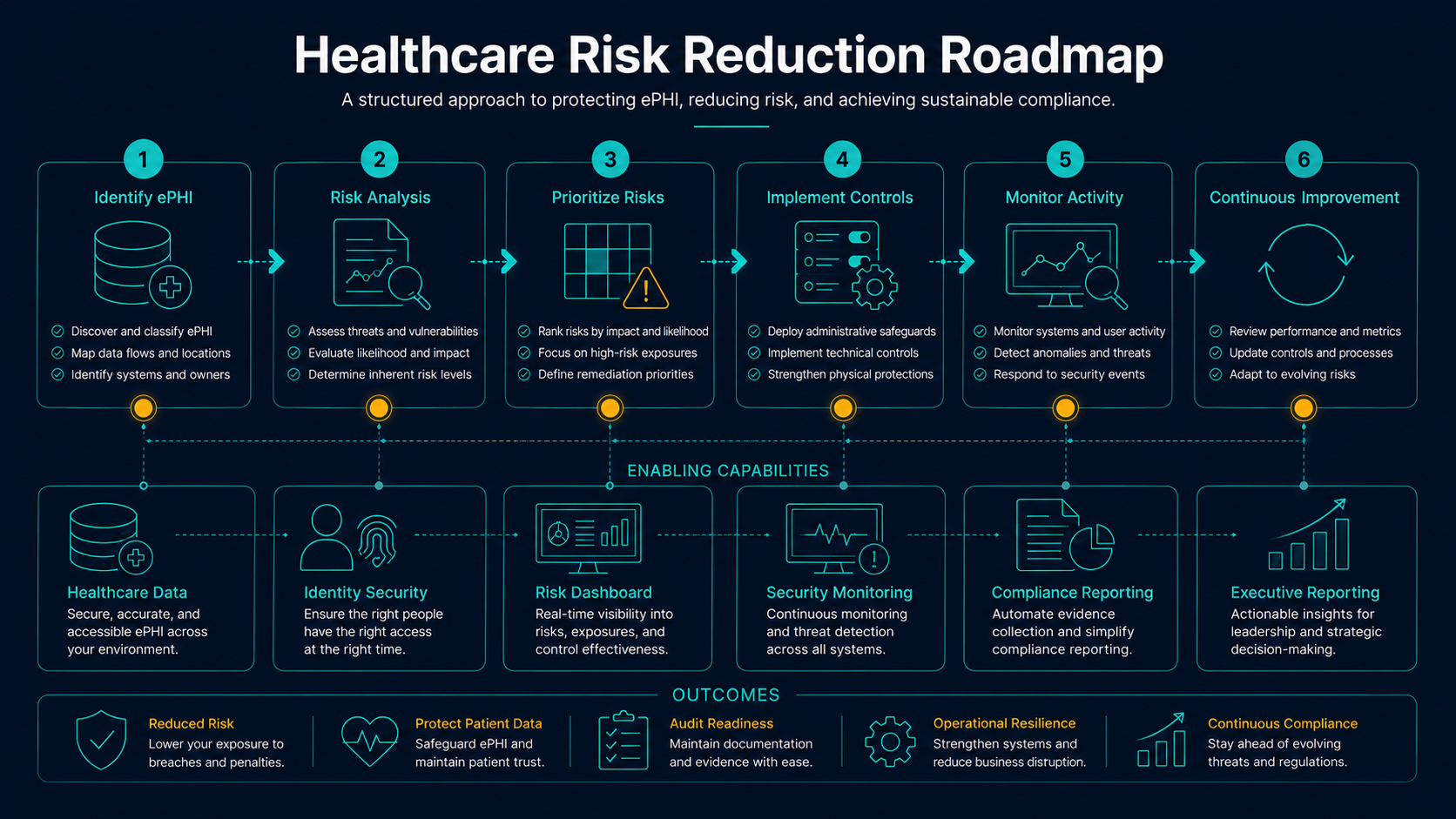
- Phase 1 – Identify ePHI: Map systems, users, vendors, workflows, applications, cloud services, backups, and data flows involving ePHI.
- Phase 2 – Perform Risk Analysis: Identify threats, vulnerabilities, likelihood, impact, current safeguards, and remediation priorities.
- Phase 3 – Prioritize Risks: Translate findings into an actionable plan with owners, deadlines, impact ratings, and leadership reporting.
- Phase 4 – Implement Controls: Strengthen MFA, endpoint security, patching, vulnerability management, backup, logging, and vendor access controls.
- Phase 5 – Monitor Activity: Centralize logs, review alerts, detect suspicious behavior, and document security operations activity.
- Phase 6 – Improve Continuously: Review control performance, test incident response, update risk analysis, validate recovery, and report progress to leadership.
Executive and Board-Level Considerations
HIPAA penalties and breach costs should be discussed in business language. Executives and board members do not need to manage every technical detail, but they should understand whether the organization has defensible security governance, a current view of material risk, and evidence that safeguards are operating.
Leadership should expect clear reporting that connects cybersecurity to patient care, business continuity, financial exposure, insurance requirements, vendor risk, and regulatory expectations.
Questions Executives Should Ask
- When was our last enterprise-wide HIPAA security risk analysis?
- Do we know where ePHI is stored, transmitted, accessed, and backed up?
- What are our top five unresolved security risks?
- Who owns remediation, and are deadlines being tracked?
- Are remote access, privileged accounts, and vendor access protected by MFA?
- Can we detect suspicious access to systems containing ePHI?
- Can we recover from ransomware without paying a ransom?
- Have we tested incident response and communication procedures?
- Are business associate responsibilities documented and reviewed?
- What evidence would we provide after a complaint, audit, or breach?
Board-Level Risk Framing
Healthcare boards should not receive only technical metrics. They should receive a concise view of material risk, unresolved control gaps, remediation progress, incident readiness, vendor exposure, and the potential operational impact of a major breach.
How Managed Security Services Support Cost Avoidance
Many healthcare organizations do not have the internal staffing depth to operate every safeguard alone. Managed security services can help reduce risk by improving operational consistency, documentation, monitoring, and response readiness.
DBT supports healthcare organizations through services that may include:
- Compliance and risk management support
- Cybersecurity operations and managed security monitoring
- Managed SIEM and log management
- Managed detection and response
- Vulnerability management and remediation tracking
- Patch and configuration management support
- Identity and access security
- Backup and recovery planning support
- Incident response preparation
- Executive reporting and evidence collection
The goal is not to outsource accountability. The goal is to help leadership maintain a stronger, more visible, and more repeatable security program.
Related Compliance Resources
This article is part of DBT’s compliance resource center. For additional guidance, review:
- HIPAA Security Rule Readiness
- HIPAA Security Controls Mapped to Managed Services
- NIST 800-171 Requirements Guide
- CMMC 2.0 Explained
- Healthcare Cybersecurity Services
Final Thoughts
HIPAA penalties are important, but they are only one part of the risk picture. A healthcare breach can disrupt patient care, delay revenue cycle activity, create legal and regulatory costs, strain staff, damage reputation, and expose weaknesses in governance.
The strongest healthcare organizations treat HIPAA readiness as an ongoing security and risk management discipline. They identify where ePHI exists, assess risk, prioritize remediation, strengthen safeguards, monitor activity, manage vendors, test response plans, and maintain evidence.
For executives and boards, the objective is not simply to avoid fines. It is to reduce the likelihood and impact of a breach, protect patient trust, support operational resilience, and demonstrate that cybersecurity risk is being managed with discipline.