
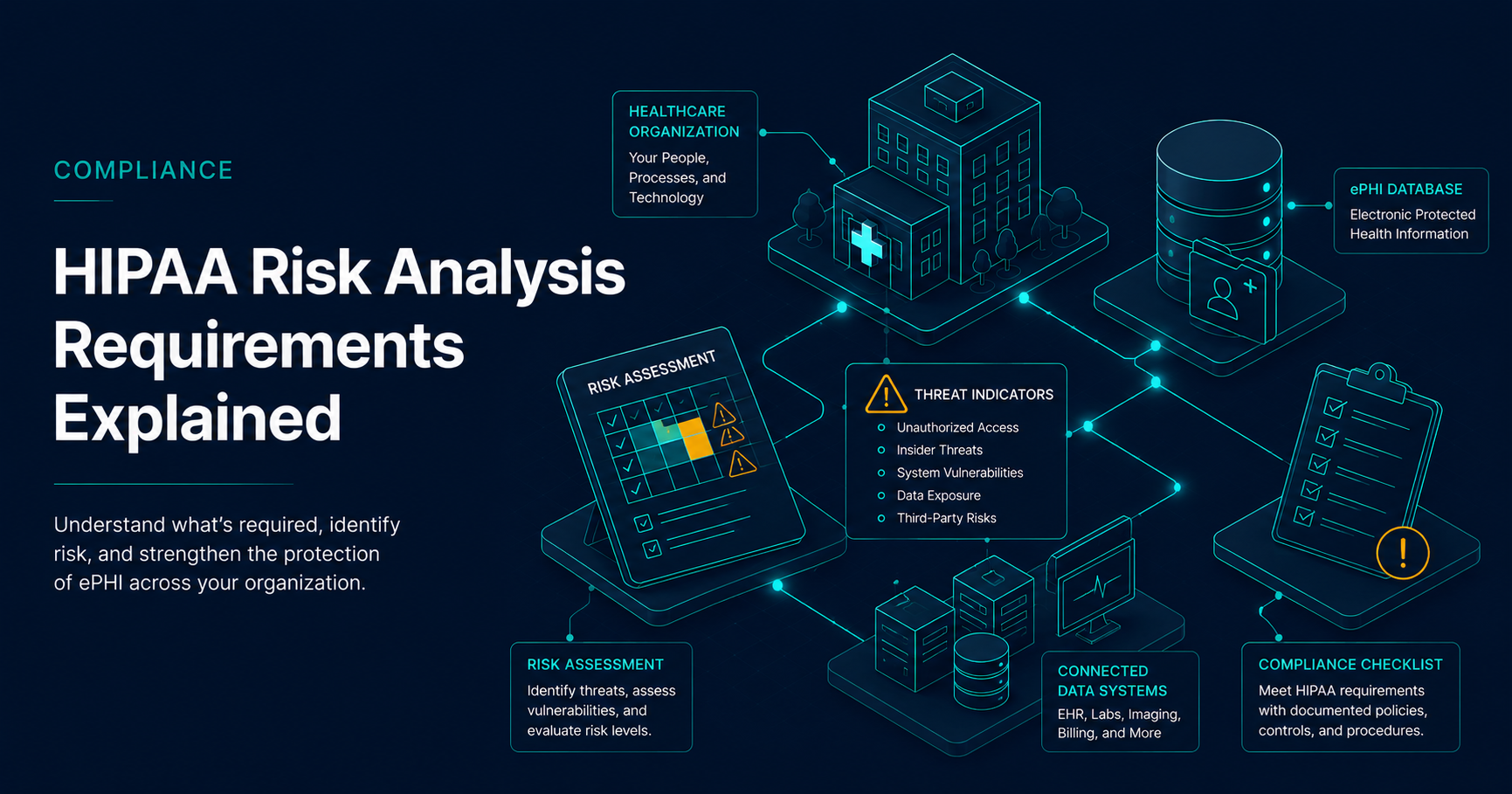
Why HIPAA Risk Analysis Matters
HIPAA risk analysis is one of the most important requirements in the HIPAA Security Rule because it connects compliance obligations to the real systems, users, vendors, data flows, and threats inside a healthcare organization. Without a meaningful risk analysis, it is difficult to prove that safeguards are reasonable, appropriate, and aligned to actual risk.
For healthcare organizations, risk analysis is not just a compliance document. It is the operating foundation for decisions about access control, logging, endpoint protection, vulnerability management, backup strategy, incident response, vendor oversight, and executive reporting.
A strong risk analysis helps leadership answer practical questions: Where does electronic protected health information exist? Who can access it? Which systems are most critical? Which vulnerabilities create the greatest exposure? Which safeguards are working? Which risks need funding, ownership, and remediation?
Key Takeaways
- HIPAA risk analysis should identify where ePHI is created, received, maintained, and transmitted.
- Risk analysis and risk management are related, but they are not the same activity.
- OCR enforcement actions frequently reference missing, incomplete, or outdated risk analysis.
- A practical risk analysis should evaluate threats, vulnerabilities, likelihood, impact, current safeguards, and remediation priorities.
- Healthcare leaders should treat risk analysis as an ongoing governance process, not a one-time checklist.
What HIPAA Risk Analysis Is Intended to Do
The purpose of a HIPAA risk analysis is to help a healthcare organization understand risks to the confidentiality, integrity, and availability of electronic protected health information, commonly referred to as ePHI.
In practical terms, risk analysis should help the organization identify:
- Which systems, applications, devices, users, workflows, vendors, and locations involve ePHI
- Which threats could affect ePHI or healthcare operations
- Which vulnerabilities could be exploited or cause loss of availability
- Which safeguards are already in place
- Where controls are missing, weak, inconsistent, or undocumented
- How likely a risk is to occur
- How severe the impact could be if it occurs
- Which risks require mitigation, acceptance, transfer, or avoidance
A risk analysis should be specific enough to guide action. A generic policy binder or high-level checklist is not enough if it does not reflect the organization’s actual environment.
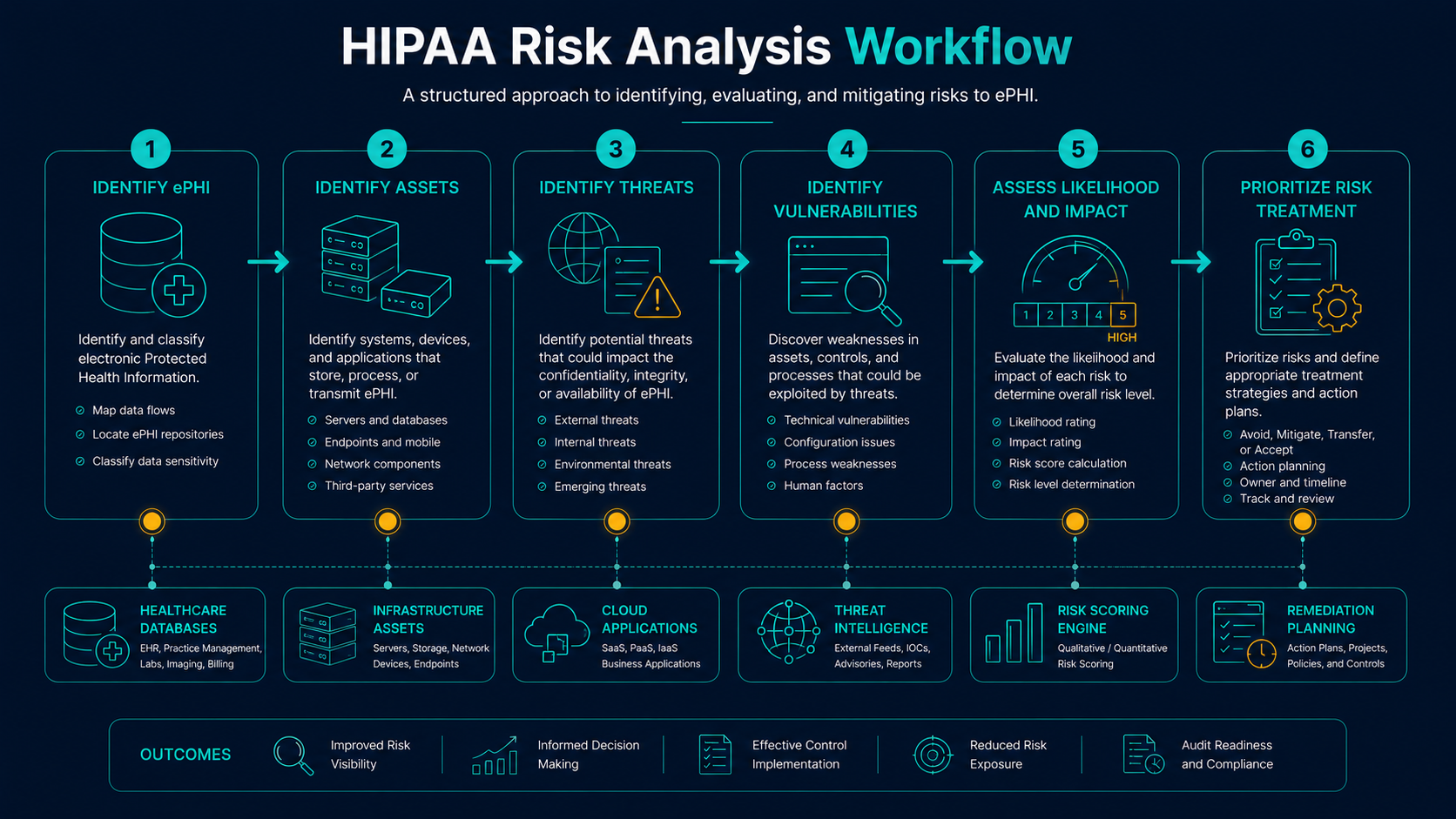
Risk Analysis vs. Risk Management
HIPAA risk analysis and risk management are closely connected, but they are different activities. Risk analysis is the process of identifying and evaluating risk. Risk management is the process of deciding what to do about the risks that were identified.
Organizations sometimes create a risk analysis report and then stop. That leaves a major gap. A risk analysis only becomes useful when the findings are translated into ownership, remediation priorities, timelines, evidence, and recurring review.
| Activity | Primary Purpose | Practical Output |
|---|---|---|
| Risk Analysis | Identify and evaluate risks to ePHI and supporting systems | Asset inventory, threat and vulnerability review, likelihood and impact scoring, prioritized risk findings |
| Risk Management | Decide how risks will be addressed, reduced, transferred, accepted, or avoided | Remediation plan, assigned owners, timelines, control improvements, exception documentation, progress reporting |
| Ongoing Review | Maintain alignment as systems, vendors, threats, and business operations change | Updated risk register, recurring control reviews, vendor updates, security reports, leadership visibility |
Why OCR Focuses on Risk Analysis
Risk analysis is a recurring theme in healthcare enforcement because it is foundational. If an organization has not identified where ePHI exists and how it is exposed, it is difficult to demonstrate that safeguards were selected thoughtfully.
Regulators are not only looking for whether an organization owns security tools. They are looking for whether the organization has evaluated its environment, understood its risks, implemented appropriate safeguards, and maintained evidence that those safeguards are operating.
Common risk analysis weaknesses include:
- Risk analysis that excludes important systems or business units
- Risk analysis that does not identify all locations of ePHI
- Risk scoring that is too vague to guide remediation
- Failure to update the analysis after system, vendor, location, or workflow changes
- Findings that are documented but never assigned, funded, or remediated
- Policies that exist without evidence that controls are implemented
- Vendor access and business associate risk that is not evaluated
- Security tools that generate alerts but are not monitored or documented consistently
Compliance Principle
A HIPAA risk analysis should be more than a static report. It should support practical security decisions, remediation planning, executive visibility, and evidence collection over time.
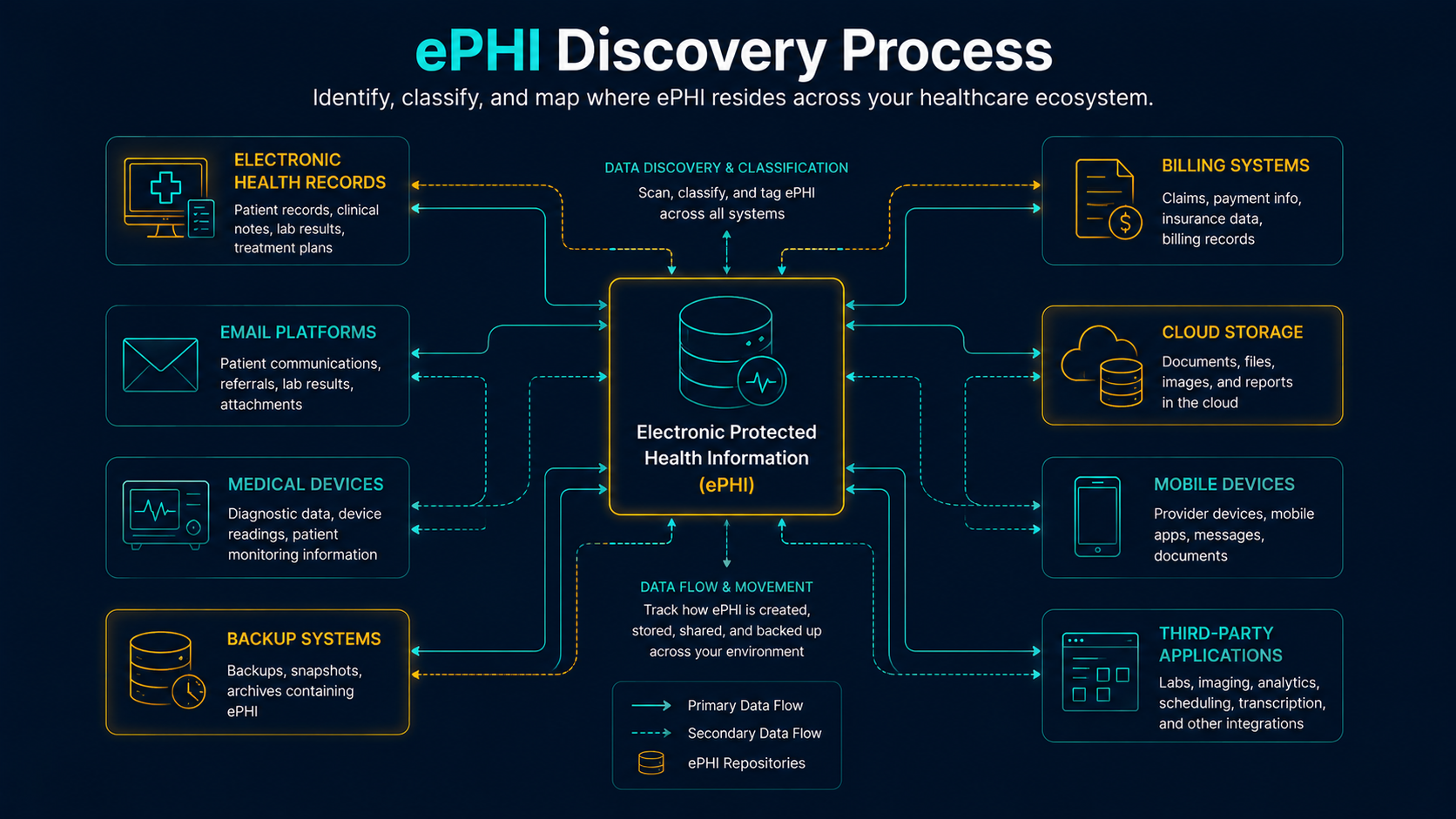
Step 1: Identify Where ePHI Exists
Healthcare organizations cannot meaningfully analyze risk until they understand where ePHI exists. This includes systems that directly store patient information and systems that may indirectly contain patient identifiers, logs, attachments, exports, backups, or reports.
Common ePHI locations include:
- Electronic health record systems
- Practice management platforms
- Billing and revenue cycle systems
- Email and collaboration tools
- Cloud storage and file shares
- Endpoints, laptops, and mobile devices
- Medical applications and connected clinical systems
- Backup repositories and archives
- Remote access platforms
- Security logs that may contain user or patient identifiers
- Vendor-managed systems and hosted applications
This discovery step should include both technical systems and operational workflows. For example, a clinic may have ePHI in its EHR, but also in exported spreadsheets, billing attachments, scanned documents, email communications, call center notes, or third-party portals.
Step 2: Identify Threats and Vulnerabilities
After ePHI locations are identified, the organization should evaluate threats and vulnerabilities that could affect confidentiality, integrity, or availability.
Threats are events or actors that could cause harm. Vulnerabilities are weaknesses that could be exploited or fail under operational stress. A ransomware group is a threat. Unpatched systems, weak authentication, poor backups, and limited monitoring are vulnerabilities.
Common Healthcare Threats
- Ransomware and data extortion
- Credential theft and phishing
- Unauthorized access by internal or external users
- Business email compromise
- Lost or stolen devices
- Cloud misconfiguration
- Third-party compromise
- Insider misuse
- System outage or data corruption
- Natural disaster or facility disruption
Common Healthcare Vulnerabilities
- Incomplete MFA coverage
- Weak or shared accounts
- Insufficient privileged access controls
- Unpatched systems or unsupported software
- Lack of centralized logging and monitoring
- Limited vulnerability management
- Inconsistent backups or untested recovery
- Unclear vendor responsibilities
- Inadequate endpoint protection
- Missing incident response testing
Step 3: Evaluate Existing Safeguards
A useful risk analysis should not only identify what could go wrong. It should also evaluate what safeguards already exist and whether those safeguards are operating effectively.
For example, a healthcare organization may have MFA enabled for email but not for remote access, privileged accounts, EHR administration, or third-party support access. In that case, the safeguard exists in some areas but does not fully address the risk.
Safeguards to evaluate may include:
- Identity and access controls
- Multi-factor authentication
- Endpoint detection and response
- Email security controls
- Network segmentation
- Firewall and remote access controls
- Encryption and transmission security
- Patch and vulnerability management
- Backups and disaster recovery
- Logging and security monitoring
- Incident response procedures
- Vendor access governance
- Security awareness training
Evidence Matters
It is not enough to say a safeguard exists. Organizations should maintain evidence such as configuration exports, access review records, monitoring reports, vulnerability scans, ticket history, incident response testing records, and backup recovery results.
Step 4: Score Likelihood and Impact
Risk scoring helps leadership prioritize remediation. Not every risk has the same likelihood, and not every risk has the same business impact. A practical scoring model should be simple enough to use consistently but specific enough to support decision-making.
Organizations often score likelihood and impact using a low, medium, and high model. More mature programs may use numeric scoring, control maturity weighting, residual risk tracking, or heat maps.
| Risk Scenario | Potential Vulnerability | Likelihood | Impact | Priority |
|---|---|---|---|---|
| Compromised remote access account | MFA not enforced for VPN or remote desktop access | High | High | Critical |
| Ransomware affecting clinical systems | Unpatched endpoints and limited EDR coverage | Medium to High | High | Critical |
| Unauthorized access to shared files | Excessive permissions and limited access reviews | Medium | Medium to High | High |
| Delayed breach investigation | Logs are not centralized, retained, or reviewed consistently | Medium | High | High |
| Vendor account misuse | Business associate access is not reviewed or monitored | Medium | Medium to High | High |
Step 5: Prioritize Risk Treatment
Once risks are scored, the organization should determine how each risk will be treated. Risk treatment should be documented and reviewed by the appropriate stakeholders.
Common risk treatment options include:
- Mitigate: Reduce the risk by implementing or improving safeguards.
- Transfer: Shift some financial or operational impact through contracts, insurance, or vendor responsibility.
- Accept: Formally accept the risk when it is within tolerance or cannot be reduced immediately.
- Avoid: Stop the activity, retire the system, or change the workflow that creates the risk.
Risk acceptance should not be informal. If leadership accepts a risk, that decision should be documented with the rationale, expected duration, compensating controls, and review date.
Business Associate and Vendor Risk
Healthcare organizations rarely operate alone. EHR vendors, billing companies, cloud providers, managed IT providers, managed security providers, consultants, call centers, and software platforms may create, receive, maintain, or transmit ePHI.
A HIPAA risk analysis should account for business associate exposure and third-party dependencies. This does not mean the healthcare organization must perform the vendor’s internal risk analysis, but it does need to understand how vendor relationships affect ePHI security.
Vendor and business associate review should consider:
- Whether a business associate agreement is required and current
- What ePHI the vendor can access
- How the vendor authenticates and authorizes users
- How vendor access is granted, reviewed, and removed
- What security responsibilities remain with the covered entity
- How incidents are reported and escalated
- Whether logs, reports, or evidence are available
- How backup, recovery, and availability responsibilities are defined
- Whether subcontractors are involved
Vendor Oversight Reminder
A business associate agreement helps define responsibilities, but it does not replace practical vendor risk management. Healthcare organizations should understand which safeguards are performed internally, which are supported by vendors, and where shared responsibility gaps may exist.
Common HIPAA Risk Analysis Failures
Many healthcare organizations believe they have completed a risk analysis because they have policies, a spreadsheet, or a prior assessment. The problem is that risk analysis must be current, complete, and operationally useful.
Common failures include:
- Scope is too narrow: The analysis only reviews the EHR and ignores email, file shares, endpoints, cloud platforms, backups, and vendors.
- ePHI is not fully mapped: The organization does not know where patient information is stored, exported, transmitted, or retained.
- Threats are generic: The analysis lists broad threats but does not connect them to actual systems or workflows.
- Vulnerabilities are not validated: Findings are based on assumptions rather than scans, configuration review, interviews, or evidence.
- Risk scoring is inconsistent: Different departments rate risk differently without a shared methodology.
- Findings are not remediated: Risks are documented but not assigned, funded, tracked, or closed.
- Vendors are excluded: Business associate access, hosted systems, and third-party support are not considered.
- Review cadence is unclear: The analysis is not updated after major changes or on a recurring schedule.
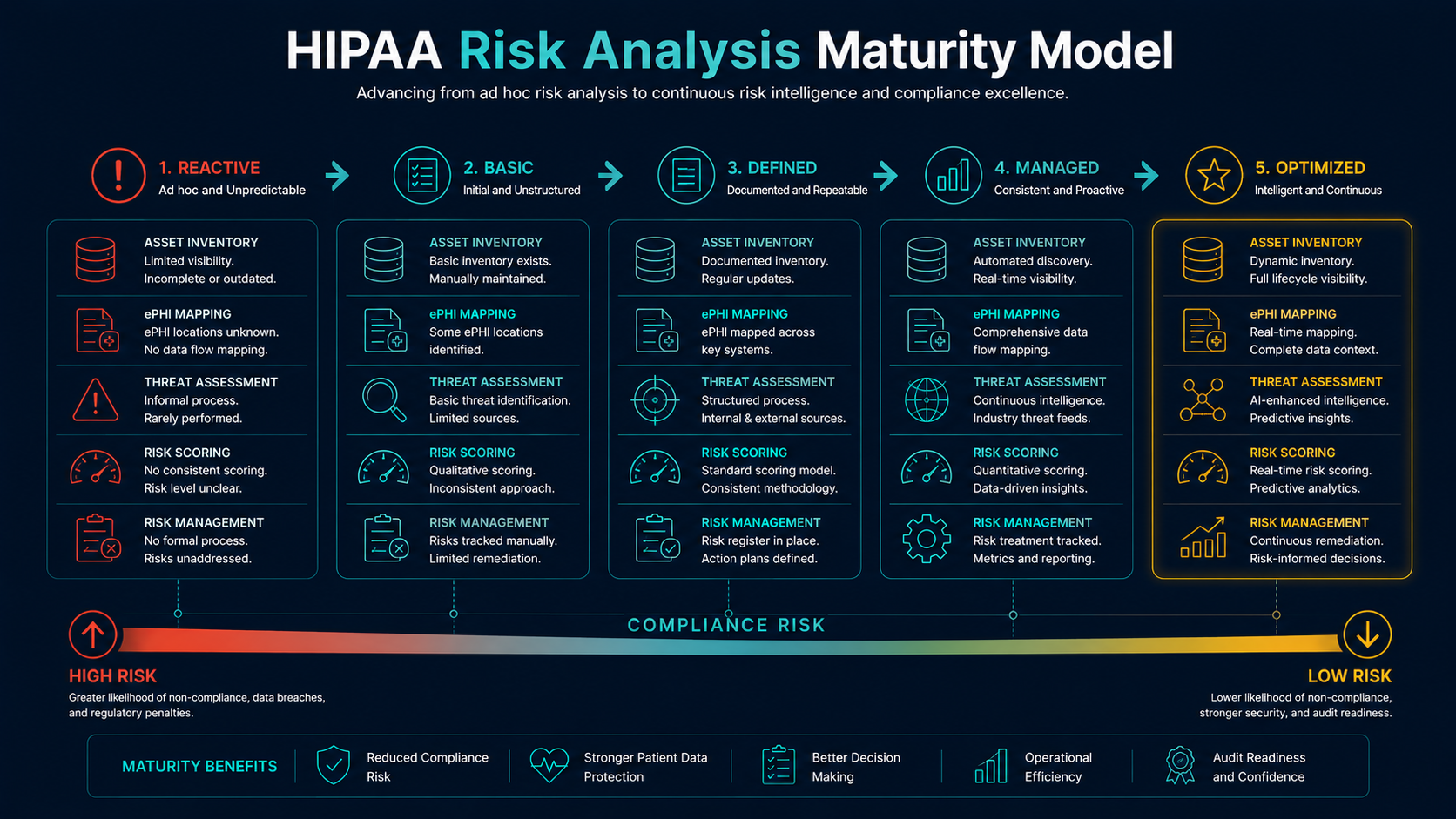
HIPAA Risk Analysis Maturity Model
Risk analysis maturity varies widely across healthcare organizations. Some organizations treat risk analysis as a one-time compliance task. More mature organizations maintain a living risk register, connect findings to remediation work, and report progress to leadership.
| Maturity Stage | Typical Behavior | Compliance Risk |
|---|---|---|
| Reactive | Risk analysis occurs only after an incident, audit request, or customer concern | High |
| Basic | A checklist or prior assessment exists, but scope and evidence are limited | Medium to High |
| Managed | Systems, ePHI locations, threats, vulnerabilities, and owners are documented | Medium |
| Measured | Risk findings are scored, tracked, reviewed, and connected to remediation evidence | Low to Medium |
| Optimized | Risk analysis is integrated into security operations, vendor management, budgeting, and executive reporting | Lower |
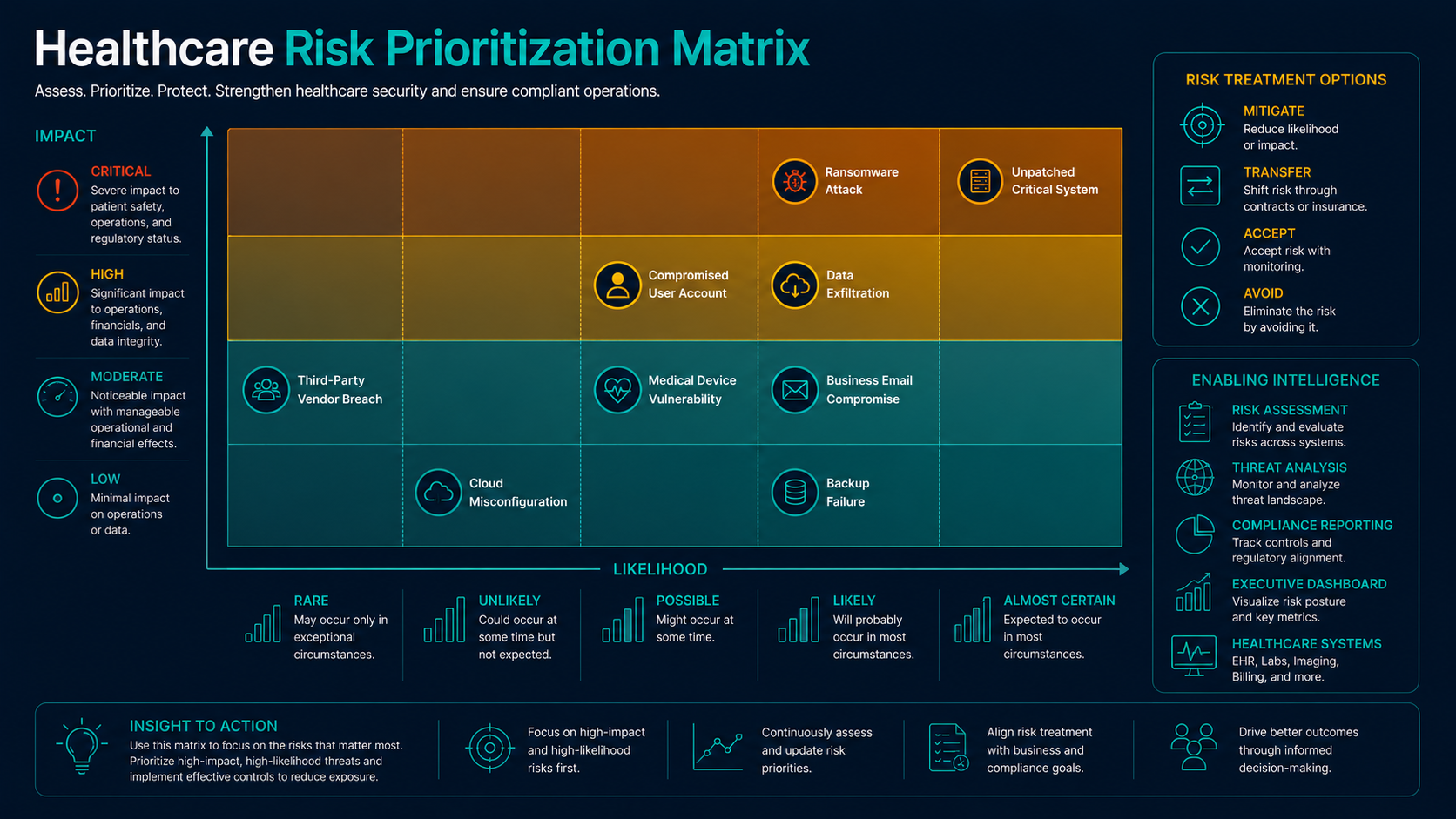
Healthcare Risk Prioritization
Healthcare organizations often have more risk findings than they can remediate immediately. Prioritization helps leadership make defensible decisions and focus resources where they reduce the most meaningful exposure.
A practical prioritization approach should consider:
- Volume and sensitivity of ePHI involved
- Clinical or operational importance of the system
- Likelihood of exploitation or failure
- Potential impact to patient care, revenue cycle, and reputation
- Existing safeguards and compensating controls
- Regulatory, contractual, and cyber insurance expectations
- Cost and effort required to remediate
- Time sensitivity and dependency on vendors
How Security Controls Support Risk Reduction
A HIPAA risk analysis should lead to practical control improvements. The goal is not to create risk documentation for its own sake. The goal is to reduce risk to ePHI, healthcare operations, patients, and the organization.
| Security Control | Risk Reduced | Operational Value |
|---|---|---|
| Multi-Factor Authentication | Credential theft, remote access compromise, unauthorized administrative access | Reduces account takeover risk for cloud, VPN, privileged, and remote access workflows |
| Endpoint Detection and Response | Malware, ransomware, suspicious endpoint behavior | Improves detection, containment, and investigation capability |
| Managed SIEM and Security Monitoring | Undetected unauthorized access, delayed incident response, missing audit visibility | Centralizes logs and improves alerting, triage, reporting, and evidence collection |
| Vulnerability Management | Known exploitable weaknesses in systems and applications | Prioritizes remediation based on exposure and business impact |
| Backup and Recovery Testing | Data loss, ransomware downtime, operational disruption | Improves resilience and supports recovery confidence |
| Vendor Access Governance | Third-party account misuse, unclear business associate responsibility | Creates better visibility into who can access ePHI and under what conditions |
How Often Should Risk Analysis Be Updated?
A HIPAA risk analysis should not be treated as a once-and-done document. Healthcare environments change frequently. Systems are replaced, cloud platforms are adopted, vendors are added, users change roles, threats evolve, and new vulnerabilities emerge.
Organizations should review and update risk analysis when meaningful changes occur, such as:
- New EHR, billing, imaging, or clinical system implementation
- Cloud migration or new cloud application adoption
- New business associate or vendor relationship
- Major network, identity, or remote access change
- Merger, acquisition, new facility, or practice expansion
- Significant security incident or near miss
- New regulatory, contractual, or cyber insurance expectation
- Material change in threat exposure or vulnerability profile
Many organizations also perform a formal annual review and maintain ongoing risk tracking throughout the year.
Executive and Board-Level Questions
Healthcare executives and board members do not need to manage every technical detail, but they should understand whether the organization has a credible, current, and actionable view of risk.
Useful leadership questions include:
- Do we know where ePHI exists across our environment?
- When was our last enterprise-wide HIPAA risk analysis?
- What systems or workflows were excluded, and why?
- What are our highest-risk findings?
- Which risks require budget, executive decisions, or vendor involvement?
- Are remediation plans assigned to owners with target dates?
- How do we know controls are operating effectively?
- Can we show evidence for access control, monitoring, patching, backup, and incident response?
- How are business associate risks reviewed?
- How are risk findings reported to leadership over time?
Leadership Perspective
A strong risk analysis gives executives a more defensible way to prioritize cybersecurity investment. It connects technical findings to business impact, operational resilience, patient trust, and compliance readiness.
How DBT Helps Healthcare Organizations with Risk Analysis
Many healthcare organizations have limited internal security capacity. DBT helps organizations move from informal checklists to practical risk analysis, remediation planning, and ongoing security operations.
DBT can support HIPAA risk analysis readiness through:
- ePHI environment discovery and technical control review
- Security risk assessment support
- Vulnerability scanning and remediation planning
- Identity and access control review
- Managed SIEM, log management, and monitoring
- Endpoint security and managed detection support
- Patch management and configuration improvement
- Backup and recovery readiness review
- Vendor and business associate responsibility mapping
- Security reporting and evidence collection
DBT does not replace legal counsel or a covered entity’s internal compliance ownership. Instead, DBT helps healthcare organizations strengthen the technical and operational security controls that support HIPAA readiness.
Related DBT Resources
For a broader overview of HIPAA safeguards, review HIPAA Security Rule Readiness. For a practical control mapping, review HIPAA Security Controls Mapped to Managed Services. For leadership risk context, review HIPAA Compliance Penalties and Breach Costs.
Organizations evaluating operational security support can also review DBT’s Compliance & Risk Management, Cybersecurity Operations, Identity & Access Security, and Healthcare Cybersecurity Services pages.
Final Thoughts
HIPAA risk analysis is one of the most important disciplines in healthcare compliance because it forces the organization to understand where ePHI exists, how it is exposed, which safeguards are operating, and which risks need action.
The strongest programs do not treat risk analysis as an annual paperwork exercise. They use it as a recurring governance process that informs security controls, risk management, vendor oversight, budgeting, incident readiness, and executive reporting.
Healthcare organizations that maintain a practical, evidence-driven risk analysis are better positioned to protect ePHI, reduce breach exposure, support compliance readiness, and make more confident cybersecurity investment decisions.