
Why Third-Party Risk Management Matters in Healthcare
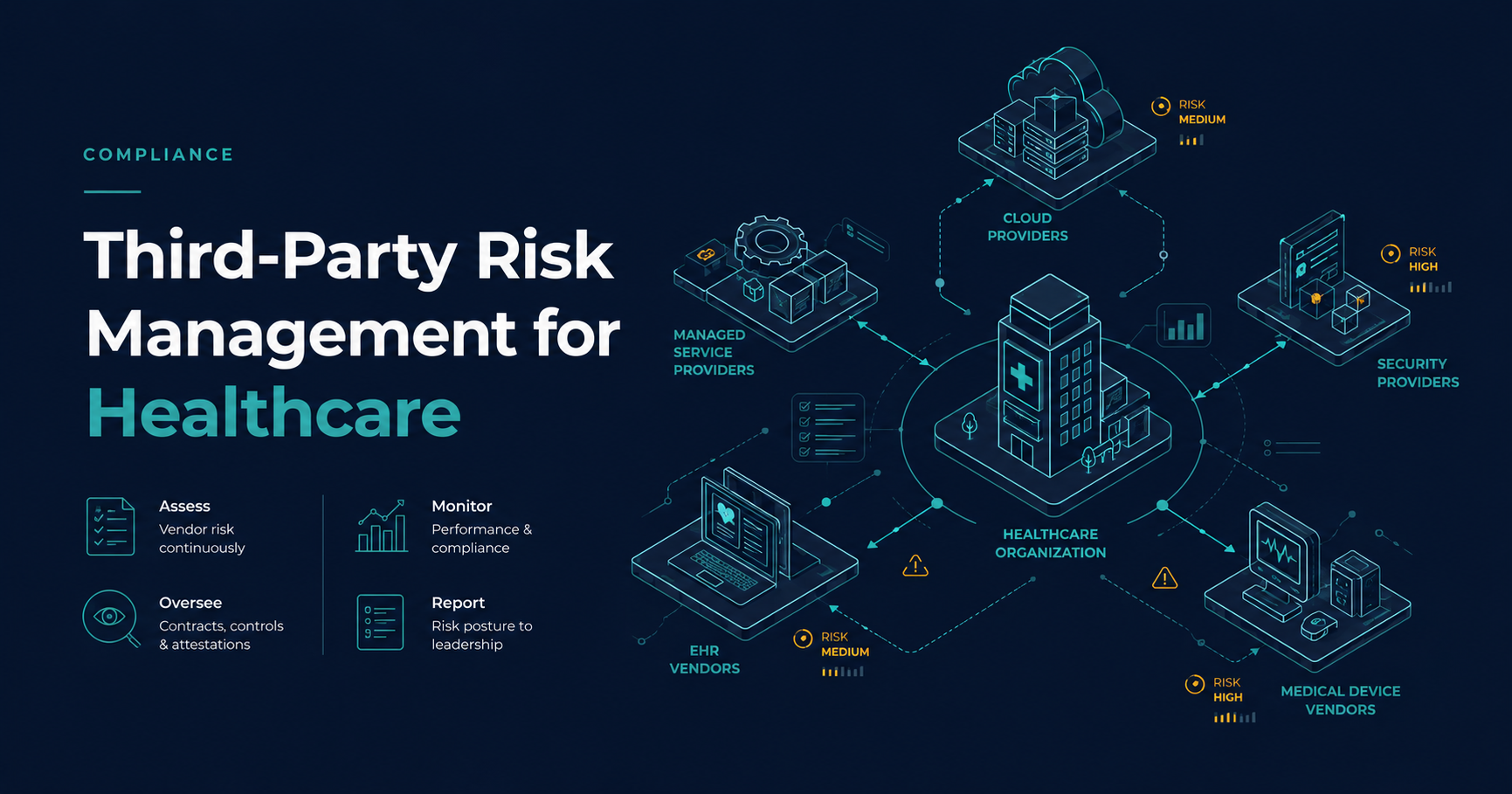
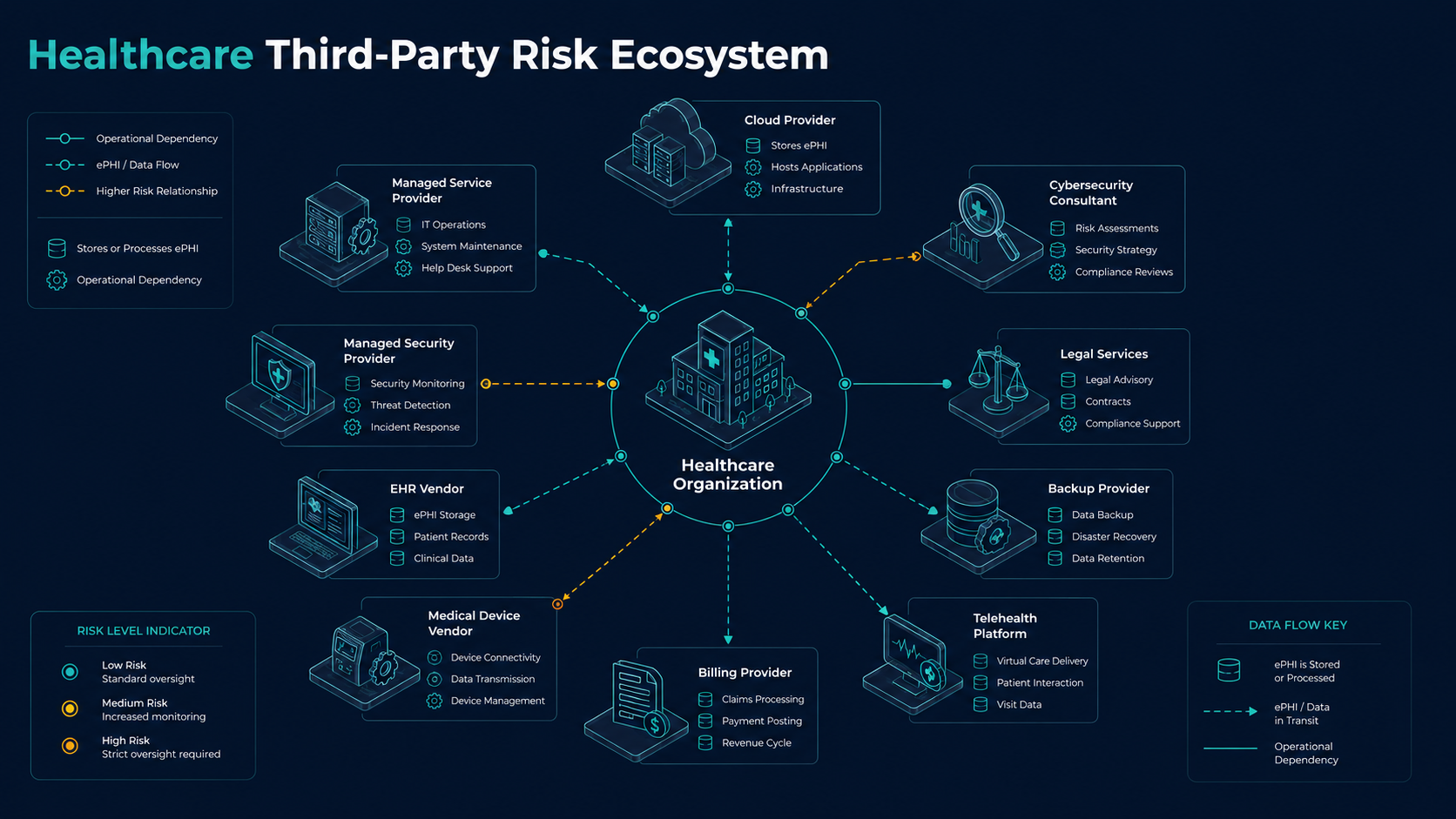
Healthcare organizations rarely operate alone. Electronic health record platforms, billing systems, cloud services, managed IT providers, managed security providers, telehealth platforms, backup providers, consultants, contractors, and other vendors often support systems that create, receive, maintain, or transmit protected health information.
That dependency creates a practical compliance and cybersecurity challenge. A healthcare organization may have strong internal policies, but risk can still enter through third-party access, vendor-managed systems, cloud misconfiguration, unsupported integrations, weak incident notification language, or unclear operational responsibilities.
Third-party risk management is the process of identifying, assessing, governing, monitoring, and offboarding vendors that may affect patient data, critical operations, compliance readiness, or organizational resilience.
Key Takeaways
- Healthcare vendor risk is not limited to vendors that directly store patient data.
- Vendors may create risk through system access, support access, cloud services, backups, integrations, or downstream subcontractors.
- Business Associate Agreements are important, but they do not replace security oversight.
- Vendor inventory, responsibility mapping, security evidence, access reviews, and incident notification procedures should be maintained continuously.
- Third-party risk management should be integrated into HIPAA risk analysis, cybersecurity operations, and executive reporting.
What Counts as Third-Party Risk?
Third-party risk includes any risk introduced by an external organization, platform, service provider, contractor, consultant, or vendor relationship. In healthcare, this often overlaps with business associate risk, but the two are not always identical.
A vendor may create third-party risk if it:
- Accesses systems containing electronic protected health information
- Stores, processes, backs up, or transmits patient information
- Provides remote support into healthcare systems
- Hosts cloud infrastructure or applications used by the organization
- Provides cybersecurity, IT, billing, legal, consulting, or compliance services
- Maintains integrations with electronic health records or billing platforms
- Uses subcontractors to provide services to the healthcare organization
- Supports systems that are critical to patient care, scheduling, revenue cycle, or operations
The key question is not whether the vendor is large or small. The key question is whether the vendor could affect confidentiality, integrity, availability, compliance readiness, patient care, or business continuity.
Third-Party Risk and HIPAA Responsibilities
HIPAA does not allow healthcare organizations to outsource accountability entirely. Covered entities and business associates need to understand which responsibilities they retain internally and which responsibilities are supported by vendors, service providers, or subcontractors.
A signed contract may establish obligations, but it does not prove that safeguards are operating effectively. Healthcare organizations should be able to show that vendor risk is identified, evaluated, documented, and monitored as part of broader compliance and cybersecurity governance.
Important Compliance Note
This article is not legal advice. Healthcare organizations should work with qualified legal counsel when interpreting HIPAA obligations, reviewing Business Associate Agreements, evaluating breach notification duties, or responding to regulatory inquiries.
Vendor Inventory Is the Foundation
A healthcare organization cannot manage vendor risk if it does not know which vendors support the environment. Vendor inventory is the foundation for third-party risk management because it establishes the population of relationships that need to be reviewed, categorized, monitored, and governed.
A useful healthcare vendor inventory should capture:
- Vendor name and business owner
- Service description
- Systems or workflows supported
- Whether PHI or ePHI is involved
- Whether a Business Associate Agreement is required
- Whether the vendor has remote or administrative access
- Authentication method and account ownership
- Subcontractor dependencies
- Contract renewal date
- Security evidence received
- Incident notification requirements
- Offboarding requirements
| Vendor Inventory Field | Why It Matters | Example Evidence |
|---|---|---|
| Service Description | Clarifies what the vendor does and which workflows it supports | Contract scope, statement of work, service description |
| PHI or ePHI Involvement | Determines whether HIPAA and business associate obligations may apply | Data flow map, application inventory, vendor questionnaire |
| System Access | Identifies whether vendor accounts could create security or operational exposure | Account list, remote access logs, privileged access review |
| Security Evidence | Supports due diligence and recurring vendor oversight | SOC report, security questionnaire, risk assessment, penetration test summary |
| Incident Notification Requirements | Defines how quickly the organization should be informed of suspected security events | Contract terms, BAA language, escalation procedures |
Vendor Risk Tiering
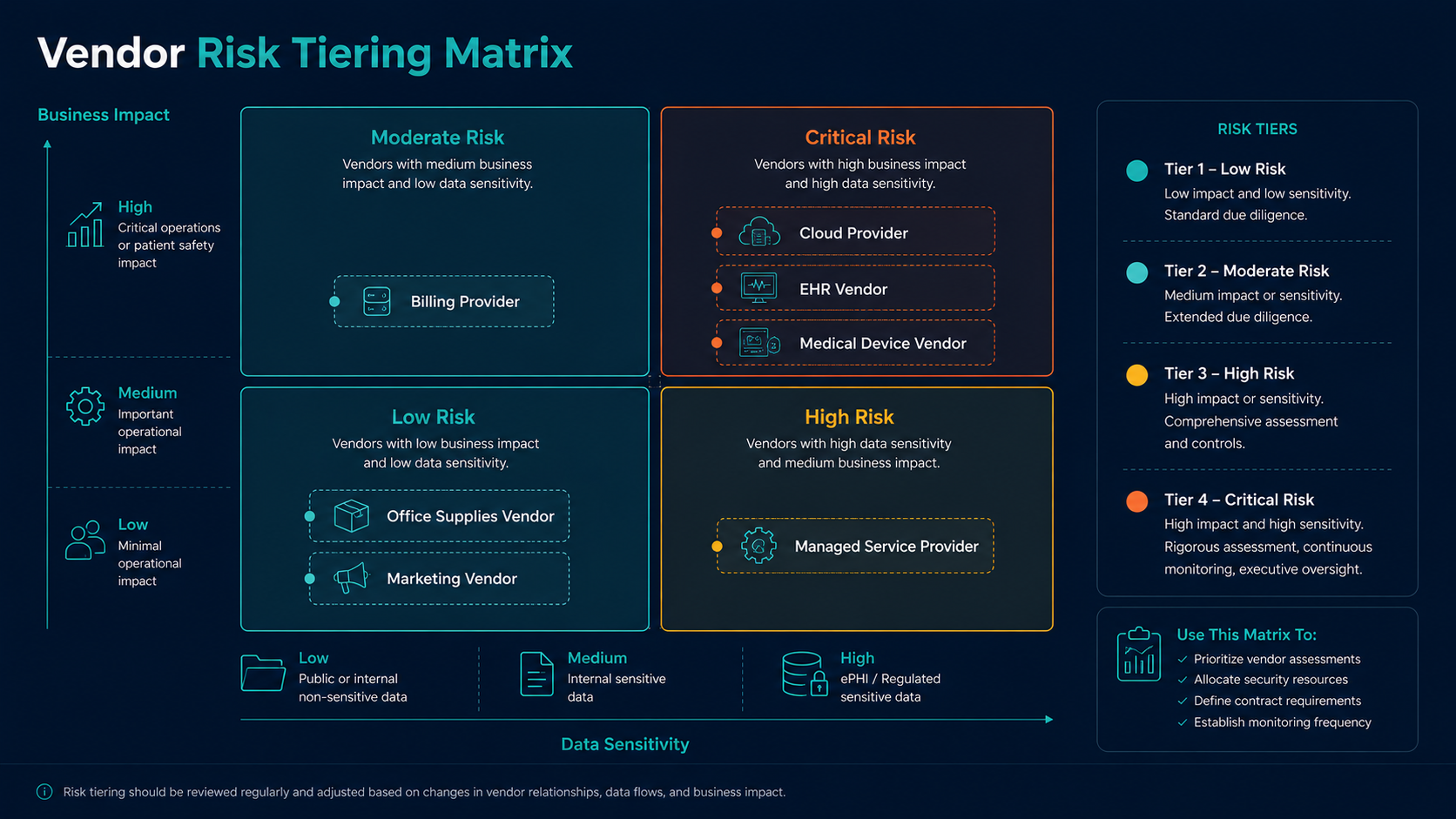
Not every vendor requires the same depth of review. A vendor that provides office supplies does not create the same risk as a vendor with administrative access to electronic health record systems or backup repositories.
Vendor tiering helps healthcare organizations prioritize review effort based on risk exposure.
- Critical vendors: Vendors that support patient care, core operations, identity, backups, security monitoring, EHR systems, or large volumes of ePHI.
- High-risk vendors: Vendors with remote access, administrative access, PHI exposure, cloud hosting responsibilities, or incident response dependencies.
- Moderate-risk vendors: Vendors that support business workflows or limited data processing but do not operate critical systems.
- Low-risk vendors: Vendors with minimal data access, no PHI exposure, and limited operational dependency.
Security Due Diligence Before Onboarding
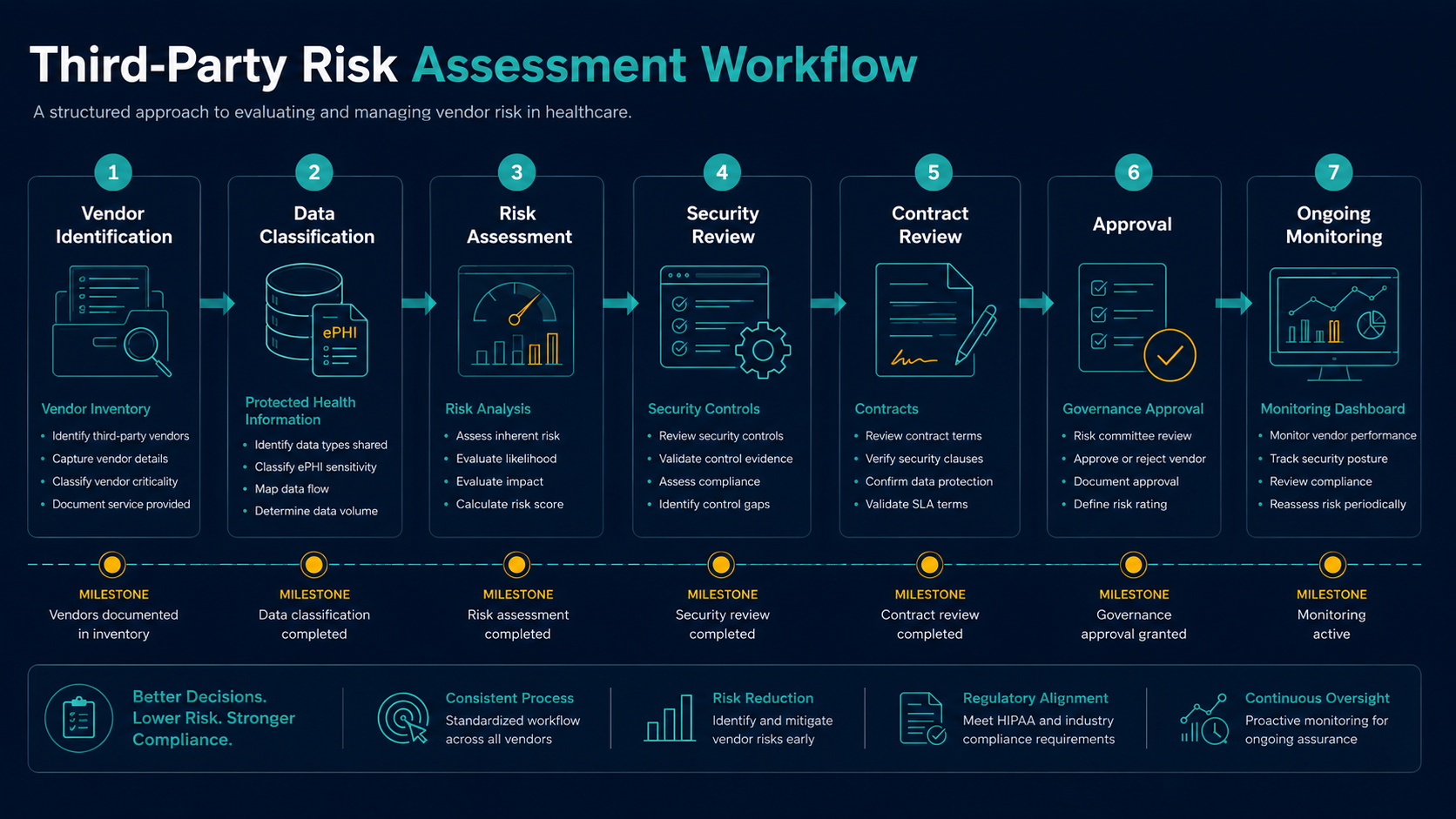
Third-party risk should be evaluated before the vendor is granted access, receives patient data, integrates with systems, or becomes operationally embedded.
Pre-onboarding due diligence may include:
- Reviewing whether the vendor will create, receive, maintain, or transmit PHI
- Determining whether a Business Associate Agreement is required
- Reviewing security questionnaires or control attestations
- Requesting SOC reports, security summaries, or third-party assessment evidence where appropriate
- Understanding subcontractor usage
- Reviewing incident notification language
- Confirming access control and authentication expectations
- Assessing data retention and destruction requirements
- Documenting internal business ownership
The goal is not to create paperwork for its own sake. The goal is to ensure the healthcare organization understands the vendor relationship before risk becomes operational.
Practical Governance Principle
Vendor onboarding should not be limited to procurement approval. For healthcare organizations, onboarding should also include security review, compliance review, access planning, responsibility mapping, and documentation of the vendor’s role in protecting PHI and critical operations.
Responsibility Mapping Prevents Control Gaps
One of the most common vendor risk problems is unclear responsibility. The healthcare organization assumes the vendor is handling a control. The vendor assumes the healthcare organization or another service provider owns it. The result is an unmanaged gap.
Responsibility mapping helps clarify who owns each safeguard across the healthcare organization, MSP, MSSP, EHR vendor, cloud provider, backup provider, and other service providers.
| Control Area | Common Ownership Question | Why It Matters |
|---|---|---|
| Access Control | Who creates, approves, reviews, and disables vendor accounts? | Inactive or excessive vendor access can create unauthorized access risk. |
| Logging and Monitoring | Who collects logs, reviews alerts, and escalates suspicious activity? | Logs without review may not support detection or audit readiness. |
| Backup and Recovery | Who protects backups, validates restoration, and confirms recovery objectives? | Unclear backup ownership can increase ransomware recovery risk. |
| Patch and Vulnerability Management | Who patches vendor-managed systems and confirms remediation? | Unpatched vendor-managed systems can expose critical workflows. |
| Incident Response | Who notifies whom, when, and with what information? | Delayed notification can increase breach impact and compliance exposure. |
Vendor Access Governance
Vendor access is one of the most practical areas of third-party risk. A vendor may not store PHI directly, but remote support access, administrative access, shared accounts, persistent VPN access, or unmanaged service accounts can create substantial exposure.
Healthcare organizations should evaluate:
- Which vendors have access to healthcare systems
- Whether access is persistent or just-in-time
- Whether accounts are named or shared
- Whether MFA is enforced
- Whether privileged access is limited and reviewed
- Whether access is logged and monitored
- Whether access is removed when support ends
- Whether emergency access procedures are documented
Vendor access reviews should be recurring. They should also occur after contract changes, staffing changes, mergers, platform migrations, service transitions, and security incidents.
Monitoring and Evidence Collection
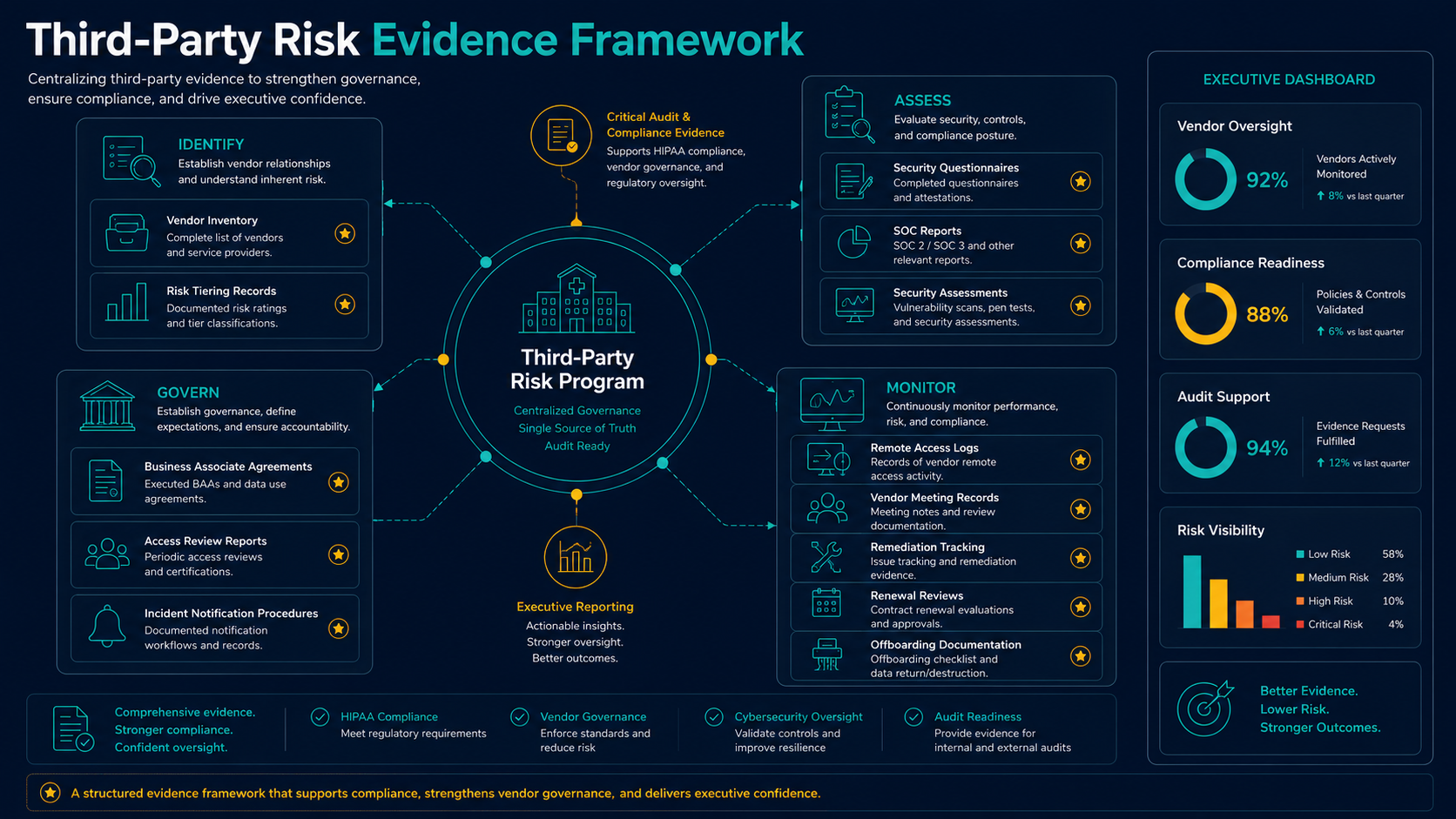
Third-party risk management should produce evidence. A healthcare organization should be able to show that vendor risk was reviewed, decisions were documented, access was governed, and material risks were escalated.
Useful evidence may include:
- Vendor inventory exports
- BAA tracking records
- Risk tiering records
- Security questionnaires
- Risk review notes
- Access review reports
- Remote access logs
- Incident notification procedures
- Vendor meeting notes
- Remediation tracking
- Renewal review documentation
- Offboarding confirmation records
Common Third-Party Risk Management Gaps
Many healthcare organizations discover vendor risk gaps during security assessments, audits, incidents, renewals, cyber insurance reviews, or technology transitions.
- Incomplete vendor inventory: Vendors are tracked by finance or operations but not linked to security and compliance risk.
- Unclear PHI exposure: The organization has not identified which vendors create, receive, maintain, or transmit PHI.
- Missing BAAs: Agreements are missing, outdated, or not aligned with current services.
- Limited security evidence: The vendor is trusted based on reputation rather than documented security review.
- Unmanaged vendor access: Accounts remain active after support changes, staffing changes, or contract termination.
- Poor subcontractor visibility: Downstream dependencies are not understood.
- Weak incident notification process: The organization does not know when or how the vendor will report a suspected event.
- No recurring review: Vendor risk is assessed once during onboarding and then ignored.
Common Failure Pattern
The existence of a signed agreement does not necessarily mean the vendor relationship is well managed. Third-party risk programs should connect contracts, access control, security evidence, risk analysis, monitoring, and offboarding into one repeatable process.
Third-Party Risk Should Feed the HIPAA Risk Analysis
Vendor risk should not be isolated from the organization’s broader HIPAA risk analysis. Vendors may affect the confidentiality, integrity, and availability of ePHI, and they may introduce risk through technology, operations, access, subcontractors, or service delivery.
A HIPAA-aligned risk analysis should consider:
- Which vendors support systems containing ePHI
- Which vendors have administrative access
- Which vendors host, store, transmit, or back up patient information
- Which vendors support critical clinical or business operations
- Which vendor risks could affect availability or ransomware recovery
- Which vendors require stronger contractual language or security evidence
- Which vendor access paths should be monitored more closely
This creates a more complete view of healthcare risk because it includes both internal controls and external dependencies.
Third-Party Risk Management Lifecycle
Vendor risk should be managed across the full lifecycle. A vendor relationship may begin with procurement, but risk continues through onboarding, service delivery, renewal, incident response, material changes, and offboarding.
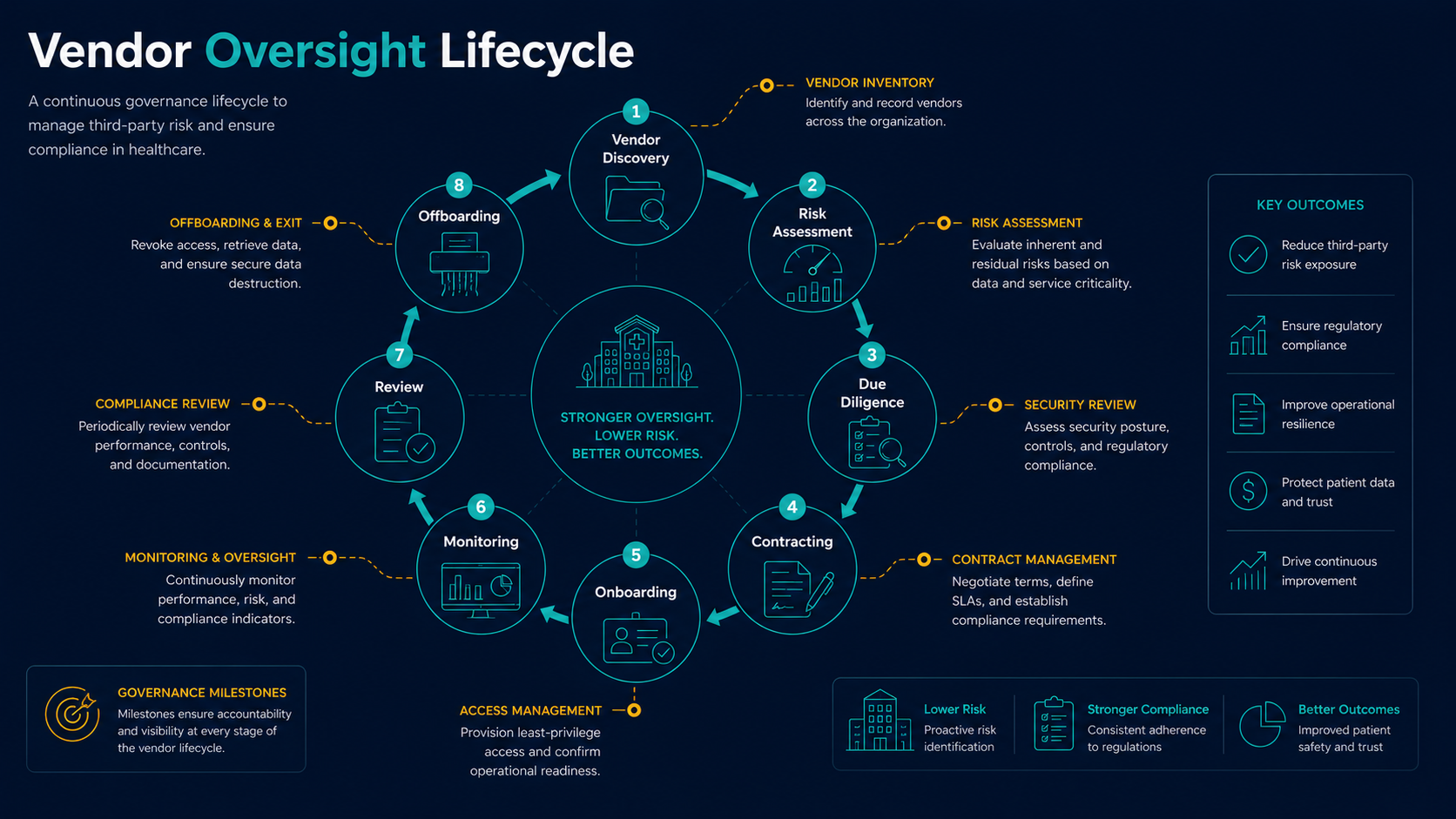
- Phase 1 – Identify Vendors: Build and maintain a vendor inventory tied to systems, workflows, data, and business ownership.
- Phase 2 – Classify Risk: Determine PHI exposure, operational dependency, system access, and risk tier.
- Phase 3 – Review Security: Collect appropriate security evidence, questionnaires, reports, and control information.
- Phase 4 – Map Responsibilities: Clarify ownership for access, logging, backup, monitoring, incident response, and documentation.
- Phase 5 – Monitor and Review: Reassess vendors during renewals, material changes, incidents, and recurring governance cycles.
- Phase 6 – Offboard Securely: Remove access, confirm data return or destruction, archive evidence, and close the vendor relationship.
Executive and Board-Level Questions
Third-party risk is not only an IT issue. Vendor exposure can affect compliance, financial risk, patient trust, operational resilience, legal exposure, and cyber insurance outcomes.
Healthcare executives and board members should be able to ask:
- Do we know which vendors have access to systems containing PHI?
- Do we know which vendors are critical to patient care or operations?
- Are Business Associate Agreements current and aligned with actual services?
- Do we review vendor access on a recurring basis?
- Do critical vendors use MFA and appropriate access controls?
- Do we collect meaningful security evidence from high-risk vendors?
- Do we understand subcontractor dependencies?
- Do vendor contracts define incident notification expectations clearly?
- Can we show evidence that vendor risk is part of our HIPAA risk analysis?
- Do we have a defined offboarding process for vendors that no longer provide services?
How Managed IT and Managed Security Providers Can Help
Healthcare organizations often need help turning vendor oversight into an operational process. Managed IT and managed security providers can support third-party risk management by improving visibility, access governance, logging, monitoring, documentation, and recurring review.
A provider may help with:
- Vendor inventory support
- System and access discovery
- Remote access review
- Privileged account review
- Security monitoring for vendor activity
- Vulnerability and patch visibility
- Backup and recovery validation
- Security evidence collection
- Incident response coordination
- Risk reporting for leadership
The best approach combines internal ownership with external operational support, clear responsibility mapping, and recurring executive visibility.
Final Thoughts
Healthcare organizations depend on third parties to operate effectively. That dependency is not inherently a problem, but unmanaged vendor risk can create compliance gaps, security exposure, operational disruption, and breach consequences.
A practical third-party risk management program starts with knowing who the vendors are, what systems they support, whether they touch PHI, what access they hold, what responsibilities they own, and what evidence supports their security posture.
The strongest healthcare vendor risk programs do not treat oversight as a one-time procurement task. They maintain third-party risk as an ongoing security, compliance, and governance discipline.