
What Are HIPAA Security Awareness Training Requirements?
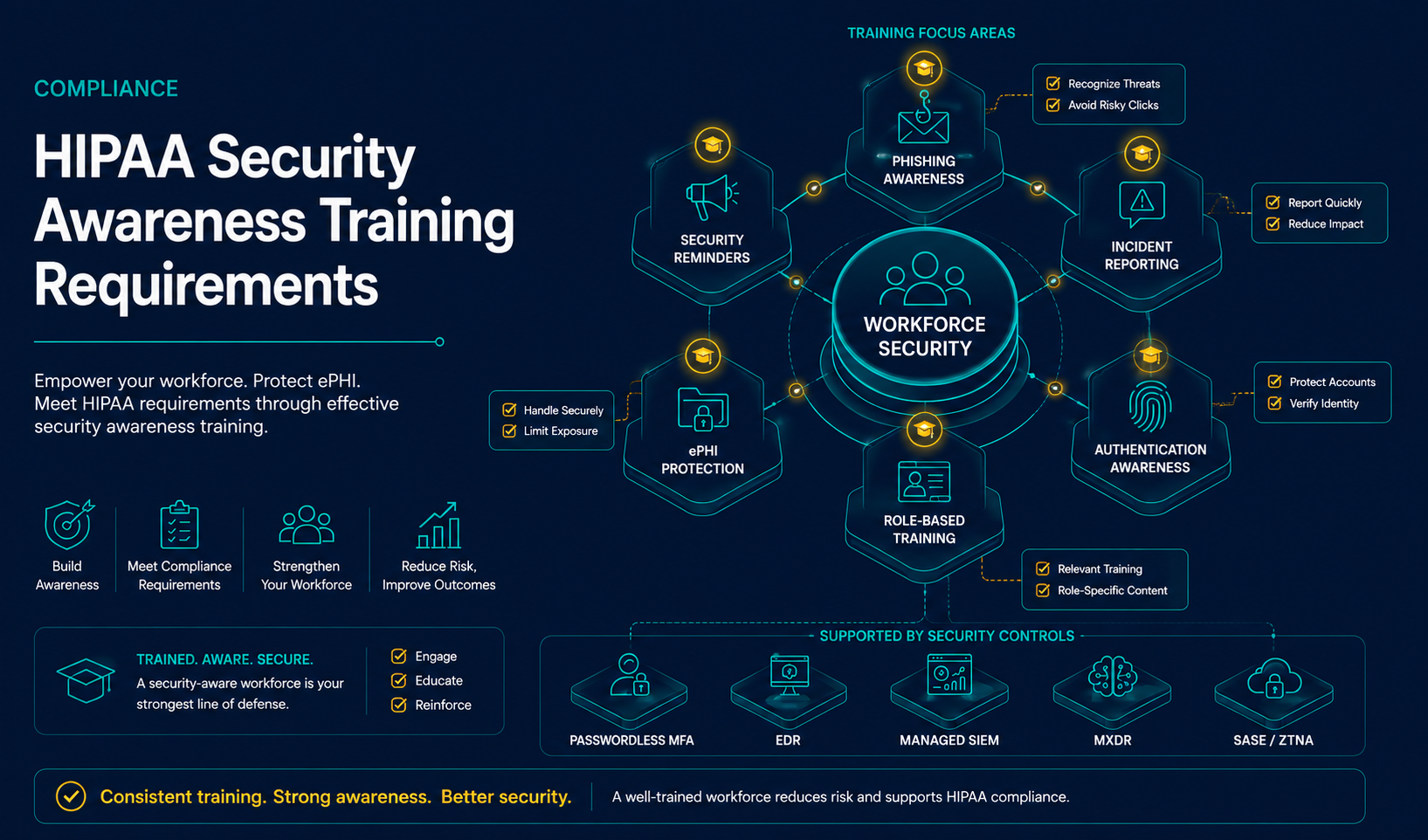
HIPAA Security Awareness and Training requirements are part of the HIPAA Security Rule’s Administrative Safeguards. They require healthcare organizations to implement a security awareness and training program for workforce members, including management.
In practical terms, security awareness training helps workforce members understand how to protect electronic protected health information, commonly referred to as ePHI, recognize common cyber threats, follow approved procedures, and report suspicious activity before a small event becomes a larger incident.
For healthcare leaders, security awareness is not just a compliance checkbox. It is an operational control that supports phishing defense, incident response, access control, ransomware prevention, business associate coordination, and patient trust.
Key Takeaways
- HIPAA security awareness training should be an ongoing workforce security program, not a one-time annual formality.
- Training should address practical healthcare risks such as phishing, credential theft, malware, improper ePHI handling, remote work, mobile devices, and incident reporting.
- Security reminders, malware protection, login monitoring, password management, and policy acknowledgement can all support awareness readiness.
- Healthcare organizations should retain evidence of training completion, reminders, phishing exercises, policy acknowledgements, and corrective actions.
- Training is strongest when paired with technical controls such as passwordless MFA, EDR, managed SIEM, MXDR, SASE, and ZTNA.
Why Security Awareness Matters in Healthcare
Healthcare organizations are highly dependent on people, systems, vendors, and clinical workflows. A single user action can expose patient data, enable account compromise, trigger ransomware, or delay incident reporting. Security awareness training helps reduce that risk by giving workforce members clear, practical guidance.
Healthcare users do not need abstract cybersecurity theory. They need to know how to recognize suspicious emails, report unusual activity, avoid unsafe data handling, protect credentials, use approved systems, handle mobile devices, follow downtime procedures, and escalate potential PHI exposure quickly.
Security awareness helps healthcare organizations answer practical questions:
- Do workforce members know how to report phishing or suspicious activity?
- Do users understand approved methods for handling ePHI?
- Are users trained on password, MFA, and authentication expectations?
- Do users know what to do if a device is lost or stolen?
- Are managers trained on access approval and role-change responsibilities?
- Can the organization produce training evidence during an audit or incident review?
Core Security Awareness Program Elements
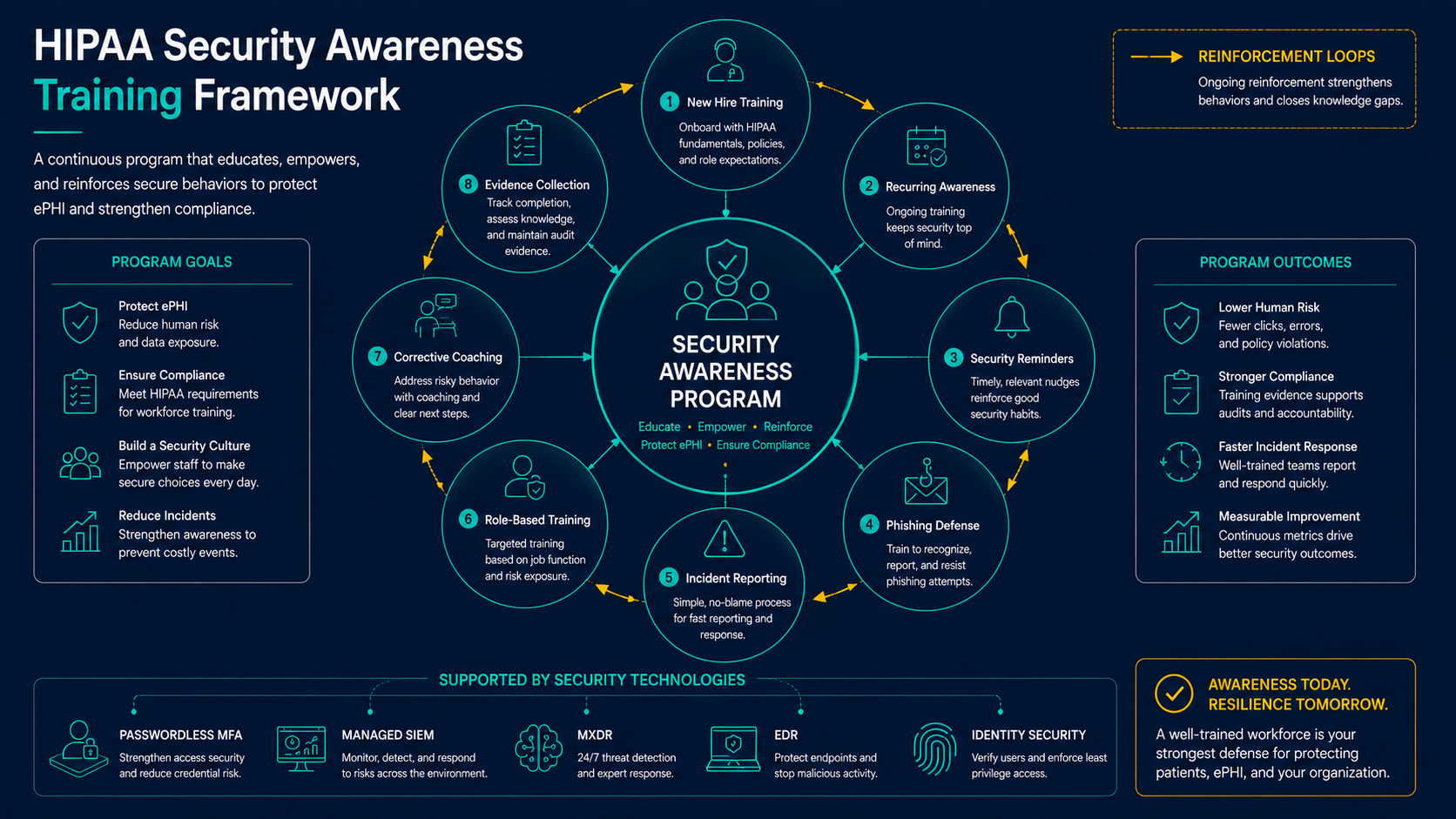
A practical HIPAA security awareness program should be structured, repeatable, role-aware, and evidence-driven. It should train users when they join the organization, reinforce expectations over time, address changing threats, and document participation.
| Training Program Element | Operational Purpose | Example Evidence |
|---|---|---|
| New Workforce Training | Introduces security responsibilities before users access ePHI systems | Training completion records, onboarding checklist, policy acknowledgement |
| Recurring Security Awareness | Reinforces expectations and adapts to changing threats | Annual or periodic training records, reminder emails, attendance reports |
| Phishing and Social Engineering Training | Helps users recognize credential theft, malicious links, impersonation, and fraud | Phishing simulation results, reported phishing metrics, coaching records |
| Incident Reporting Guidance | Ensures suspicious activity and possible PHI exposure are escalated quickly | Reporting instructions, helpdesk tickets, escalation records, user reminders |
| Role-Based Training | Provides targeted guidance for managers, privileged users, remote workers, and clinical staff | Role-specific training modules, completion reports, manager attestations |
| Corrective Training | Addresses repeated mistakes, policy violations, or incident-related gaps | Coaching records, follow-up training, corrective action documentation |
Security Reminders and Ongoing Reinforcement
HIPAA awareness should not be limited to a single annual training event. Security reminders help keep important behaviors visible throughout the year. These reminders can be short, practical, and tied to current risks facing the organization.
Useful reminder topics include phishing, suspicious MFA prompts, secure handling of patient information, reporting lost devices, avoiding unauthorized cloud storage, protecting mobile devices, recognizing social engineering, and using approved communication channels.
- Send short security reminders tied to current threats.
- Reinforce incident reporting procedures during staff meetings or newsletters.
- Use phishing simulation results to focus future reminders.
- Remind users not to approve unexpected MFA prompts.
- Provide clear examples of approved and unapproved ePHI handling.
- Document reminder cadence and communication evidence.
Practical Training Principle
Security awareness works best when users repeatedly see clear, relevant guidance in the context of their daily healthcare workflows. Short, practical reminders often produce better operational value than dense annual training alone.
Phishing, Credential Theft, and Social Engineering
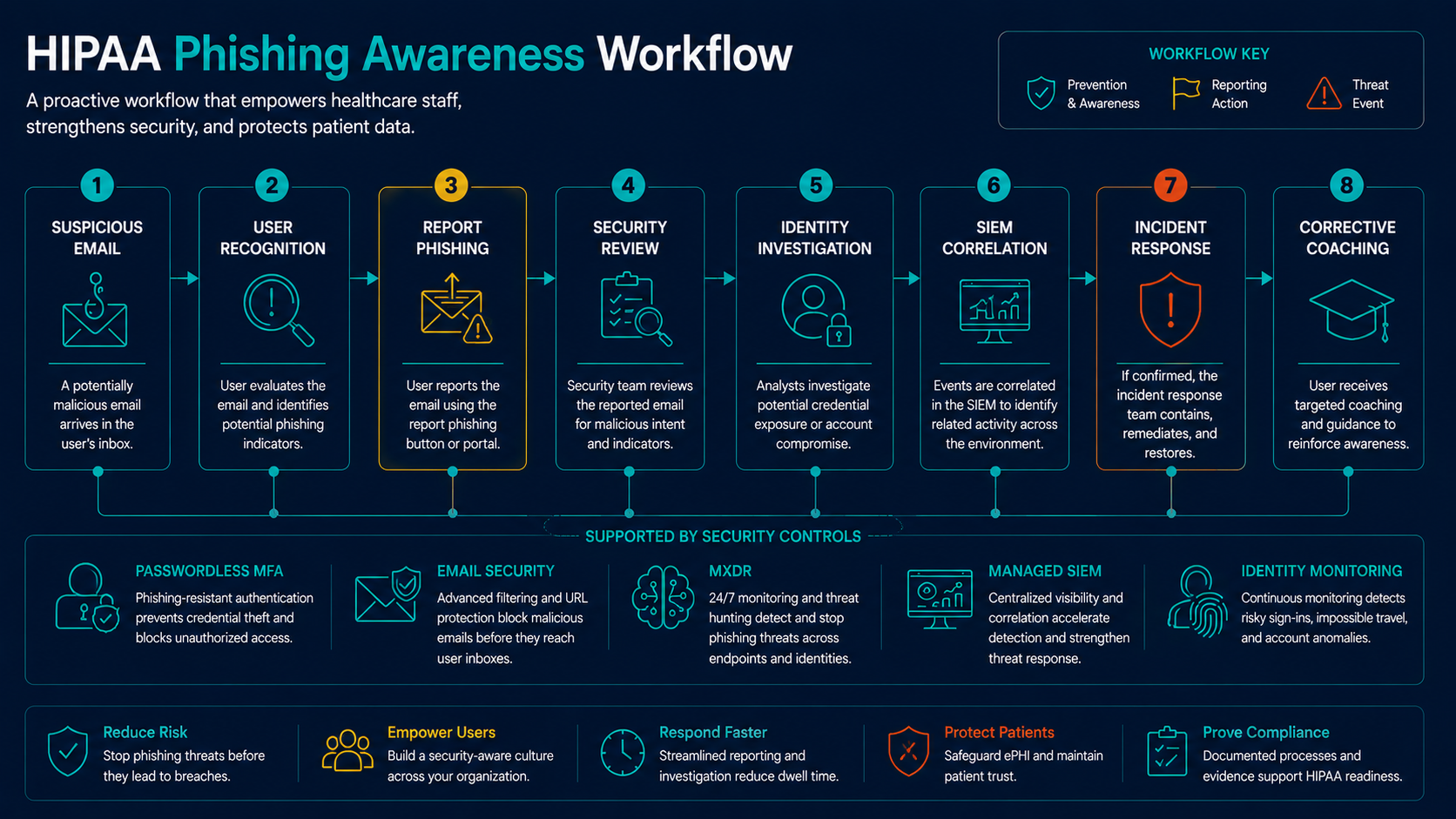
Phishing remains one of the most common ways attackers gain access to healthcare systems. A successful phishing attack can lead to mailbox compromise, stolen credentials, ransomware, payment fraud, unauthorized ePHI access, or business email compromise.
Security awareness should train workforce members to recognize social engineering techniques and report suspicious activity quickly. Training should also explain how technical controls such as MFA, passwordless authentication, email security, managed SIEM, and MXDR support detection and response.
| Threat Scenario | User Training Objective | Supporting Security Control |
|---|---|---|
| Credential Harvesting Email | Teach users to identify fake login pages and report suspicious links | Passwordless MFA, phishing-resistant authentication, email filtering, SIEM monitoring |
| Unexpected MFA Prompt | Train users not to approve unknown prompts and to report them immediately | MFA logging, conditional access, identity monitoring, MXDR escalation |
| Impersonation of Executive or Vendor | Teach users to verify unusual payment, data, or access requests | Email security, business process controls, user reporting, alert review |
| Malicious Attachment | Train users to avoid opening unexpected files and report suspicious messages | EDR, email sandboxing, managed SIEM, incident response process |
| Patient Data Request Fraud | Teach users to validate requests before sending PHI or sensitive records | Policy guidance, approval workflows, secure transmission controls |
Password Management, MFA, and Passwordless Authentication
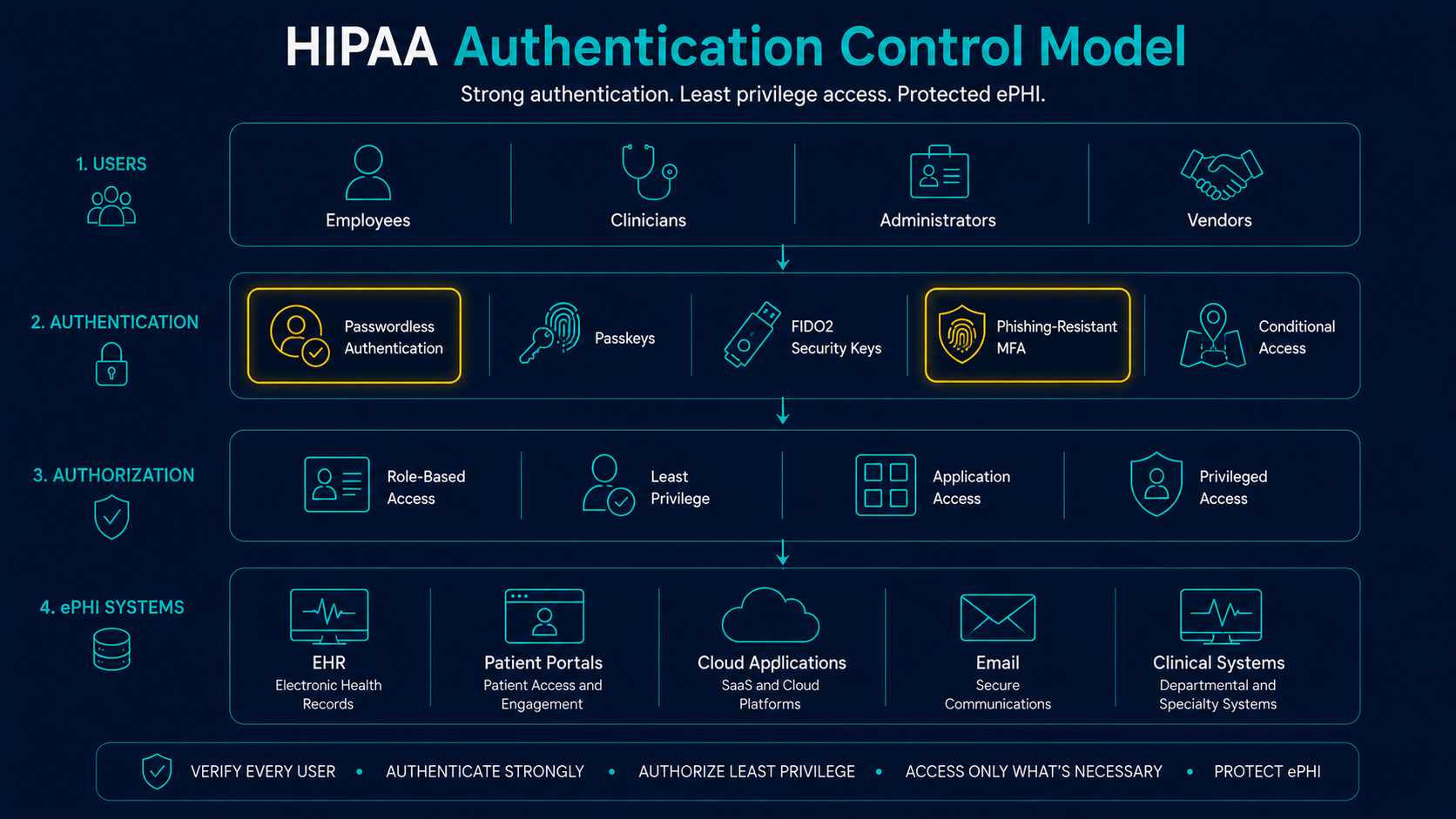
HIPAA security awareness should reinforce how users authenticate to systems containing or supporting ePHI. While technical safeguards enforce authentication controls, workforce members still need to understand password expectations, MFA prompts, approved authentication methods, and how to report suspicious access activity.
Healthcare organizations moving toward passwordless authentication or phishing-resistant MFA should also train users on the new workflow. The goal is to reduce confusion, improve adoption, and prevent users from bypassing stronger security controls.
Malware Protection and Endpoint Behavior
Security awareness should help users understand how malware and ransomware enter healthcare environments. Users should know how to avoid unsafe downloads, report suspicious files, recognize browser warnings, and respond when endpoint protection alerts appear.
Training should align with technical controls. Endpoint detection and response, vulnerability management, patching, managed SIEM, MXDR, and backup resilience all support malware defense, but users remain an important early warning signal.
- Do not install unauthorized software.
- Report suspicious pop-ups, browser warnings, or unexpected application behavior.
- Avoid opening unexpected attachments from unknown or unusual senders.
- Do not disable endpoint protection or security tools.
- Report suspected ransomware activity immediately.
- Follow downtime procedures if systems become unavailable.
Handling ePHI Securely
Security awareness training should address how workforce members handle electronic protected health information in routine workflows. Healthcare users may interact with ePHI through EHR systems, email, file shares, scanned documents, cloud applications, patient portals, billing platforms, mobile devices, and reports.
Training should be specific enough to reduce common mistakes, such as sending PHI to the wrong recipient, storing patient data in unauthorized cloud tools, exporting unnecessary reports, leaving sessions unattended, or using personal devices outside approved procedures.
| ePHI Handling Area | Common Risk | Training Emphasis |
|---|---|---|
| Email and Attachments | Misdirected messages or unsecured transmission of sensitive information | Verify recipients, use approved secure transmission methods, report mistakes quickly |
| Cloud Storage | Patient data stored in unauthorized or unmanaged locations | Use approved platforms, avoid personal storage, follow retention rules |
| Shared Workstations | Unattended sessions or activity under the wrong user account | Lock or log off sessions, avoid shared credentials, maintain user accountability |
| Mobile Devices | Lost or stolen devices exposing patient information | Use approved devices, report loss immediately, follow device security requirements |
| Reports and Exports | Unnecessary copies of patient data increase exposure | Export only when needed, store securely, delete according to approved process |
Incident Reporting and Escalation Training
One of the most important outcomes of security awareness training is faster reporting. Users should understand that reporting suspicious activity is not an admission of failure. It is a critical part of protecting patients, reducing impact, and supporting timely investigation.
Incident reporting training should explain what to report, how to report it, when to escalate, and what not to do. Users should know not to delete suspicious emails, wipe devices, ignore endpoint alerts, or wait until the end of the day to report potential PHI exposure.
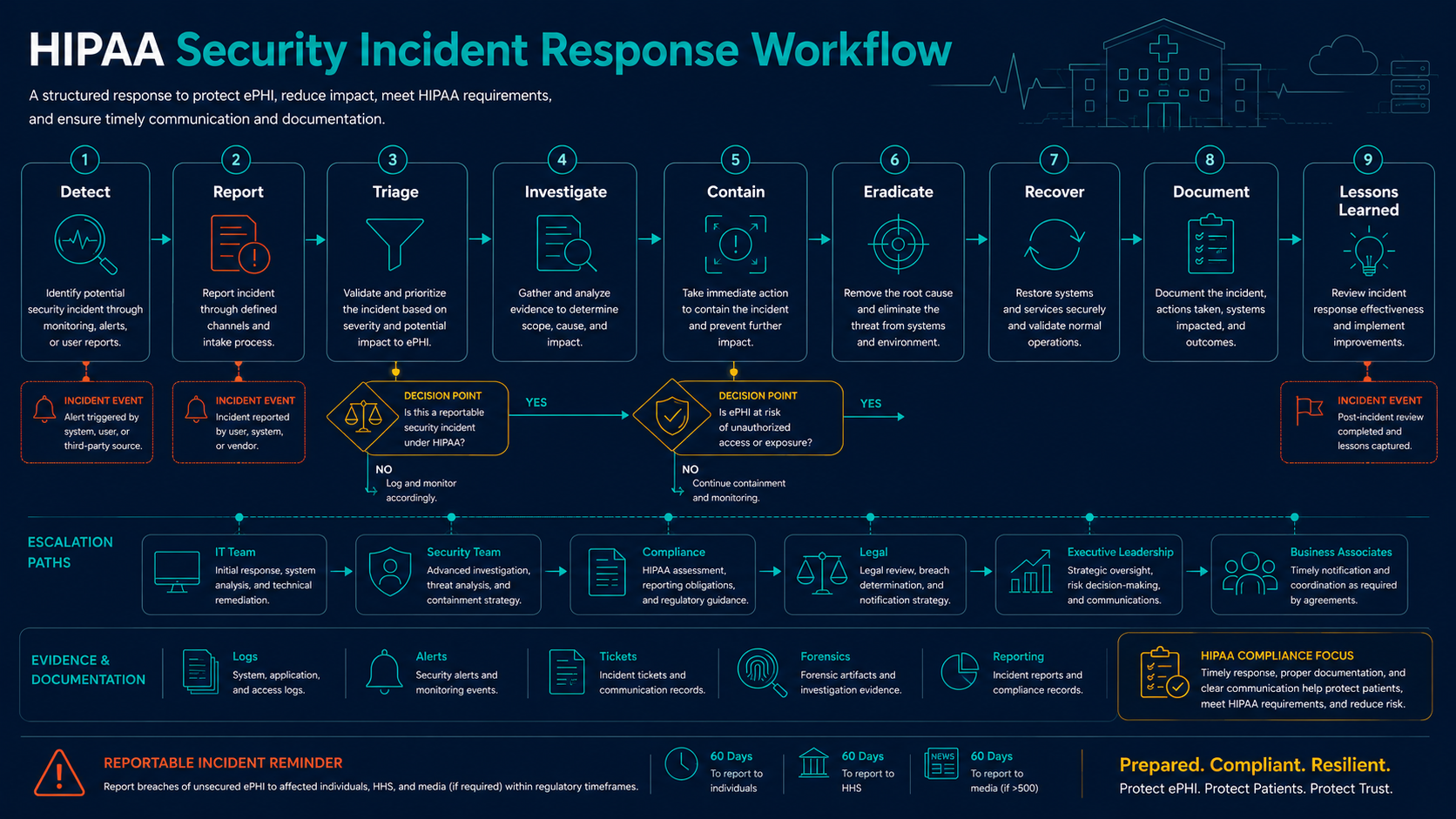
- Report suspicious emails, links, attachments, or login prompts.
- Report lost or stolen devices immediately.
- Report misdirected emails or accidental PHI disclosures quickly.
- Report unusual system behavior, ransomware messages, or endpoint alerts.
- Report suspected unauthorized access to patient information.
- Use approved channels such as helpdesk, security inbox, reporting button, or emergency contact.
Role-Based Training for Higher-Risk Users
Some workforce members need more targeted training because their roles create higher risk. Managers approve access. Helpdesk teams reset credentials. Administrators manage privileged systems. Clinical users interact with patient records. Billing teams handle sensitive financial and patient information. Vendors may support critical platforms.
Role-based training helps make security awareness more relevant and more effective.
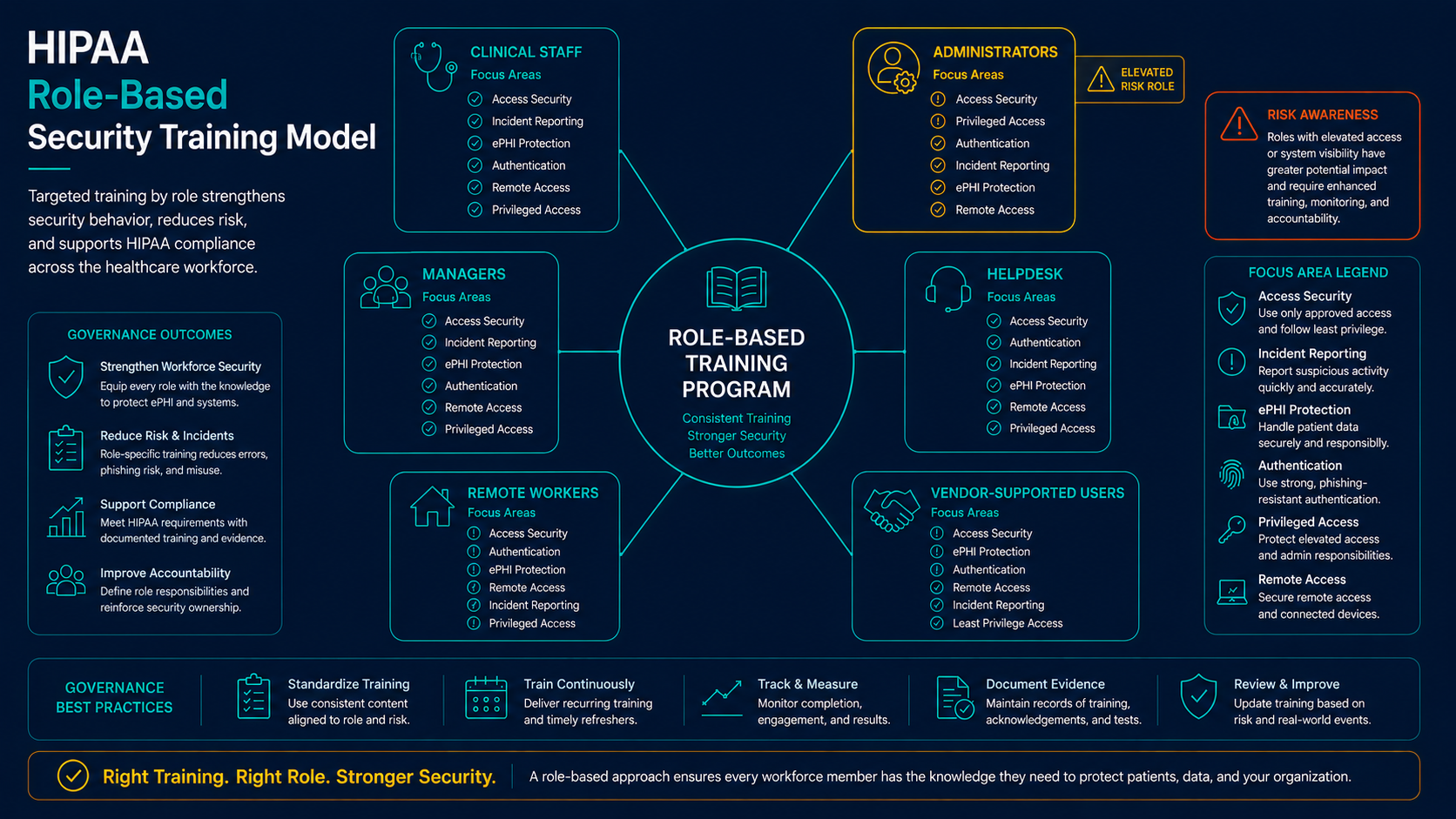
| Role or Group | Training Focus | Why It Matters |
|---|---|---|
| Clinical Staff | Secure patient record access, shared workstation use, downtime procedures, suspicious activity reporting | Clinical workflows often involve frequent access to ePHI and time-sensitive systems |
| Managers | Access approval, role changes, termination notifications, policy enforcement | Managers influence workforce access and timely removal of unnecessary permissions |
| Helpdesk | Identity verification, password reset controls, MFA issues, social engineering resistance | Helpdesk workflows are frequent targets for account takeover attempts |
| Administrators | Privileged access, change control, logging, backup access, incident escalation | Privileged users can affect many systems and large volumes of ePHI |
| Remote Workers | SASE, ZTNA, approved devices, secure networks, reporting lost devices or suspicious access | Remote access creates additional authentication, device, and network exposure |
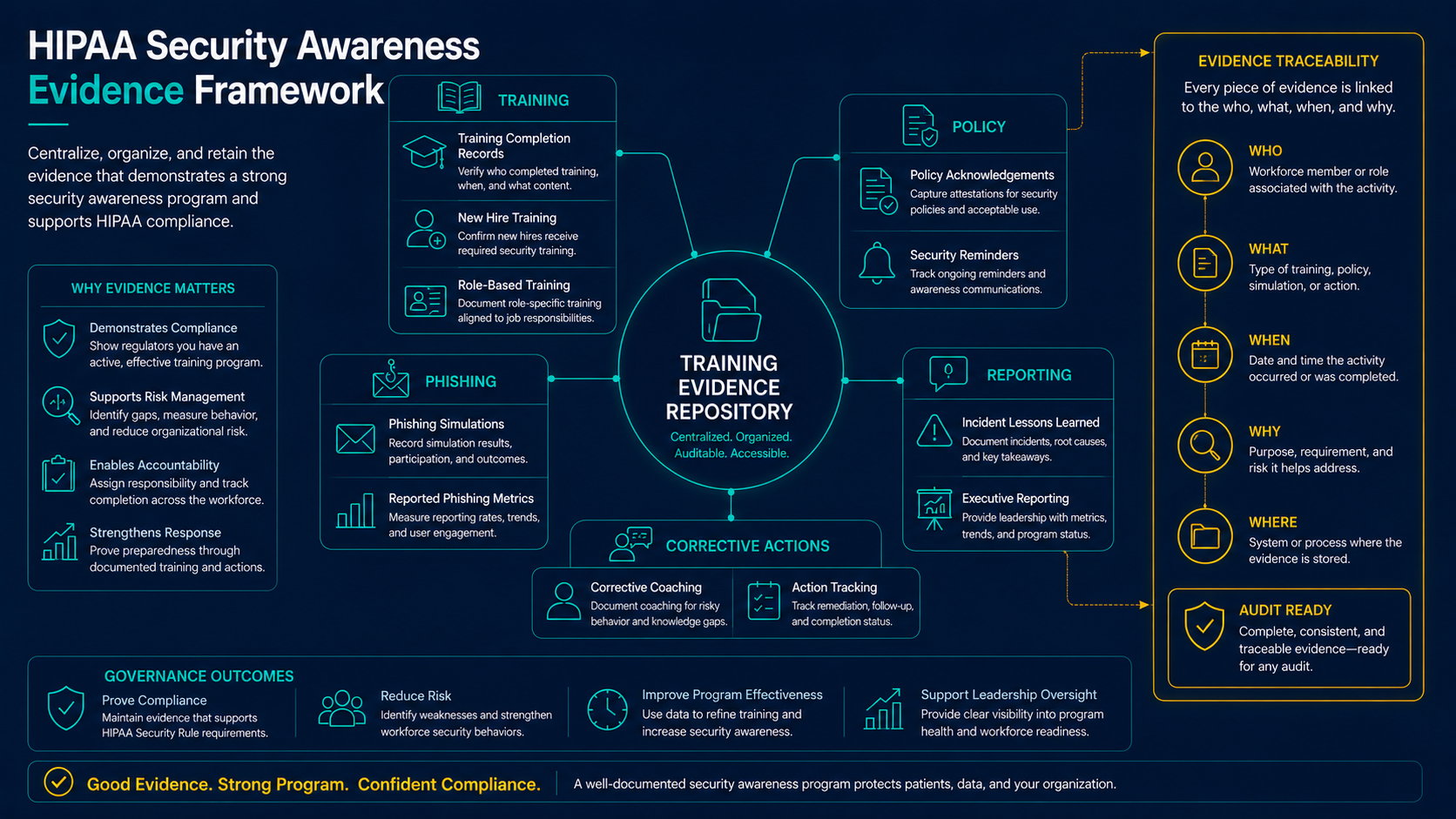
Evidence and Documentation
Security awareness training should produce evidence. If a healthcare organization cannot show who was trained, when training occurred, what topics were covered, and how exceptions were handled, it may struggle to demonstrate that the program is operating.
Training evidence may include:
- Training completion records
- Policy acknowledgement records
- New hire onboarding records
- Security reminder communications
- Phishing simulation results
- Reported phishing metrics
- Role-based training records
- Corrective training documentation
- Incident-related coaching records
- Training content version history
- Executive reporting on completion and risk trends
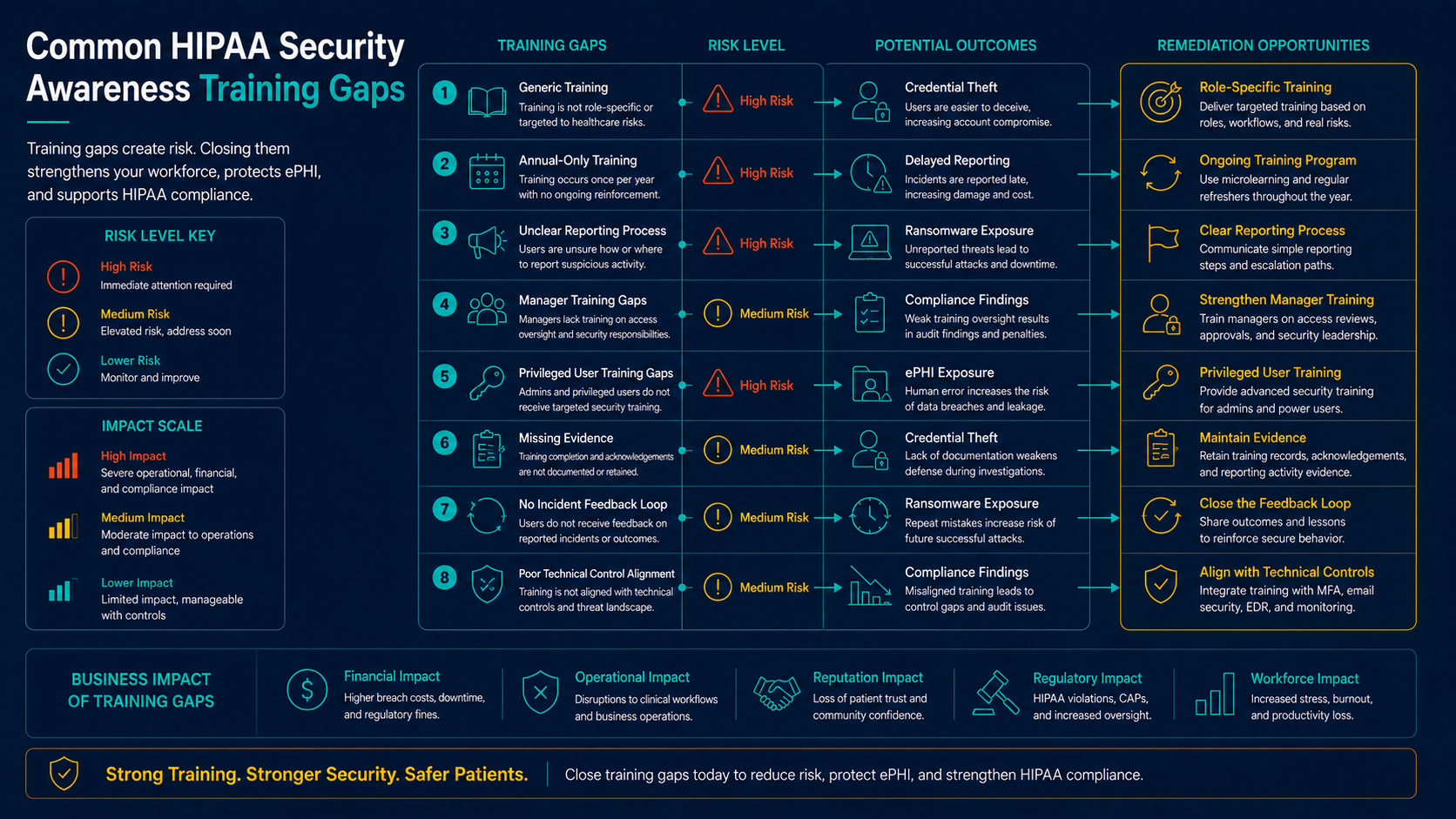
Common HIPAA Security Awareness Training Gaps
Many healthcare organizations provide training but still have awareness gaps because the program is generic, inconsistent, poorly documented, or disconnected from real threats.
- Training is too generic: Users do not receive healthcare-specific examples involving ePHI, EHR access, downtime, phishing, or incident reporting.
- Training is only annual: Users are not reminded throughout the year as threats and workflows change.
- Phishing reporting is unclear: Users do not know how or when to report suspicious emails or MFA prompts.
- Managers are not trained on access responsibilities: Role changes and terminations do not trigger timely access updates.
- Privileged users lack targeted training: Administrators are not trained on elevated risk, logging, backup access, or change control.
- Training evidence is incomplete: Completion records, reminders, acknowledgements, or corrective actions are missing.
- Lessons from incidents are not incorporated: Training content does not change after real events, near misses, or audit findings.
- Training is disconnected from technical controls: Users are not taught how MFA, passwordless authentication, EDR, SIEM, or reporting tools affect their workflow.
How Managed Security Services Support Awareness Programs
Security awareness is a workforce governance requirement, but managed security services can make awareness programs more effective by improving phishing detection, identity protection, endpoint visibility, monitoring, and incident response feedback.
| Awareness Program Need | Supporting DBT Capability | Compliance-Ready Output |
|---|---|---|
| Phishing Defense | Email security, phishing reporting workflows, identity monitoring, incident response support | Reported phishing metrics, triage records, phishing incident timelines |
| Authentication Awareness | MFA, passwordless authentication, phishing-resistant authentication, access policy support | MFA coverage reports, authentication records, user adoption evidence |
| Incident Reporting | Managed SIEM, MXDR, alert triage, helpdesk escalation, response support | Alert records, escalation tickets, investigation timelines, corrective actions |
| Endpoint Security | EDR, patch visibility, malware detection, ransomware response support | Endpoint alerts, containment records, remediation tickets, user coaching inputs |
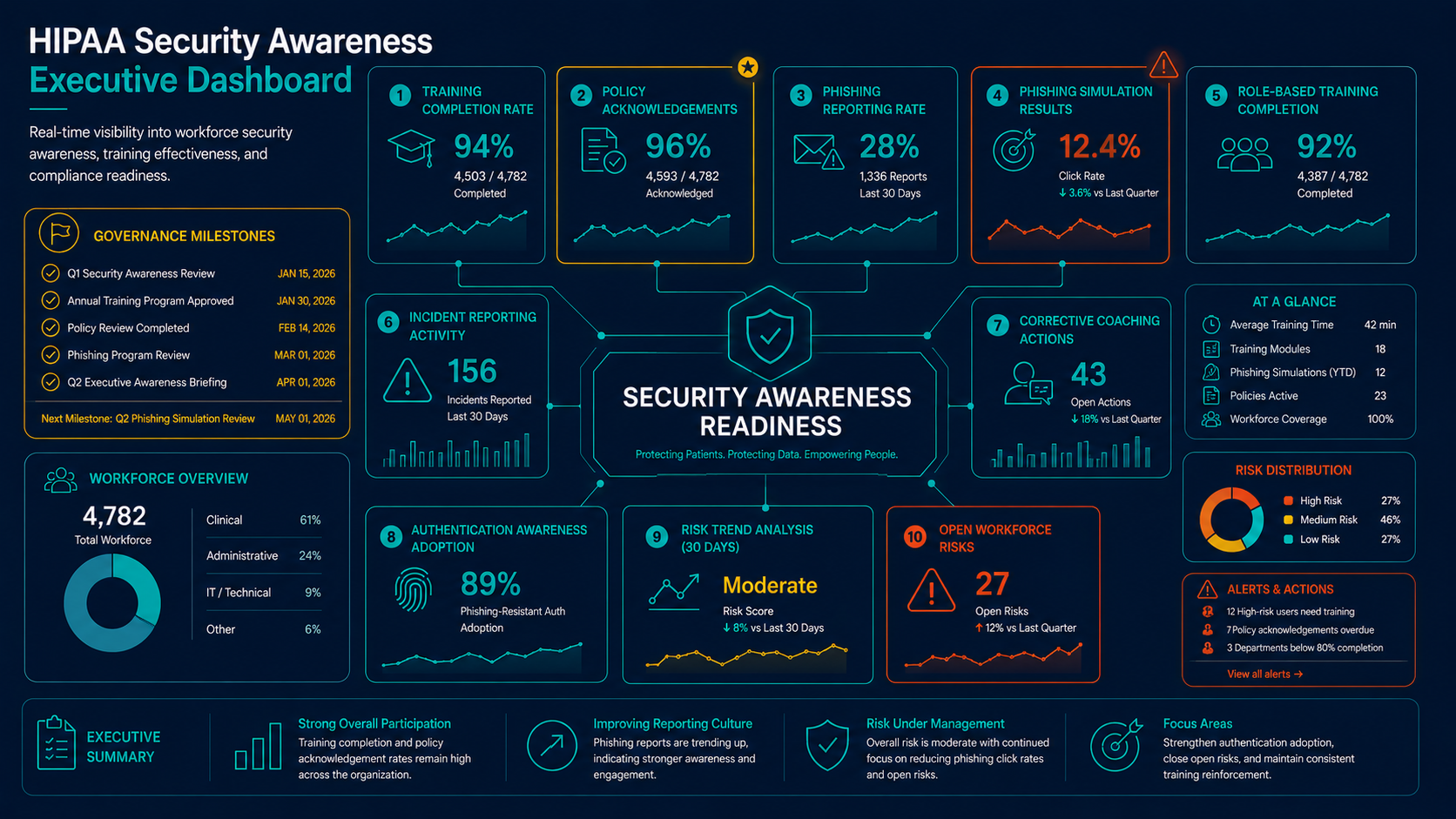
| Executive Reporting | Risk reporting, training evidence support, incident trend reporting, remediation tracking | Executive dashboards, open risk reports, awareness trend summaries |
Executive and Board-Level Considerations
Security awareness should be visible to leadership because workforce behavior affects breach risk, ransomware resilience, incident reporting speed, patient trust, compliance evidence, and cyber insurance expectations. Executives do not need to manage every training module, but they should know whether the awareness program is operating and improving.
Useful leadership questions include:
- Do workforce members receive training before accessing systems containing ePHI?
- How often are security reminders sent?
- Can users identify and report phishing, suspicious MFA prompts, and potential PHI exposure?
- Are managers trained on access approval, role change, and termination responsibilities?
- Do privileged users receive targeted security training?
- Are phishing simulation results improving over time?
- Can we produce training completion and policy acknowledgement evidence?
- Are incident lessons and audit findings incorporated into training?
- How are repeat issues handled through coaching or corrective action?
- What awareness metrics are reported to leadership?
How DBT Helps Healthcare Organizations
DBT helps healthcare organizations strengthen the technical and operational controls that support effective security awareness. We help connect workforce training expectations to identity security, phishing defense, monitoring, incident response, endpoint protection, and executive reporting.
DBT can support security awareness readiness through:
- Phishing defense and reporting workflow support
- MFA and passwordless authentication implementation
- Identity security and suspicious login monitoring
- Managed SIEM and security monitoring
- MXDR and incident response support
- Endpoint detection and response
- SASE and ZTNA access control improvements
- Incident reporting workflow review
- Security evidence collection and executive reporting
- Corrective action tracking after incidents or repeated issues
DBT does not replace legal counsel or the healthcare organization’s internal compliance ownership. We help build, operate, monitor, and document cybersecurity capabilities that support HIPAA security awareness readiness.
Related DBT Resources
For the governance foundation behind workforce security, review HIPAA Administrative Safeguards Explained. For identity and authentication controls, review HIPAA Access Control Requirements Explained. For response procedures, review HIPAA Incident Response Requirements Explained.
Healthcare organizations evaluating authentication modernization should also review Phishing-Resistant MFA Explained, Passwordless Authentication Compliance Considerations, and DBT’s Identity & Access Security services. For operational support, review Cybersecurity Operations, Compliance & Risk Management, and Healthcare Cybersecurity Services.
Final Thoughts
HIPAA security awareness training requirements are about more than checking a box. They help healthcare organizations prepare workforce members to recognize threats, protect patient information, use approved systems, report suspicious activity, and support compliance readiness.
The strongest healthcare organizations connect awareness training to identity security, phishing defense, incident response, access control, endpoint protection, and executive reporting.
When security awareness is implemented well, healthcare leaders gain faster reporting, better workforce accountability, stronger evidence, reduced phishing exposure, and a more defensible approach to protecting ePHI.