
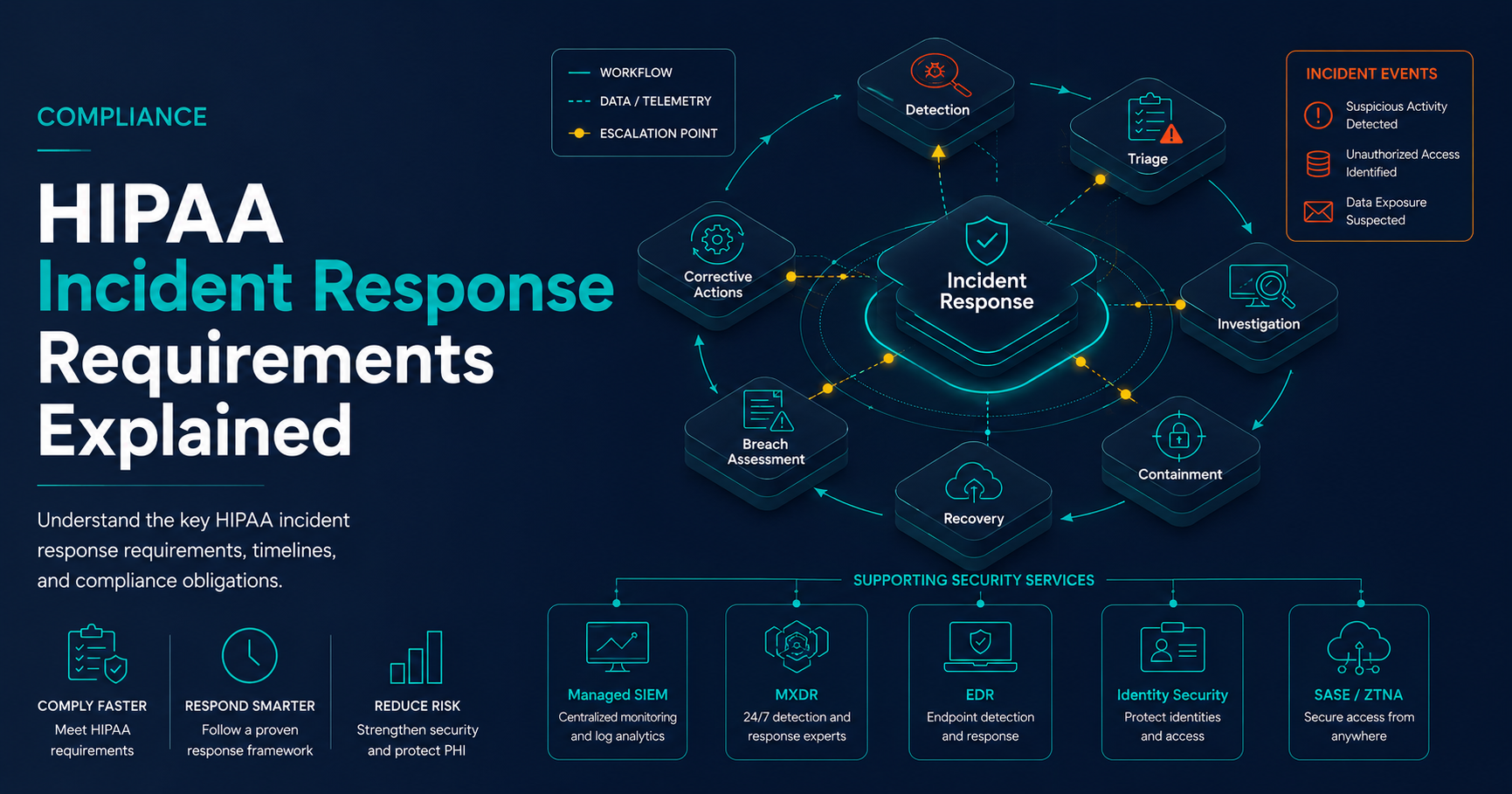
What Are HIPAA Incident Response Requirements?
HIPAA incident response requirements are primarily addressed through the HIPAA Security Rule’s Administrative Safeguards, especially the Security Incident Procedures standard. In practical terms, healthcare organizations need a defined process to identify, respond to, document, and mitigate security incidents involving electronic protected health information, commonly referred to as ePHI.
Incident response is not only a technical function. It is a coordinated healthcare governance process involving IT, security, compliance, privacy, legal counsel, operations, executive leadership, and in some cases business associates, cyber insurance providers, outside forensic firms, and regulators.
A strong incident response program helps healthcare organizations detect suspicious activity quickly, preserve evidence, contain the threat, determine whether PHI may be involved, support breach notification analysis, and track corrective actions after the event.
Key Takeaways
- HIPAA expects healthcare organizations to have procedures for identifying, responding to, documenting, and mitigating security incidents.
- Incident response readiness depends on logging, monitoring, access control, endpoint visibility, escalation procedures, and evidence preservation.
- Security incidents and reportable breaches are related, but they are not the same thing.
- Business associates and vendors should be included in incident response planning when they support ePHI systems or critical operations.
- Executive leadership should receive incident response readiness reporting before an incident occurs.
Security Incident vs. Breach
A security incident is not automatically a reportable breach. A security incident may involve suspicious access, malware activity, a phishing attempt, a lost device, failed login activity, exposed credentials, misdirected communications, or an alert from a security tool. A breach analysis is a separate process that evaluates whether protected health information was compromised in a way that triggers notification obligations.
Healthcare organizations should prepare for both tracks. The incident response process should quickly determine what happened, what systems were involved, whether PHI or ePHI may be affected, what evidence exists, whether legal or privacy review is required, and whether breach notification analysis should begin.
| Response Concept | Primary Question | Practical Output |
|---|---|---|
| Security Incident | Did suspicious, unauthorized, malicious, or policy-violating activity occur? | Incident ticket, triage notes, containment action, evidence timeline, corrective action plan |
| Breach Assessment | Was unsecured PHI acquired, accessed, used, or disclosed in a way that compromises privacy or security? | Legal and compliance review, PHI scope analysis, affected individual analysis, notification decision |
| Corrective Action | What needs to change so the incident is less likely or less impactful in the future? | Assigned remediation tasks, control improvements, policy updates, training, executive reporting |
The HIPAA Incident Response Lifecycle
A practical healthcare incident response program should define the full lifecycle of response. The goal is to avoid improvising under pressure. Healthcare organizations should know how incidents are reported, who receives alerts, how triage occurs, how containment is approved, how evidence is preserved, and how leadership decisions are documented.
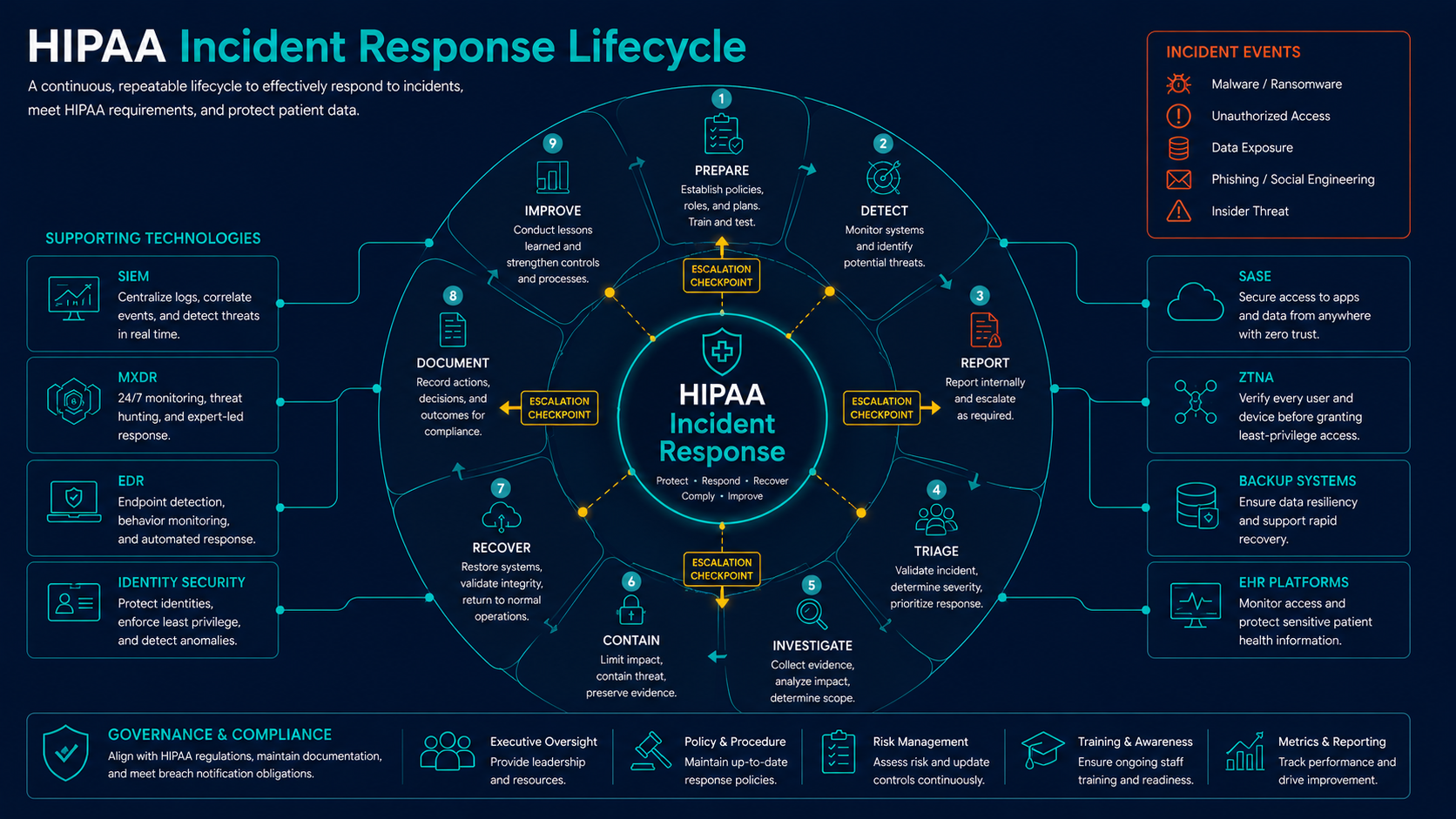
- Prepare: Define roles, procedures, escalation paths, evidence sources, and communication expectations before an incident occurs.
- Detect: Identify suspicious activity through users, monitoring tools, SIEM alerts, EDR alerts, vendor notifications, and system logs.
- Report: Provide workforce members and vendors with clear reporting paths for suspected incidents.
- Triage: Determine severity, affected systems, possible PHI involvement, and immediate response needs.
- Investigate: Preserve and analyze logs, endpoint data, account activity, email activity, cloud events, and vendor information.
- Contain: Stop unauthorized activity, isolate systems, disable accounts, block access, or restrict affected workflows.
- Recover: Restore systems, validate integrity, confirm access controls, and return operations safely.
- Document: Record the timeline, decisions, evidence, notifications, actions, and lessons learned.
- Improve: Track corrective actions, update procedures, and report material improvements to leadership.
Required Operational Elements
A HIPAA-aligned incident response program should include more than a policy. It should produce repeatable operational evidence that shows how incidents are managed from detection through resolution.
| Incident Response Element | Operational Purpose | Evidence to Maintain |
|---|---|---|
| Incident Response Plan | Defines roles, responsibilities, escalation paths, and response procedures | Approved plan, role assignments, contact list, review history |
| Reporting Procedure | Ensures users and vendors know how to report suspicious activity quickly | Workforce reporting instructions, helpdesk process, vendor notification contacts |
| Incident Triage Process | Classifies severity, potential PHI involvement, affected systems, and response urgency | Triage checklist, severity ratings, ticket notes, escalation records |
| Evidence Preservation | Maintains logs, endpoint evidence, email records, cloud activity, and timelines | SIEM exports, EDR records, authentication logs, chain-of-custody notes where applicable |
| Breach Escalation Path | Connects security incidents to privacy, compliance, legal, and executive review when PHI may be involved | Escalation notes, legal review records, breach assessment documentation |
| Corrective Action Tracking | Ensures lessons learned result in practical risk reduction | Remediation tickets, owners, due dates, closure evidence, executive reports |
Incident Detection and Reporting
Incident response begins with detection and reporting. In healthcare, suspicious activity may be identified by a workforce member, a helpdesk ticket, a managed SIEM alert, an EDR detection, a phishing report, a vendor notification, or a patient complaint. The organization should make it easy for users to report unusual activity and should ensure security alerts are reviewed consistently.
Common healthcare incident indicators include:
- Unexpected MFA prompts or failed login spikes
- Suspicious mailbox rules or email forwarding
- Unusual EHR access patterns
- Endpoint malware or ransomware alerts
- Remote access from unusual locations
- Vendor account activity outside expected windows
- Large file downloads or suspicious cloud activity
- Unexpected changes to backups, security tools, or identity systems
- Reports of misdirected patient information
- Lost or stolen laptops, mobile devices, or removable media
Response Principle
A healthcare organization cannot respond to incidents it does not detect or that users do not know how to report. Incident response readiness depends on both technical monitoring and workforce reporting behavior.
Triage and Severity Classification
Not every security event requires the same response. Triage helps the organization determine whether the event is informational, suspicious, urgent, or potentially reportable. A severity model should consider operational impact, PHI involvement, threat activity, affected systems, containment needs, and business continuity risk.
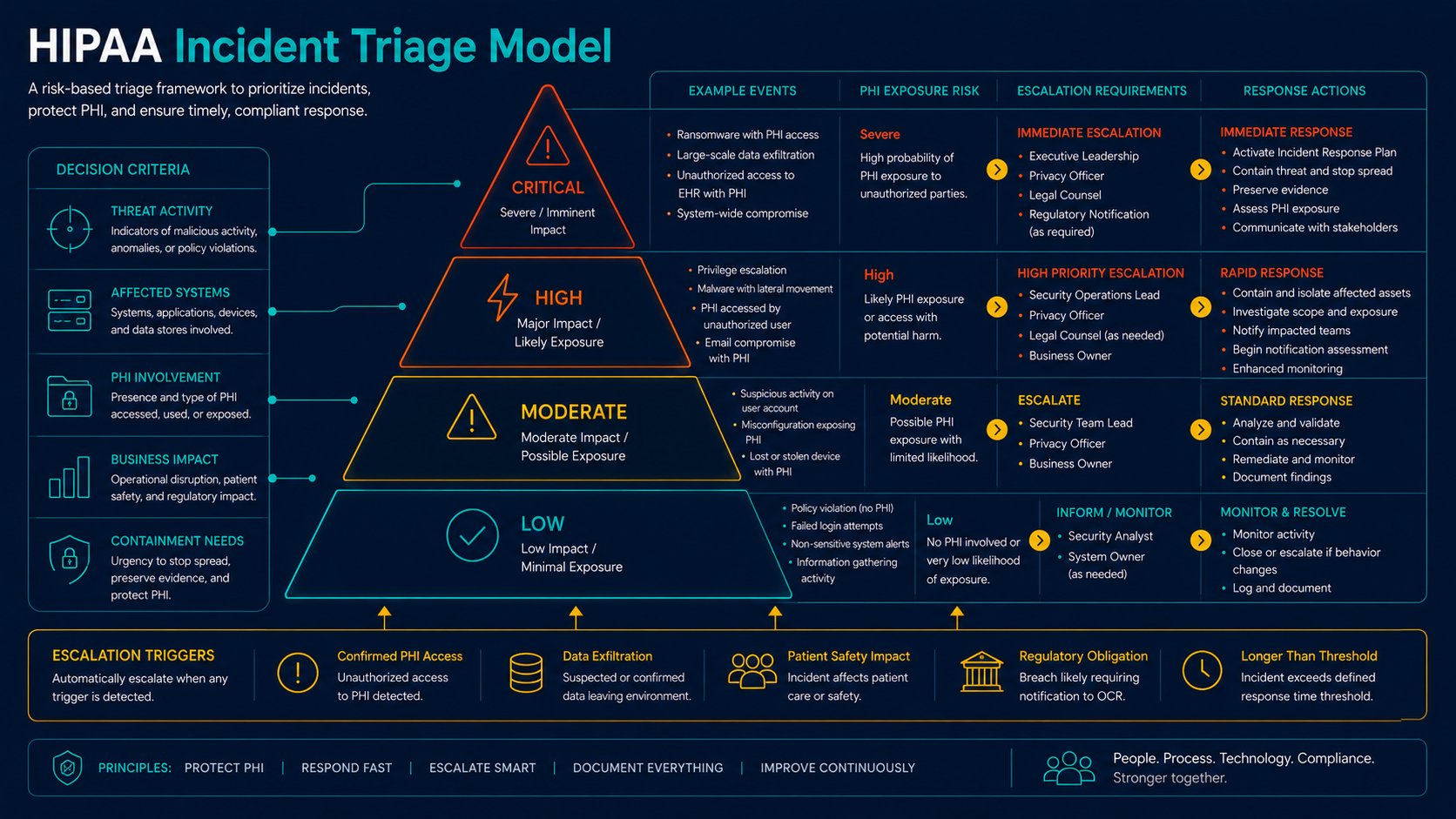
| Severity Level | Example Scenario | Typical Response |
|---|---|---|
| Low | Blocked phishing email, failed login noise, policy reminder issue | Document, monitor, educate user, close with limited action |
| Moderate | Suspicious login attempt, malware blocked on endpoint, possible misdirected email | Investigate, preserve evidence, validate scope, document actions |
| High | Compromised account, endpoint compromise, unauthorized access to system containing ePHI | Escalate, contain, notify leadership, involve compliance and privacy, assess PHI exposure |
| Critical | Ransomware, widespread compromise, suspected data exfiltration, major vendor breach | Activate incident response team, legal review, executive coordination, external support, breach assessment |
Investigation and Evidence Collection
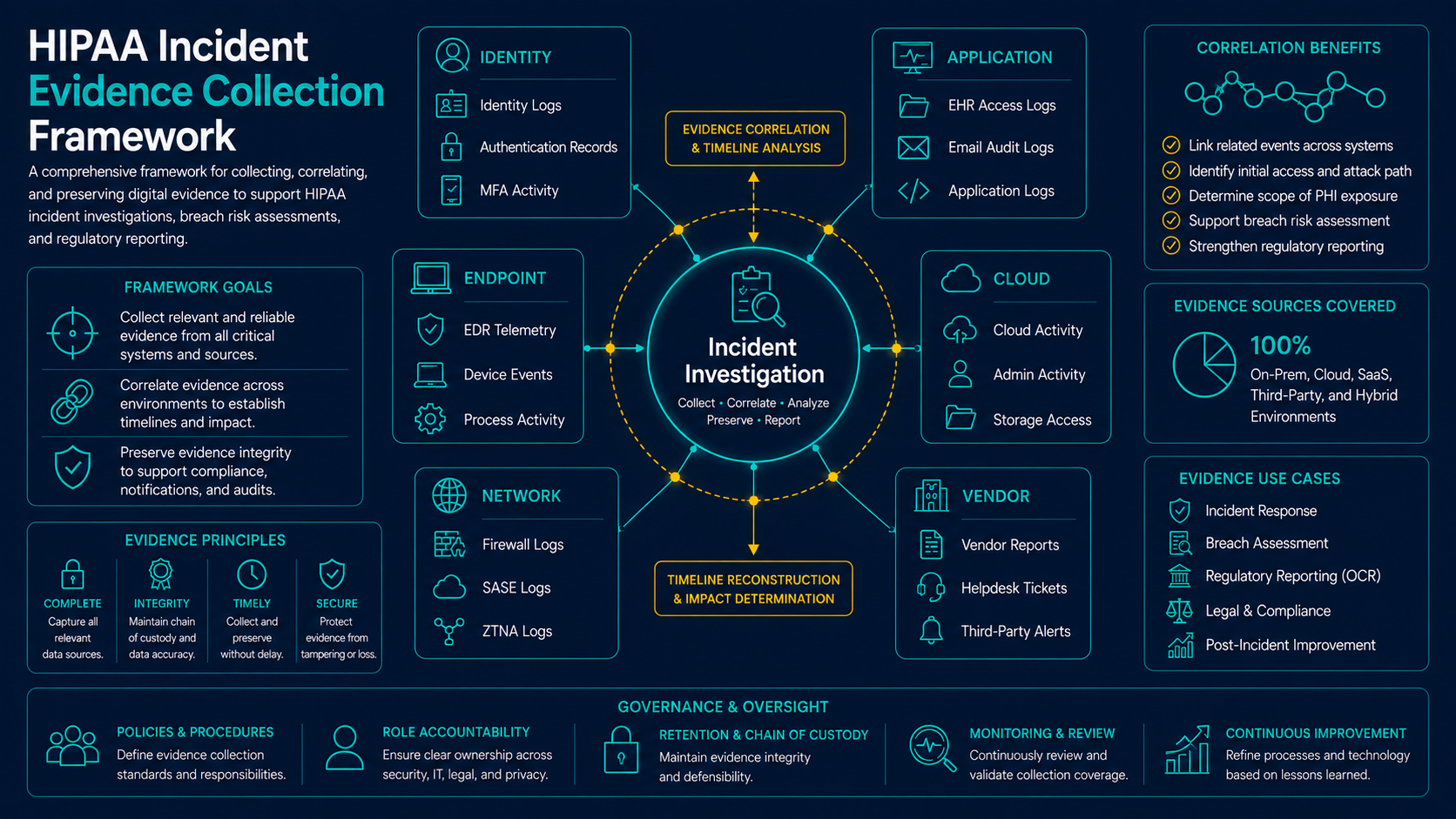
Incident response decisions depend on evidence. Healthcare organizations should know which systems generate logs, how long logs are retained, who can access them, and how evidence is preserved during an investigation. Without evidence, the organization may struggle to determine whether PHI was accessed, whether an account was misused, or whether systems were affected.
Useful incident response evidence may include:
- Identity provider and authentication logs
- MFA and passwordless authentication activity
- EHR access logs
- Email audit logs and mailbox activity
- Endpoint detection and response telemetry
- SIEM alerts and correlated timelines
- Firewall, VPN, SASE, and ZTNA logs
- Cloud application activity
- Backup and recovery records
- Vulnerability and patch records
- Helpdesk tickets and user reports
- Business associate incident reports
- Legal, privacy, and compliance decision records
Containment and Recovery
Containment limits the impact of an incident. Recovery restores systems and workflows safely. In healthcare, containment and recovery decisions need to consider patient care, system availability, clinical workflows, revenue cycle operations, and evidence preservation.
Potential containment and recovery actions include:
- Disable or reset compromised accounts
- Revoke sessions and tokens
- Block malicious IP addresses, domains, or access paths
- Isolate affected endpoints or servers
- Remove malicious mailbox rules or forwarding
- Restrict vendor access temporarily
- Apply emergency patches or configuration changes
- Restore from validated backups when needed
- Re-enable access only after validation
- Monitor for recurrence after recovery
Operational Caution
Containment actions should be coordinated. Disabling accounts, wiping systems, deleting emails, or changing logs without preserving evidence may make investigation and breach analysis harder. Healthcare organizations should balance rapid containment with defensible evidence handling.
Business Associate and Vendor Incident Coordination
Healthcare incident response often involves vendors and business associates. EHR providers, billing platforms, cloud services, MSPs, MSSPs, backup providers, remote access vendors, consultants, and application providers may support systems that contain or access PHI.
An incident response program should define how the organization works with vendors before an incident occurs. The organization should know who to contact, what evidence the vendor can provide, how quickly the vendor must notify the covered entity, and who owns containment and corrective actions.
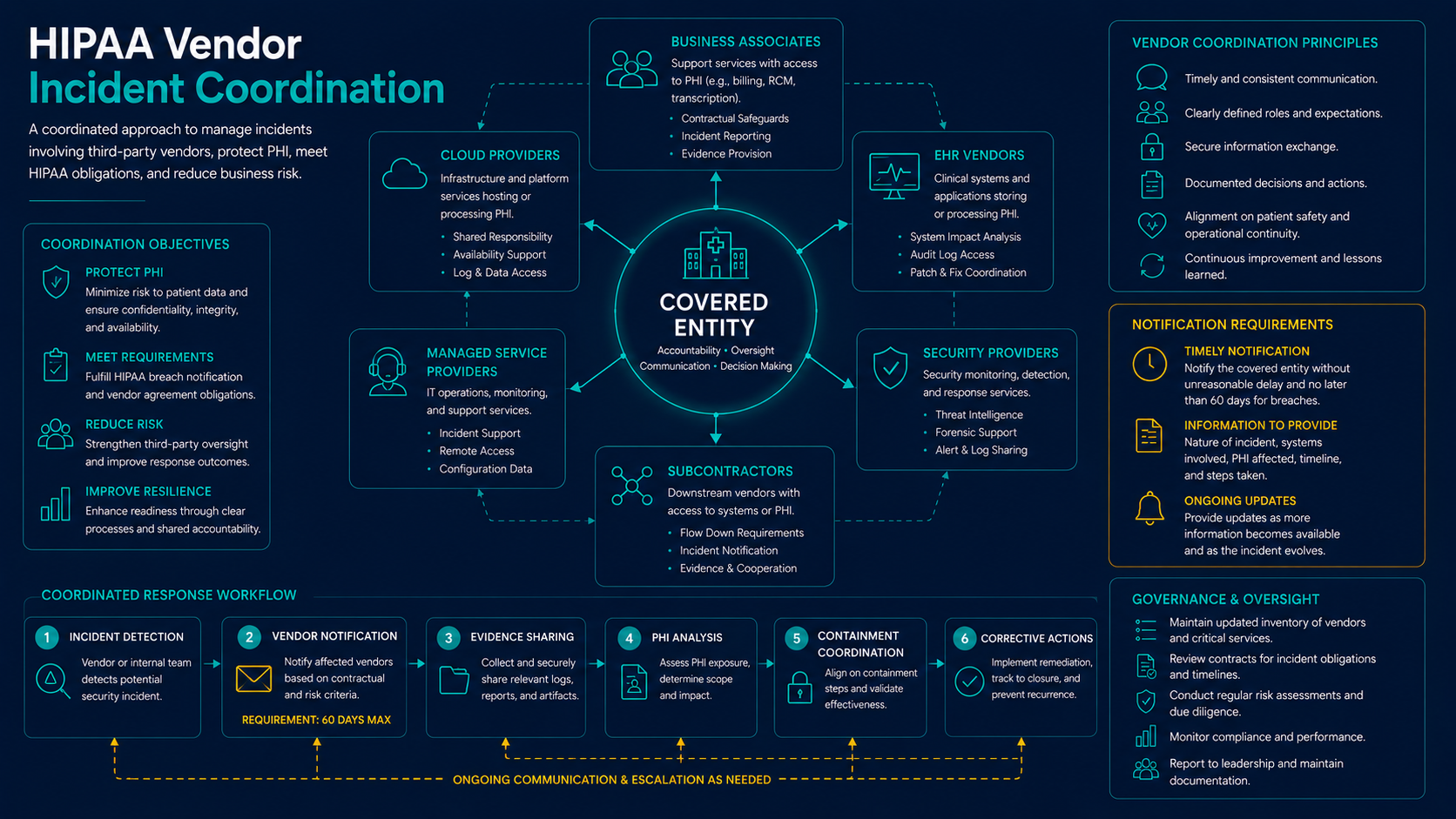
- Maintain current vendor and business associate contacts.
- Define security incident notification expectations in contracts and BAAs.
- Clarify who owns access control, logging, monitoring, backups, and incident escalation.
- Confirm which logs or reports vendors can provide during an incident.
- Understand subcontractor dependencies and escalation paths.
- Document vendor response actions and corrective commitments.
How Managed Security Services Support Incident Response
Managed security services can improve incident response readiness by increasing visibility, accelerating detection, providing triage support, preserving evidence, and helping leadership understand what happened. These services do not replace legal counsel or internal compliance ownership, but they can materially improve the organization’s ability to respond quickly and document facts.
| Managed Security Capability | Incident Response Value | Evidence Produced |
|---|---|---|
| Managed SIEM | Centralizes logs from identity, endpoint, cloud, email, network, and healthcare systems | Alert timelines, log source inventory, correlation reports, investigation notes |
| MXDR | Provides threat detection, triage, escalation, containment coordination, and response support | Triage records, escalation notes, containment actions, event summaries |
| EDR | Improves endpoint visibility and supports malware, ransomware, and suspicious process investigation | Endpoint alerts, process history, isolation records, affected asset inventory |
| SASE and ZTNA | Controls and monitors remote access to applications and ePHI systems | Access decisions, remote session logs, policy records, user activity reports |
| Identity Security | Helps determine whether accounts were compromised and whether authentication controls were enforced | Authentication logs, MFA evidence, access review records, privileged activity reports |
| Vulnerability Management | Identifies exploitable weaknesses and supports corrective action after incidents | Scan results, remediation tickets, exposure records, closure evidence |
Incident Response Tabletop Exercises
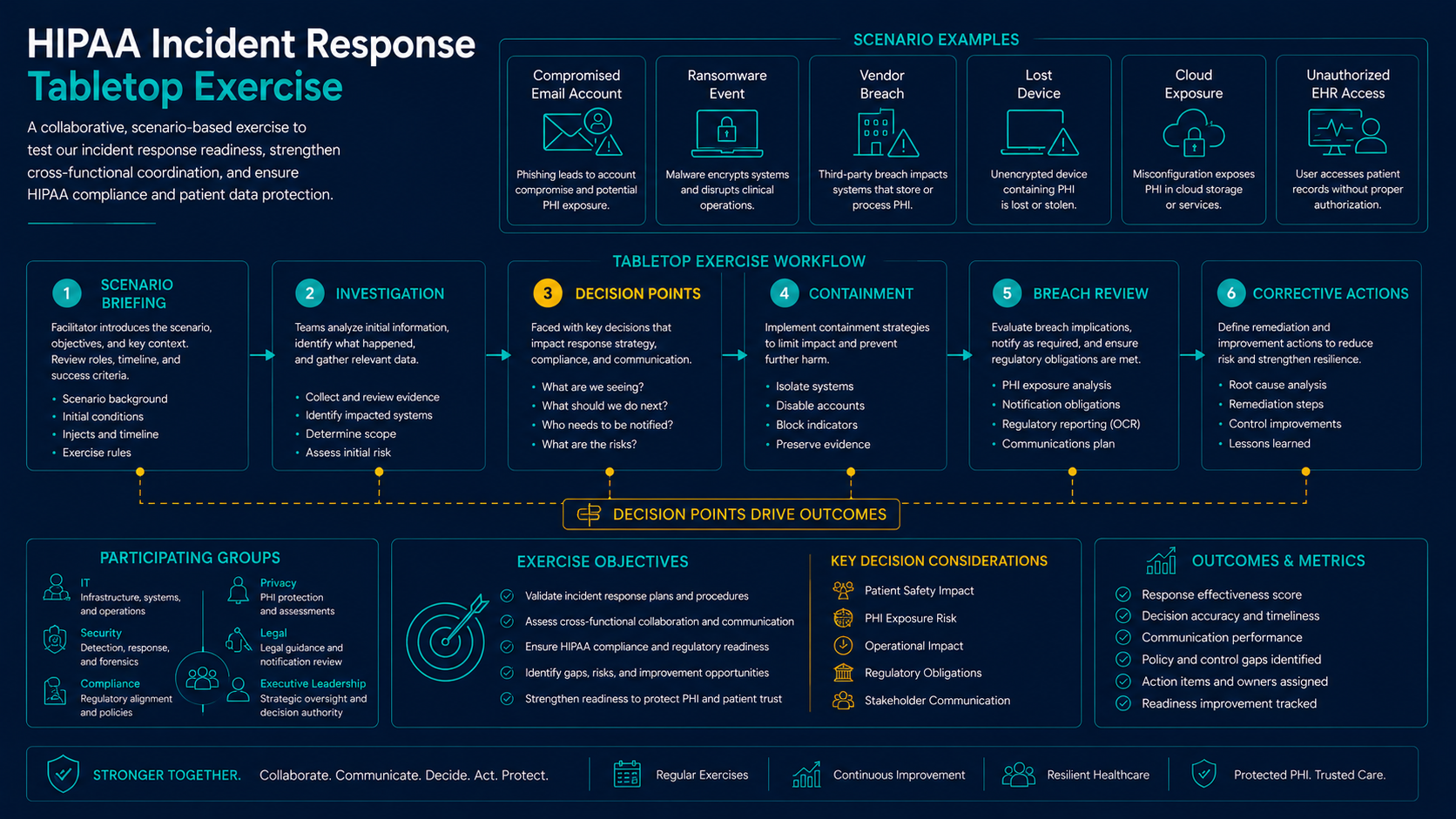
Incident response plans should be tested before they are needed. A tabletop exercise gives healthcare leadership, IT, security, compliance, privacy, legal, and operations teams a structured way to walk through realistic scenarios and identify gaps.
Useful tabletop scenarios include:
- Compromised email account containing patient information
- Ransomware affecting clinical and billing systems
- Lost laptop or mobile device with possible PHI exposure
- Vendor compromise involving shared ePHI
- Suspicious EHR access by a workforce member
- Cloud storage exposure involving patient files
- Remote access compromise affecting privileged accounts
Common HIPAA Incident Response Gaps
Many healthcare organizations have an incident response policy but lack the operational structure needed to execute it under pressure. Common gaps include unclear ownership, missing logs, poor escalation, untested backups, weak vendor coordination, and limited executive visibility.
- Unclear incident ownership: The organization has not defined who leads technical response, privacy review, legal escalation, vendor coordination, and executive communication.
- Limited log visibility: Critical systems do not produce or retain enough evidence to investigate suspicious activity.
- No central monitoring: Alerts are spread across tools and are not correlated into a defensible timeline.
- Weak workforce reporting: Users do not know how to report phishing, suspicious activity, lost devices, or misdirected PHI.
- Untested response plan: Roles, decisions, communications, and evidence handling have not been validated through exercises.
- Vendor response gaps: Business associates do not provide timely notification, sufficient detail, or usable evidence.
- Delayed legal and privacy escalation: Potential PHI exposure is not reviewed early enough.
- Corrective actions are not tracked: Remediation is discussed but not assigned, monitored, or verified.
Important Compliance Note
This article is not legal advice. Healthcare organizations should work with qualified legal counsel when interpreting HIPAA obligations, making breach determinations, responding to regulatory inquiries, or drafting incident and notification procedures.
Executive and Board-Level Considerations
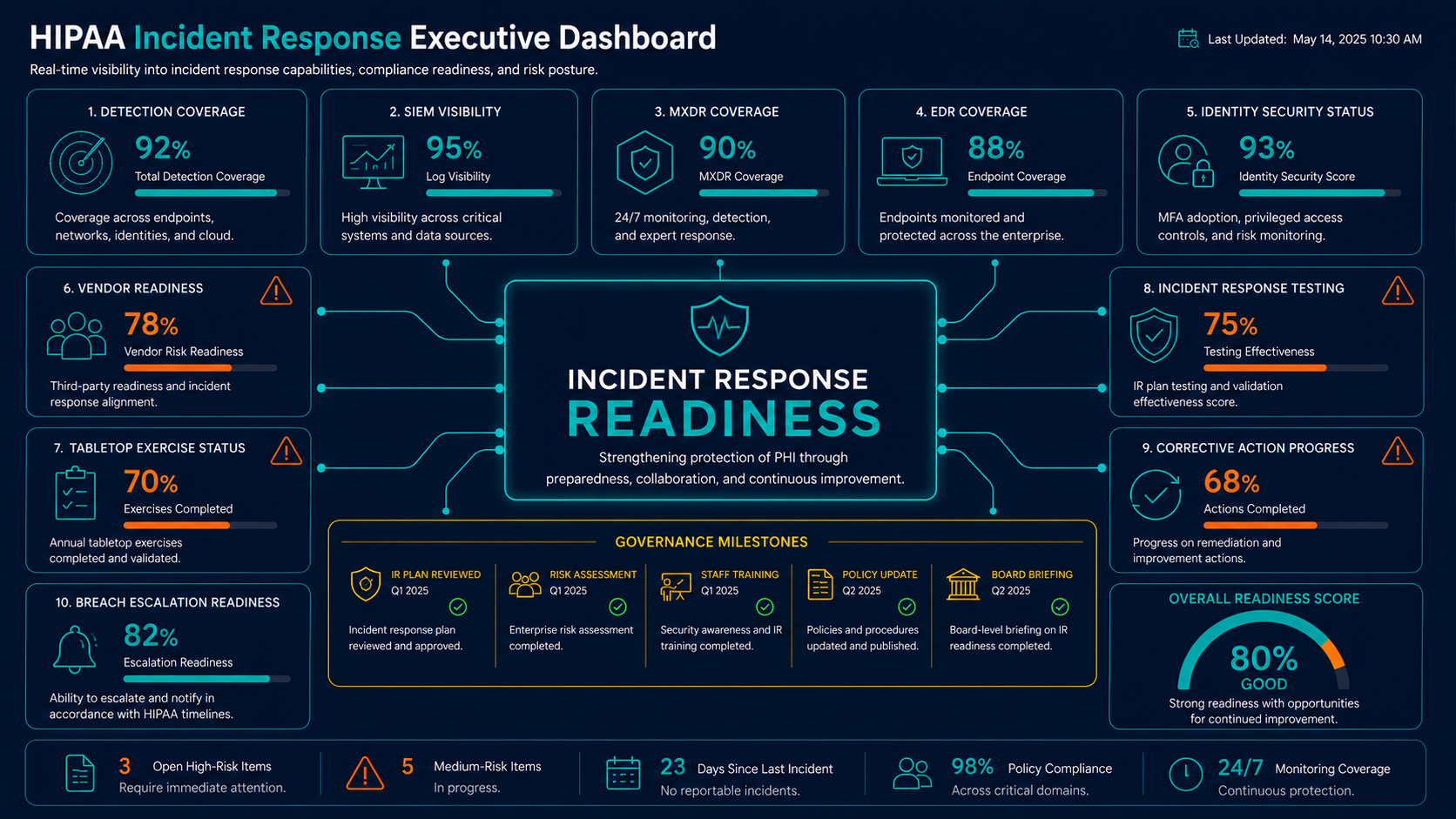
Incident response readiness should be visible to leadership because incidents affect patient trust, clinical operations, regulatory exposure, legal strategy, cyber insurance, financial impact, and organizational resilience. Executives do not need to perform technical triage, but they should understand whether the organization can respond quickly and produce evidence.
Useful leadership questions include:
- Who leads our incident response process?
- How do workforce members report suspicious activity?
- Are SIEM, EDR, identity, cloud, email, and remote access logs available for investigation?
- How quickly can we determine whether PHI may be involved?
- When are compliance, privacy, legal, and executive leadership brought into the process?
- Do our business associates know how and when to notify us?
- Have we tested ransomware, email compromise, vendor breach, and lost device scenarios?
- Can we preserve evidence while containing threats quickly?
- How are corrective actions assigned, funded, tracked, and reported?
- What incident response metrics are reported to leadership?
How DBT Helps Healthcare Organizations
DBT helps healthcare organizations strengthen the operational cybersecurity capabilities that support HIPAA incident response readiness. We help organizations improve visibility, detection, triage, containment coordination, documentation, corrective action tracking, and executive reporting.
DBT can support HIPAA incident response readiness through:
- Managed SIEM and log management
- MXDR and security monitoring
- Endpoint detection and response
- Incident response support
- Identity and access security review
- Passwordless MFA and phishing-resistant authentication support
- SASE and ZTNA access control improvements
- Vulnerability management and patch visibility
- Backup and recovery readiness review
- Vendor access and business associate responsibility mapping
- Tabletop exercise support
- Security evidence collection and executive reporting
- Post-incident corrective action tracking
DBT does not replace legal counsel, breach counsel, forensic counsel, or the healthcare organization’s internal compliance ownership. DBT helps build, operate, monitor, and document cybersecurity capabilities that support timely, evidence-driven incident response.
Related DBT Resources
For notification requirements after a reportable breach, review HIPAA Breach Notification Rule Explained. For the governance foundation behind incident procedures, review HIPAA Administrative Safeguards Explained. For technical controls that support detection and evidence collection, review HIPAA Technical Safeguards Explained.
Healthcare organizations evaluating operational support should also review DBT’s Cybersecurity Operations, Compliance & Risk Management, Identity & Access Security, and Healthcare Cybersecurity Services pages.
Final Thoughts
HIPAA incident response requirements are not satisfied by a policy sitting in a folder. Healthcare organizations need repeatable procedures, trained users, available logs, defined escalation paths, vendor coordination, evidence preservation, containment capabilities, and corrective action tracking.
The strongest healthcare organizations prepare before an incident occurs. They test response workflows, improve monitoring coverage, clarify decision points, validate backup and recovery procedures, and ensure leadership understands response readiness.
When incident response is connected to administrative governance, technical safeguards, breach notification planning, and managed security operations, healthcare organizations are better positioned to protect patients, reduce disruption, support compliance readiness, and respond with confidence.