
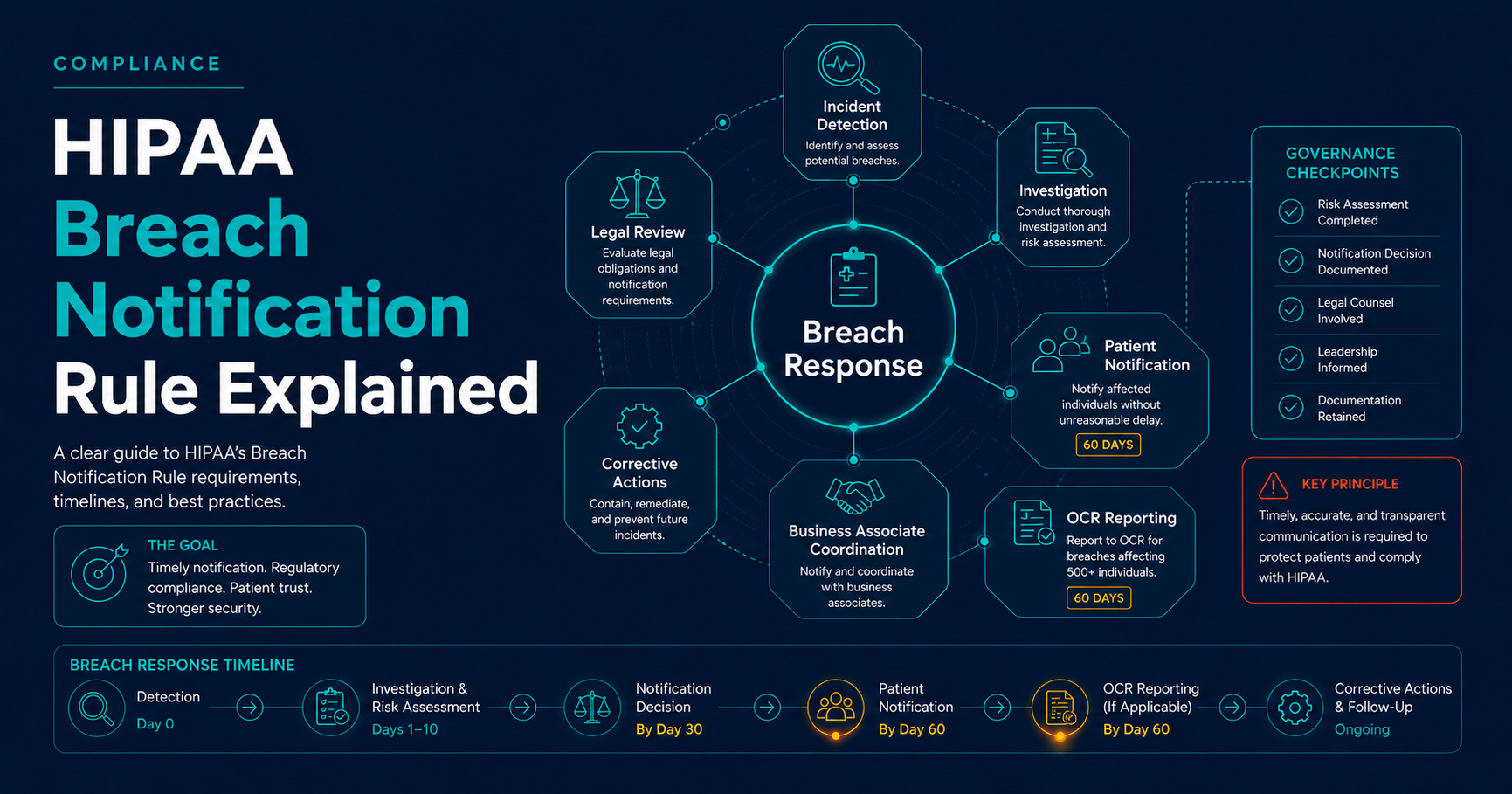
What Is the HIPAA Breach Notification Rule?
The HIPAA Breach Notification Rule establishes notification requirements when unsecured protected health information, commonly referred to as PHI, is breached. In practical terms, it defines when affected individuals, the U.S. Department of Health and Human Services Office for Civil Rights, and in some cases the media must be notified after a breach involving unsecured PHI.
For healthcare organizations, breach notification is not only a legal and compliance issue. It is an incident response issue, a documentation issue, a vendor coordination issue, and an executive governance issue. The ability to meet notification expectations depends heavily on how quickly the organization can detect suspicious activity, investigate scope, preserve evidence, involve legal counsel, coordinate with business associates, and make informed decisions.
A strong breach response program does not start when notification letters are being drafted. It starts long before an incident occurs, with security monitoring, access control, logging, business associate oversight, incident response procedures, communication planning, and leadership visibility.
Key Takeaways
- The HIPAA Breach Notification Rule applies to breaches of unsecured PHI.
- Covered entities may need to notify affected individuals, HHS OCR, and in some cases the media.
- Business associates must notify covered entities when a breach occurs at or by the business associate.
- Notification timelines are driven by discovery and should not wait until every investigation detail is perfect.
- Incident response, logging, managed detection, evidence preservation, and vendor coordination directly support breach notification readiness.
Why Breach Notification Readiness Matters
Healthcare incidents move quickly. A phishing attack, ransomware event, compromised mailbox, vendor breach, stolen laptop, exposed cloud repository, or unauthorized EHR access can create urgent questions about whether PHI was involved, how many individuals were affected, whether the information was secured, and what notifications may be required.
Organizations that have not prepared in advance often struggle with the same issues during a high-pressure event: missing logs, unclear escalation paths, incomplete vendor contacts, uncertain data ownership, limited business associate visibility, and delayed decision-making.
Breach notification readiness helps healthcare leaders answer practical questions during an incident:
- Was PHI involved?
- Was the PHI unsecured?
- When was the incident discovered?
- What systems, accounts, vendors, or workflows were affected?
- How many individuals may be involved?
- What evidence supports the investigation?
- Who needs to be notified internally?
- Does legal counsel need to guide breach determination?
- Do business associates need to provide information?
- What corrective actions are required?
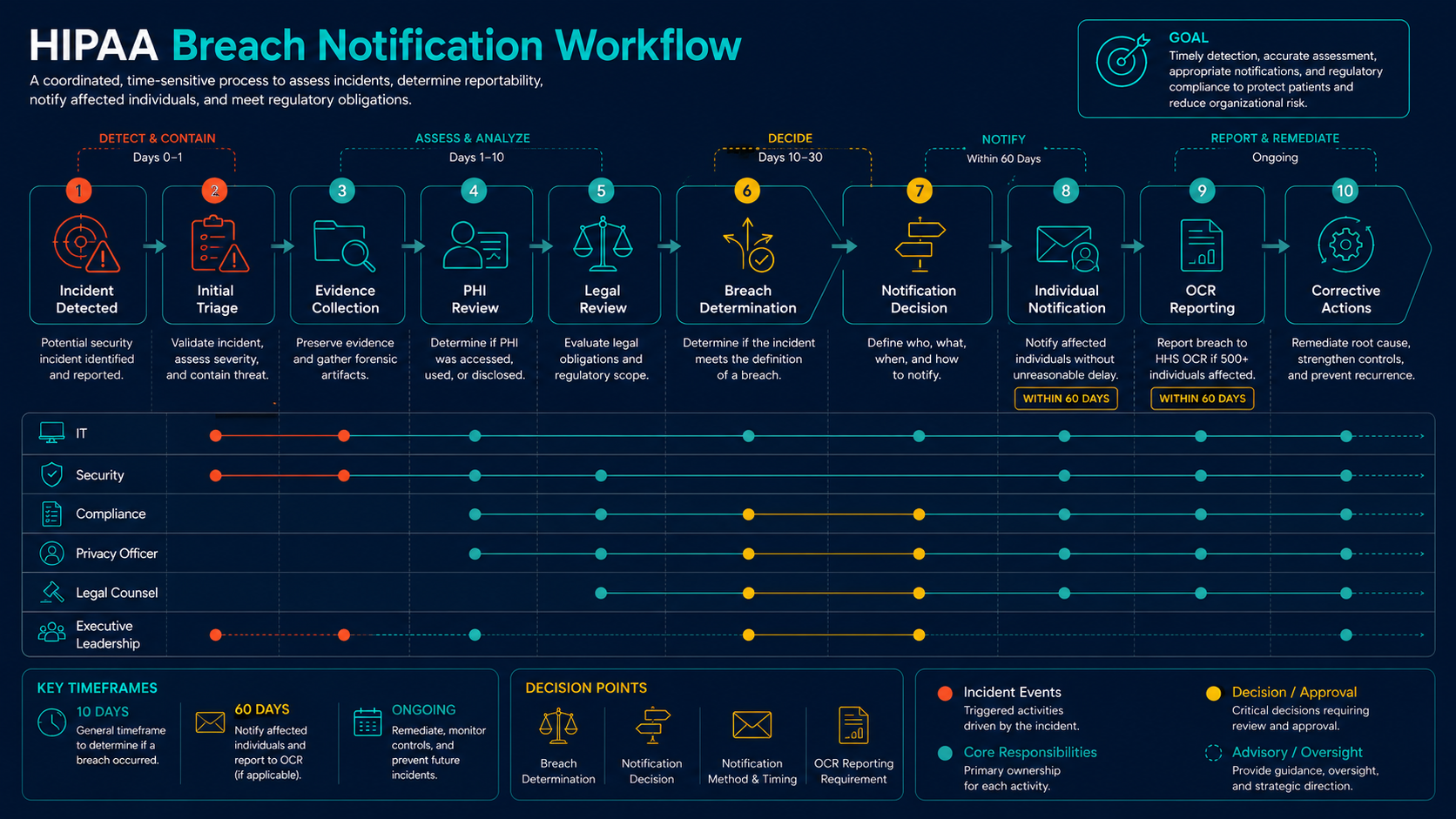
What Counts as a Breach?
Under HIPAA, a breach generally involves the acquisition, access, use, or disclosure of protected health information in a way that is not permitted and that compromises the security or privacy of that information. The details matter, and healthcare organizations should involve qualified legal counsel when making breach determinations.
From an operational cybersecurity perspective, potential breach scenarios may include:
- A compromised email account containing patient information
- Unauthorized access to an EHR or patient portal
- Ransomware affecting systems that contain PHI
- Lost or stolen laptops, mobile devices, or removable media
- Misconfigured cloud storage exposing patient files
- Improperly sent email, fax, file transfer, or report
- Business associate compromise involving PHI
- Vendor support account misuse
- Insider access outside job responsibilities
- Improper disposal of records or media
Important Compliance Note
This article is not legal advice. Healthcare organizations should work with qualified legal counsel when interpreting HIPAA obligations, determining whether an incident is a reportable breach, drafting notifications, or responding to regulatory inquiries.
Unsecured PHI and Why Security Controls Matter
The Breach Notification Rule focuses on unsecured PHI. Healthcare organizations should understand whether PHI was encrypted, protected, inaccessible, or otherwise secured in a manner that affects notification analysis. This is one reason security controls matter far beyond prevention.
Controls such as encryption, access control, MFA, endpoint protection, logging, remote access security, and backup protection can affect the facts available during an investigation. They may help determine whether PHI was accessed, whether an account was misused, whether data was exfiltrated, whether a device was protected, and whether the organization has credible evidence to support its conclusions.
| Security Control | Incident Response Value | Breach Readiness Output |
|---|---|---|
| Encryption | Helps protect PHI on devices, systems, backups, and transmission paths | Encryption status, configuration records, device protection evidence |
| MFA and Passwordless Authentication | Reduces credential compromise risk and strengthens evidence of authorized access | MFA coverage reports, authentication logs, conditional access records |
| Managed SIEM and Log Management | Centralizes evidence needed to determine scope, access, timing, and affected systems | Log timelines, alert records, investigation notes, escalation tickets |
| EDR and MXDR | Improves detection, containment, endpoint investigation, and threat response | Endpoint alert data, containment actions, investigation timeline, response records |
| SASE and ZTNA | Controls remote access to healthcare applications and ePHI from managed access paths | Remote access logs, policy records, user activity reports, access decisions |
| Backup and Recovery Controls | Supports resilience after ransomware, data corruption, or destructive activity | Backup reports, restore tests, recovery timelines, protected systems list |
Breach Risk Assessment
When an incident involves PHI, the organization typically needs to assess whether the security or privacy of the information was compromised. This assessment should be structured, documented, and supported by evidence.
A practical breach risk assessment often considers:
- The nature and extent of the PHI involved
- The types of identifiers and sensitivity of the information
- The unauthorized person or entity that used or received the PHI
- Whether the PHI was actually acquired or viewed
- The extent to which risk has been mitigated
- Whether forensic or technical evidence supports the determination
- Whether business associate or subcontractor information is required
- Whether the incident creates continuing risk to affected individuals
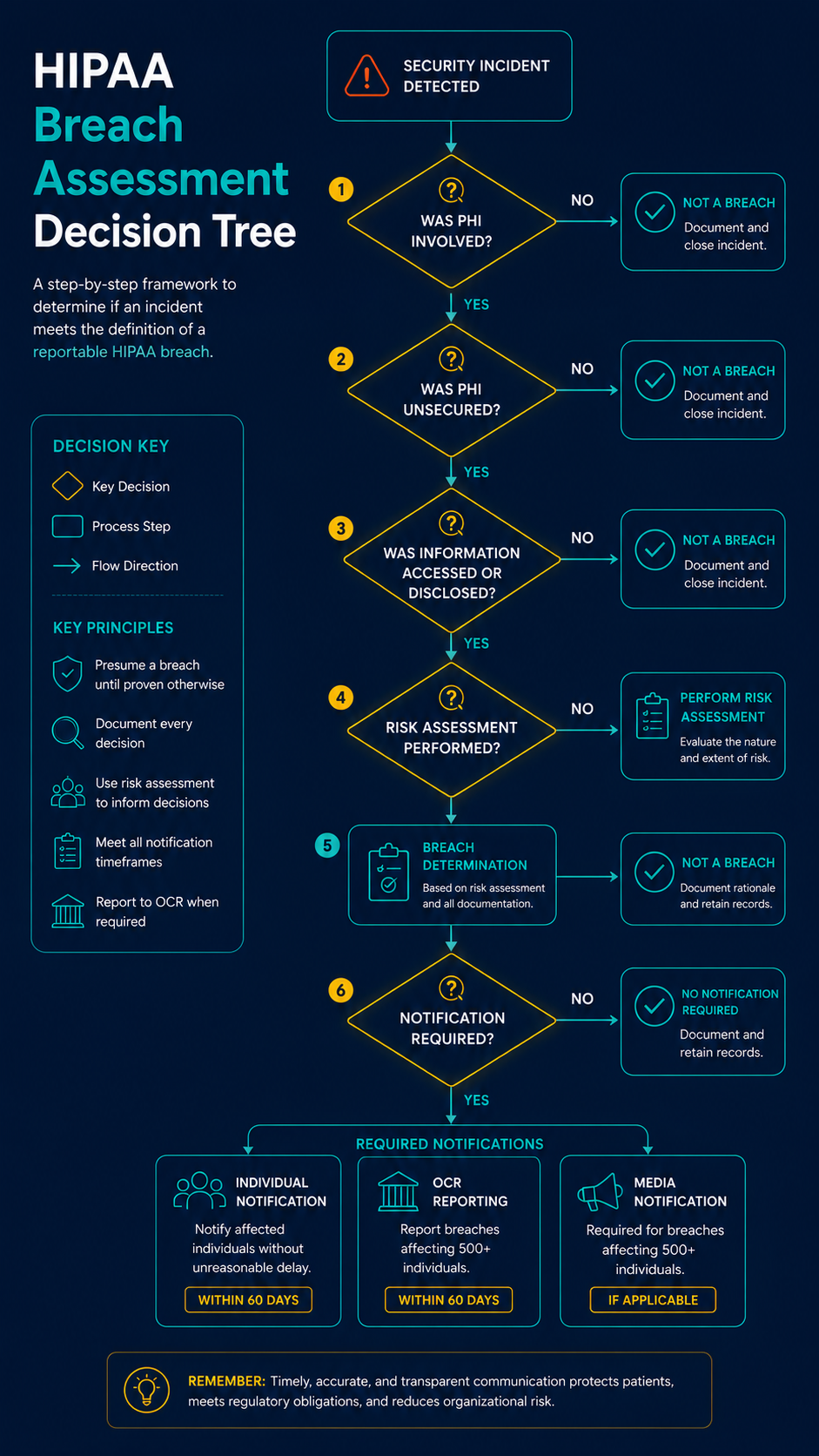
Notification Timeline Considerations
HIPAA breach notification timelines are driven by discovery and should be treated as executive-level response milestones. For breaches affecting 500 or more individuals, covered entities notify HHS OCR without unreasonable delay and no later than 60 calendar days from discovery. Breaches affecting fewer than 500 individuals are reported to HHS OCR no later than 60 days after the end of the calendar year in which the breach was discovered.
Affected individuals generally must be notified without unreasonable delay and no later than 60 calendar days from discovery. If a breach affects more than 500 residents of a state or jurisdiction, media notification may also be required. Business associates must notify the covered entity without unreasonable delay and no later than 60 calendar days from discovery of a breach at or by the business associate.
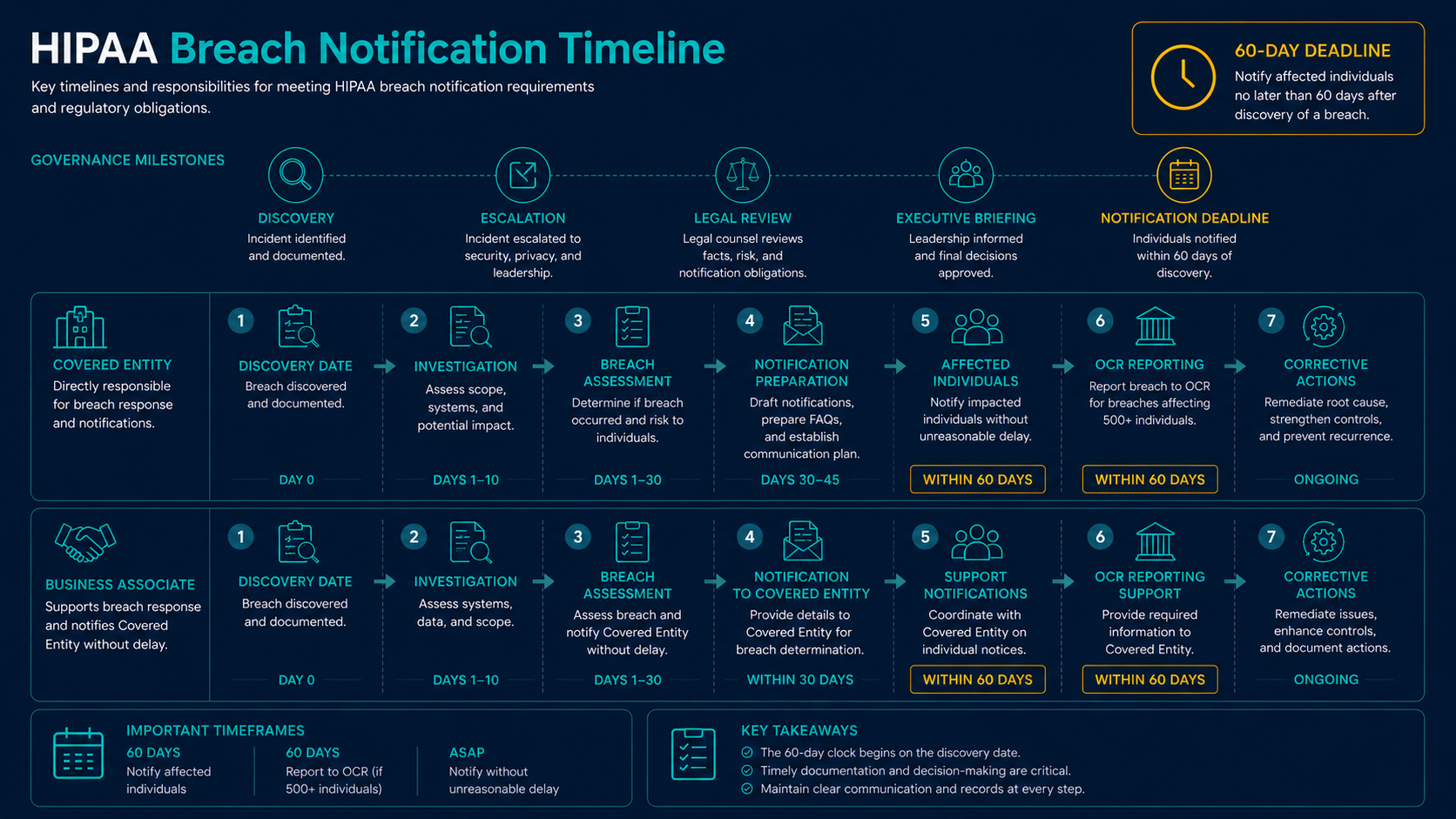
| Notification Scenario | Primary Recipient | Timing Consideration |
|---|---|---|
| Affected individuals | Individuals whose unsecured PHI was breached | Without unreasonable delay and no later than 60 calendar days from discovery |
| Breach affecting 500 or more individuals | HHS OCR | Without unreasonable delay and no later than 60 calendar days from discovery |
| Breach affecting fewer than 500 individuals | HHS OCR | No later than 60 days after the end of the calendar year in which the breach was discovered |
| Breach affecting more than 500 residents of a state or jurisdiction | Prominent media outlet serving the affected area | May be required in addition to individual and HHS notification |
| Business associate breach | Covered entity | Without unreasonable delay and no later than 60 calendar days from discovery |
Discovery Date Is a Critical Governance Detail
Discovery date is one of the most important facts in a breach response. It influences notification timelines, escalation urgency, leadership communication, legal review, and evidence preservation. Organizations should avoid treating discovery as an afterthought.
A practical incident response process should document:
- When suspicious activity was first detected
- Who first became aware of the incident
- When the incident was escalated to IT, security, compliance, privacy, or legal
- When PHI involvement was suspected
- When the organization determined whether unsecured PHI was involved
- When business associates or vendors provided relevant information
- When leadership was briefed
- When notification decisions were made
Response Principle
The breach response clock is a governance issue, not only a technical issue. Healthcare organizations should capture incident discovery, escalation, investigation, and decision milestones in a defensible timeline.
Business Associate Breach Notification
Business associates play a major role in healthcare breach response. If a breach occurs at or by a business associate, the business associate must notify the covered entity. The covered entity then needs enough timely information to meet its own notification obligations.
This is why vendor governance, Business Associate Agreements, incident notification language, security monitoring, access controls, and vendor contact records matter. If the covered entity cannot quickly obtain affected individual information, system scope, timeline details, and mitigation status from a vendor, the covered entity may struggle to manage its own response.
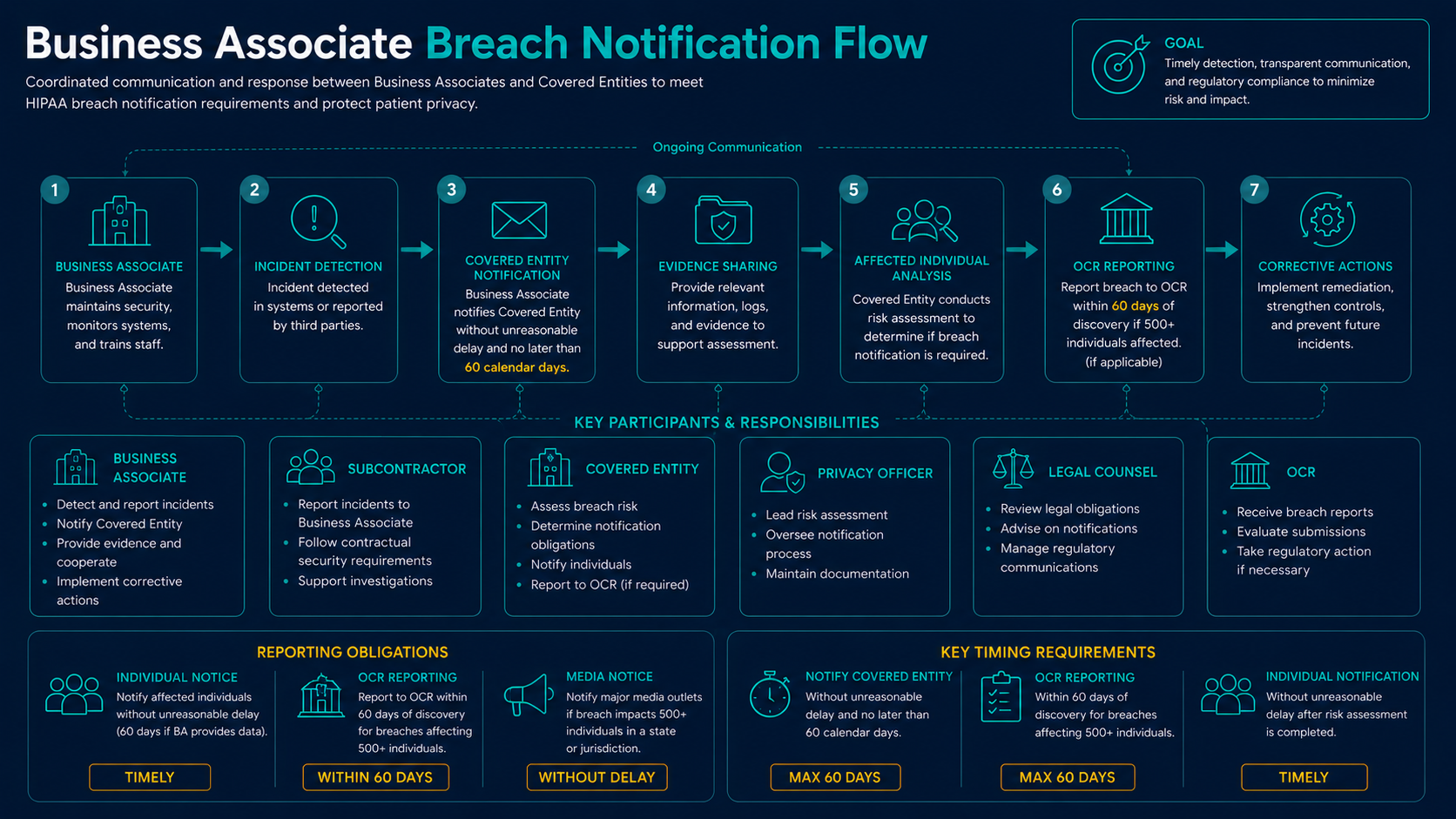
Covered entities should consider whether business associate relationships define:
- Who the vendor notifies during a suspected incident
- How quickly initial notification must occur
- What information the vendor must provide
- How affected individuals will be identified
- Whether subcontractors are involved
- How forensic or technical evidence will be shared
- How communications will be coordinated
- Who is responsible for corrective actions
- How post-incident documentation will be retained
Incident Response Evidence Needed for Breach Decisions
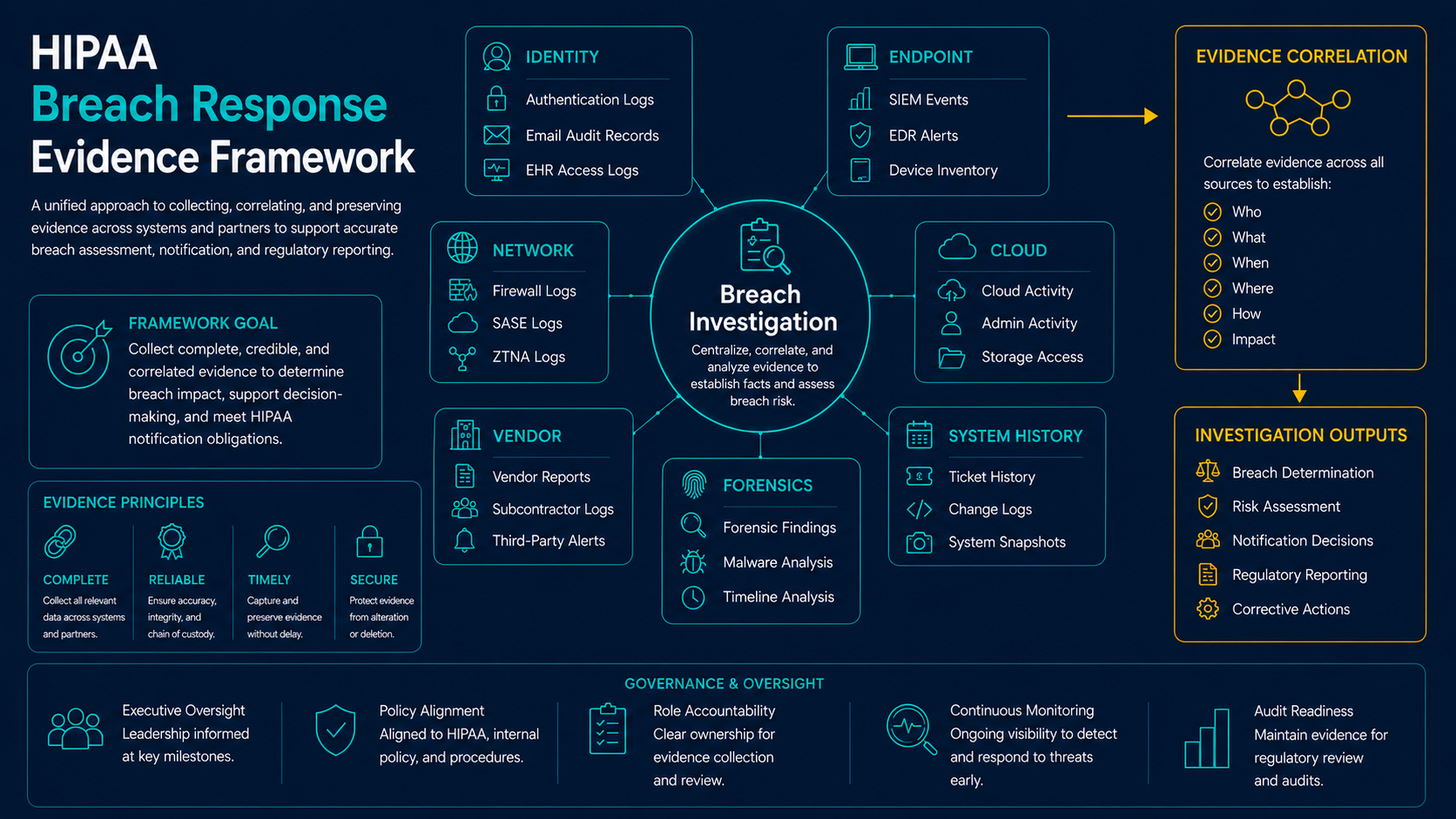
Breach notification decisions depend on facts. During an incident, healthcare organizations should be able to collect, preserve, and interpret evidence from systems, users, vendors, security tools, logs, endpoints, cloud platforms, and communication records.
Evidence may include:
- Authentication logs
- Email audit records
- EHR access logs
- Endpoint detection and response alerts
- SIEM timelines and alert history
- Firewall, VPN, SASE, or ZTNA access logs
- Cloud activity logs
- Data loss prevention or file access records
- Backup and recovery records
- Ticket history and escalation notes
- Forensic investigation summaries
- Vendor incident reports
- Legal and compliance decision records
Common Breach Notification Readiness Failures
Many breach response problems are caused by preparation gaps that existed before the incident. These gaps can delay investigation, increase uncertainty, and make notification decisions harder to defend.
- Incomplete ePHI inventory: The organization cannot quickly determine which systems, workflows, or vendors may contain PHI.
- Limited logging: Critical systems do not retain enough activity data to confirm access, scope, or timing.
- No centralized monitoring: Alerts are scattered across tools and are not correlated into a reliable timeline.
- Unclear escalation paths: Workforce members do not know how to report suspicious activity or suspected PHI exposure.
- Weak vendor notification language: Business associates are not required to provide enough detail quickly enough.
- No affected individual process: The organization has no reliable method to identify impacted individuals from system records.
- Untested incident response plan: Roles, communications, legal review, and evidence handling have not been validated.
- Delayed executive involvement: Leadership is brought in too late to support timely decisions and resource allocation.
- Corrective actions are not tracked: Post-incident remediation is discussed but not assigned, documented, or verified.
Common Failure Pattern
A healthcare organization may have an incident response policy and still be unprepared for breach notification if it lacks log visibility, vendor coordination, affected individual workflows, legal escalation, and executive decision procedures.
How Security Operations Support Breach Notification Readiness
Security operations directly influence breach response. The faster an organization detects suspicious activity, preserves evidence, scopes the incident, and coordinates response, the better positioned it is to make timely notification decisions.
| Security Operations Capability | Breach Response Benefit | Evidence Produced |
|---|---|---|
| Managed SIEM | Centralizes logs and supports event correlation across identity, endpoint, network, cloud, and healthcare systems | Timeline reports, alert records, log source inventory, investigation notes |
| MXDR | Provides detection, triage, containment coordination, and response support | Triage records, escalation notes, containment actions, incident timeline |
| EDR | Improves endpoint visibility and helps determine whether malware, ransomware, or unauthorized activity occurred | Endpoint alerts, process history, containment record, affected asset list |
| Identity Security | Helps determine whether accounts were compromised, whether MFA was enforced, and what access was used | Authentication logs, MFA evidence, account activity, access review records |
| SASE and ZTNA | Improves visibility and control over remote and application access to ePHI systems | Access logs, policy decisions, remote session records, vendor access reports |
| Vulnerability Management | Helps identify exploited weaknesses and prioritize corrective actions | Scan reports, remediation tickets, exposure records, closure evidence |
Corrective Actions After a Breach
Breach response should not end when notices are submitted. Healthcare organizations should identify and track corrective actions that reduce the likelihood or impact of similar incidents in the future. These actions should be assigned, prioritized, documented, and reported to leadership.
Corrective actions may include:
- Expanding MFA or passwordless authentication coverage
- Improving SASE, ZTNA, VPN, or remote access controls
- Disabling shared or stale accounts
- Improving privileged access management
- Adding or improving SIEM log sources
- Increasing log retention for critical systems
- Deploying or tuning EDR and MXDR coverage
- Improving backup protection and restoration testing
- Updating incident response procedures
- Improving security awareness training
- Updating Business Associate Agreements or vendor incident notification procedures
- Completing vulnerability remediation
- Updating risk analysis and risk management records
Executive and Board-Level Considerations
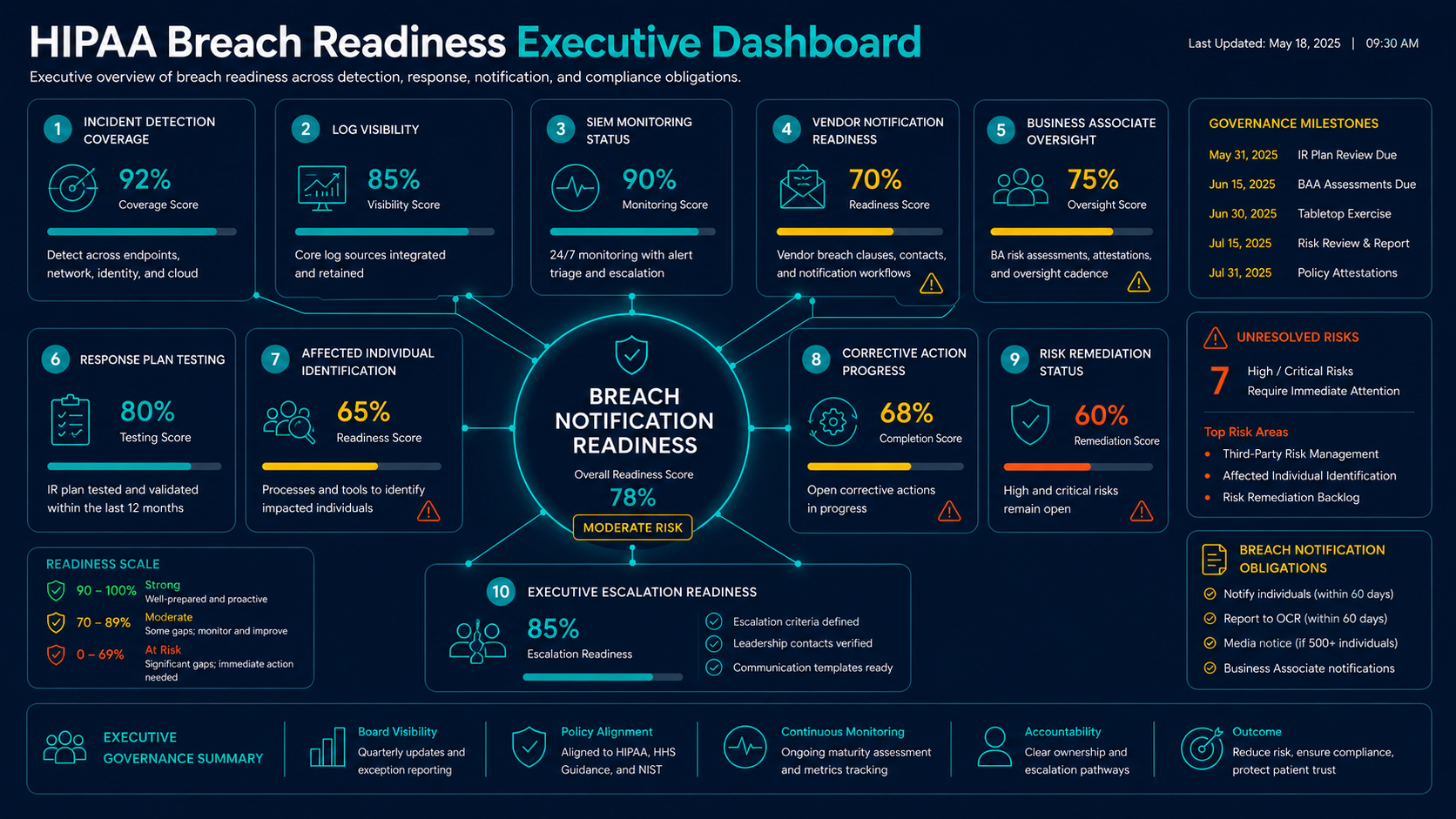
Breach notification is a leadership issue because it can affect regulatory exposure, patient trust, reputation, legal strategy, business continuity, cyber insurance, and operational resilience. Executives should not wait for a breach to understand the organization’s readiness.
Useful leadership questions include:
- Do we know where PHI exists across systems, vendors, cloud platforms, and workflows?
- Can we determine quickly whether an incident involved unsecured PHI?
- Are logs available to reconstruct suspicious access or data exposure?
- Who decides when legal counsel, privacy, compliance, and executive leadership are involved?
- Are business associates required to notify us quickly and provide enough detail?
- Can we identify affected individuals if PHI exposure occurs?
- Have incident response and breach notification procedures been tested?
- Can we meet notification timelines without relying on improvised processes?
- How are corrective actions tracked after incidents?
- What reporting does leadership receive about incident readiness and breach exposure?
How DBT Helps Healthcare Organizations
DBT helps healthcare organizations strengthen the security operations and evidence collection capabilities that support breach notification readiness. Our role is to help organizations detect incidents faster, preserve useful evidence, improve response coordination, reduce technical exposure, and provide leadership with clearer visibility into risk.
DBT can support breach notification readiness through:
- Managed SIEM and log management
- MXDR and security monitoring
- Incident response support
- Endpoint detection and response
- Identity and access security review
- Passwordless MFA and phishing-resistant authentication support
- SASE and ZTNA access control improvements
- Vulnerability management and patch visibility
- Backup and recovery readiness review
- Business associate and vendor access review
- Security evidence collection and executive reporting
- Post-incident corrective action tracking
DBT does not replace legal counsel, breach counsel, forensic counsel, or the healthcare organization’s internal compliance ownership. DBT helps build, operate, monitor, and document the cybersecurity capabilities that support timely, evidence-driven response.
Related DBT Resources
For the governance foundation behind incident response, review HIPAA Administrative Safeguards Explained. For technical safeguards that support detection and evidence collection, review HIPAA Technical Safeguards Explained. For financial and enforcement context, review HIPAA Compliance Penalties and Breach Costs.
Healthcare organizations evaluating operational support should also review Cybersecurity Operations, Compliance & Risk Management, Identity & Access Security, and Healthcare Cybersecurity Services.
Final Thoughts
The HIPAA Breach Notification Rule is often discussed as a reporting requirement, but in practice it depends on security operations, evidence collection, vendor coordination, legal review, executive decision-making, and corrective action tracking.
The strongest healthcare organizations prepare before an incident occurs. They know where PHI exists, how access is controlled, which logs are available, how incidents are escalated, how business associates must communicate, and how leadership will make timely decisions.
When breach notification readiness is connected to technical controls and administrative governance, healthcare organizations are better positioned to respond quickly, protect patients, support compliance readiness, and reduce the operational impact of security incidents.