
What Are HIPAA Contingency Planning Requirements?
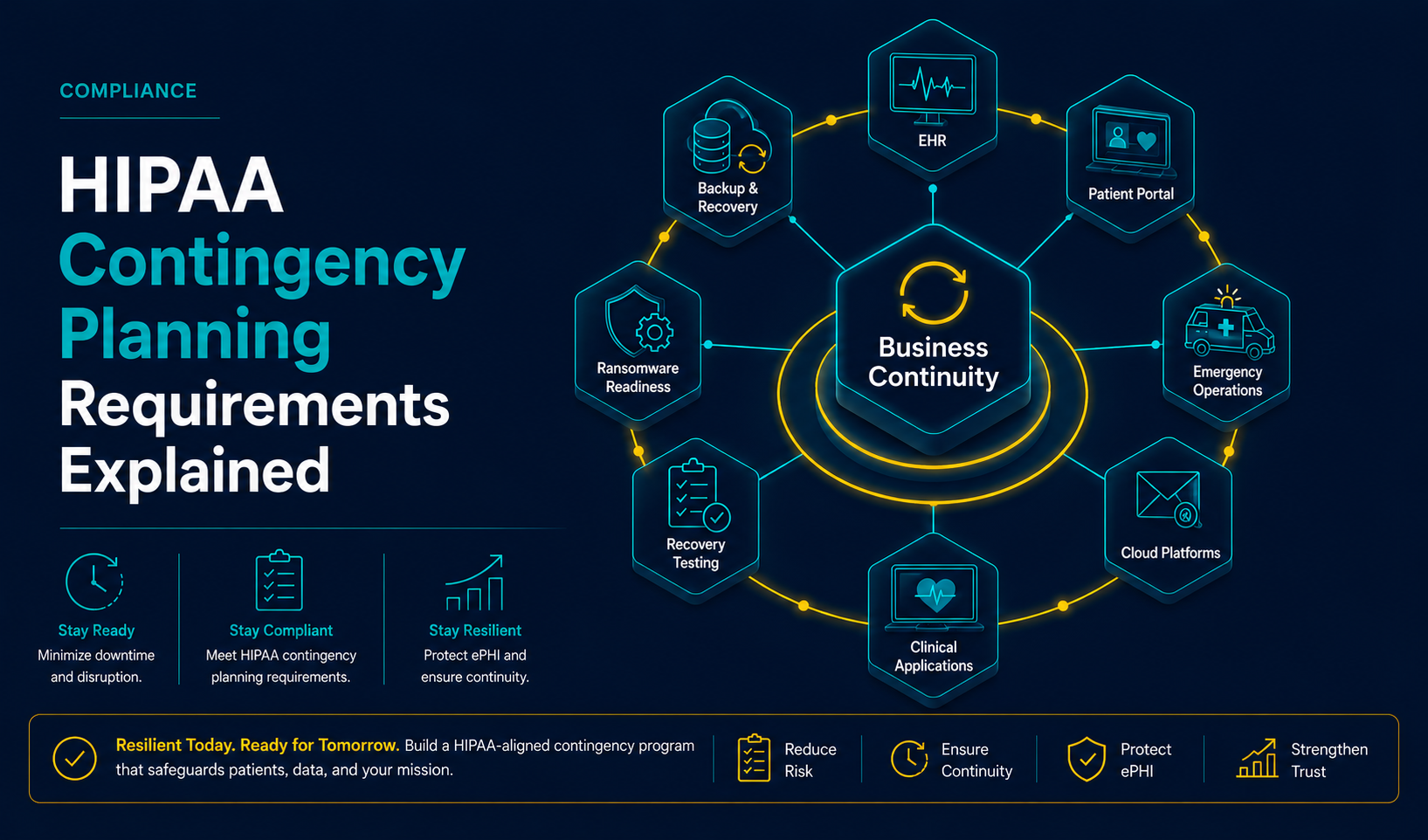
HIPAA contingency planning requirements are part of the HIPAA Security Rule’s Administrative Safeguards. They focus on how healthcare organizations prepare for emergencies or disruptions that affect systems containing electronic protected health information, commonly referred to as ePHI.
Contingency planning is not limited to backup software. A practical contingency program should address data backup, disaster recovery, emergency mode operations, testing and revision, application criticality analysis, ransomware resilience, vendor dependencies, documentation, and executive decision-making.
For healthcare leaders, contingency planning answers a direct operational question: if a system containing or supporting ePHI becomes unavailable, corrupted, encrypted, destroyed, or inaccessible, can the organization continue critical operations and recover safely?
Key Takeaways
- HIPAA contingency planning connects backup, disaster recovery, emergency operations, testing, and critical system prioritization.
- Healthcare organizations should understand which systems contain ePHI and which systems are required for patient care, revenue cycle, communications, and security operations.
- Backup jobs are not enough; organizations should test restoration, validate recovery procedures, and document results.
- Ransomware readiness should be built into contingency planning because ransomware can affect availability, integrity, and breach response.
- Executives should receive reporting on backup status, recovery testing, critical system readiness, vendor dependencies, and unresolved recovery risks.
Why Contingency Planning Matters in Healthcare
Healthcare organizations depend on technology for clinical care, scheduling, billing, communications, prescription workflows, imaging, labs, telehealth, identity, security monitoring, and vendor-supported operations. When those systems are unavailable, the impact can extend beyond IT into patient care, revenue, compliance, legal exposure, and reputation.
Common disruption scenarios include ransomware, destructive malware, cloud outages, failed backups, accidental deletion, hardware failure, natural disasters, vendor outages, power events, network disruption, and loss of access to critical applications.
A healthcare contingency plan should help the organization answer:
- Which systems and data are most critical?
- Which systems contain or support access to ePHI?
- Where are backups stored, and are they protected from ransomware?
- How quickly can critical systems be restored?
- Which downtime procedures allow operations to continue?
- Who makes recovery, communication, and prioritization decisions?
- Which vendors are required during recovery?
- When was the last successful restoration test?
- What evidence proves the plan is current and tested?
Core HIPAA Contingency Planning Components
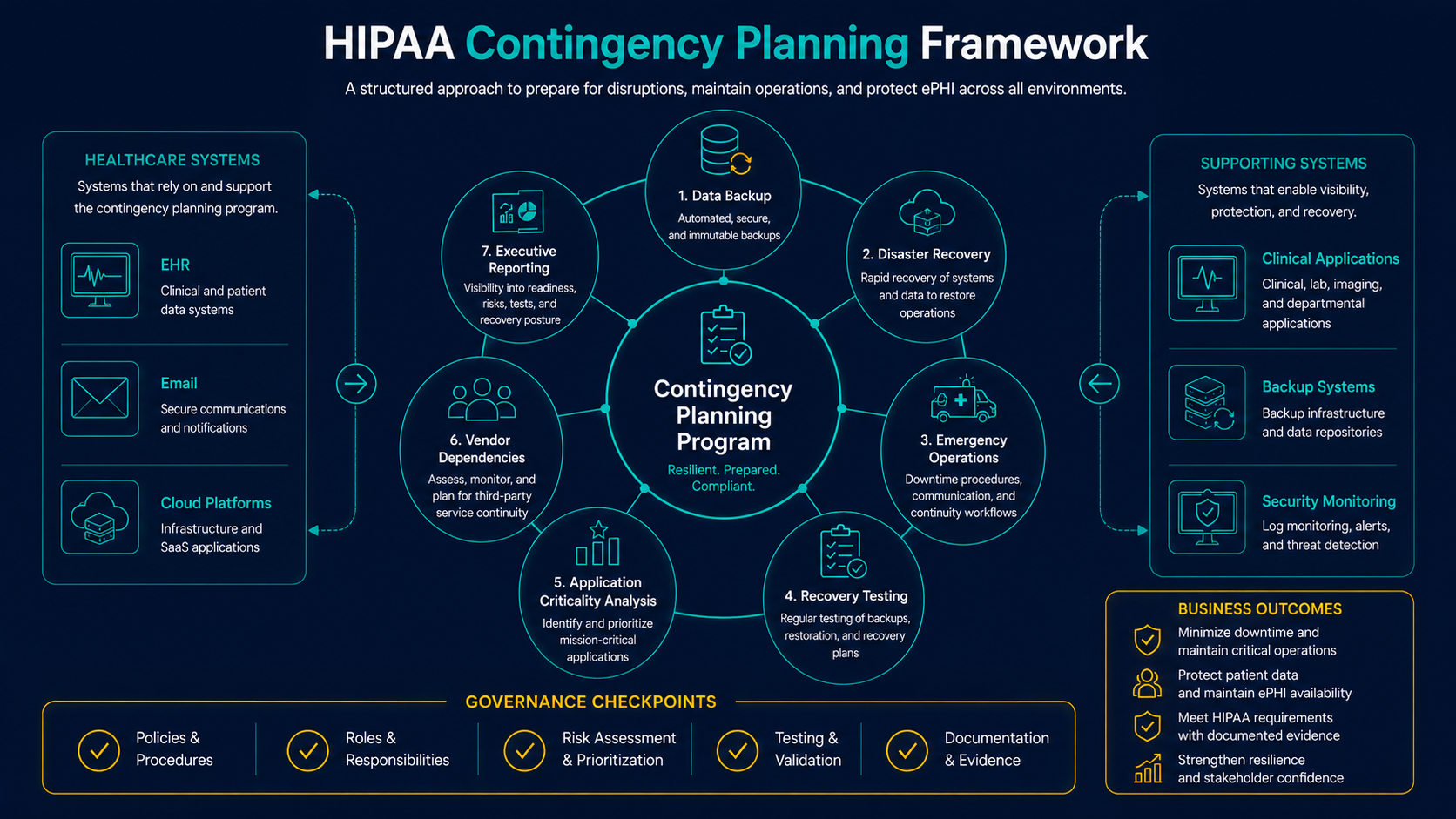
The HIPAA Security Rule identifies several contingency planning implementation specifications. In practical healthcare operations, these requirements should be translated into a program that protects availability, supports recovery, preserves evidence, and keeps critical workflows functioning during disruption.
| Contingency Planning Component | Operational Purpose | Example Evidence |
|---|---|---|
| Data Backup Plan | Create retrievable exact copies of ePHI and critical systems where appropriate | Backup policy, protected systems list, job reports, backup alerts, backup storage configuration |
| Disaster Recovery Plan | Restore systems and data after a failure, outage, ransomware event, or disaster | Recovery procedures, recovery objectives, runbooks, restoration test results, vendor contacts |
| Emergency Mode Operation Plan | Continue critical processes while normal systems are unavailable | Downtime workflows, communication plan, emergency access procedures, manual process instructions |
| Testing and Revision Procedures | Validate that backup, recovery, and emergency procedures work and remain current | Tabletop records, restore tests, lessons learned, plan updates, corrective action records |
| Application and Data Criticality Analysis | Prioritize systems and data based on clinical, operational, compliance, and recovery importance | Critical systems inventory, dependency map, business impact analysis, recovery prioritization |
Data Backup Planning
A data backup plan defines how ePHI and supporting systems are copied, protected, monitored, retained, and restored. Backup planning should cover more than the EHR. It should also account for file shares, cloud data, email, servers, databases, clinical applications, billing systems, identity systems, security tools, and vendor-supported platforms.
Healthcare organizations should evaluate backup coverage, backup frequency, retention, encryption, access control, immutability, offsite storage, alerting, backup failure handling, and restoration validation.
- Identify systems that contain or support access to ePHI.
- Define backup frequency based on clinical and business impact.
- Protect backups from ransomware and unauthorized deletion.
- Monitor backup job success and failure conditions.
- Document backup retention and recovery expectations.
- Test restoration for critical systems and representative data sets.
- Retain evidence of backup health and recovery tests.
Compliance Principle
A backup job report only proves that a backup attempted to run. It does not prove the organization can recover. Healthcare contingency planning should include restoration testing, recovery documentation, and evidence that critical systems can be restored within practical business requirements.
Disaster Recovery Planning
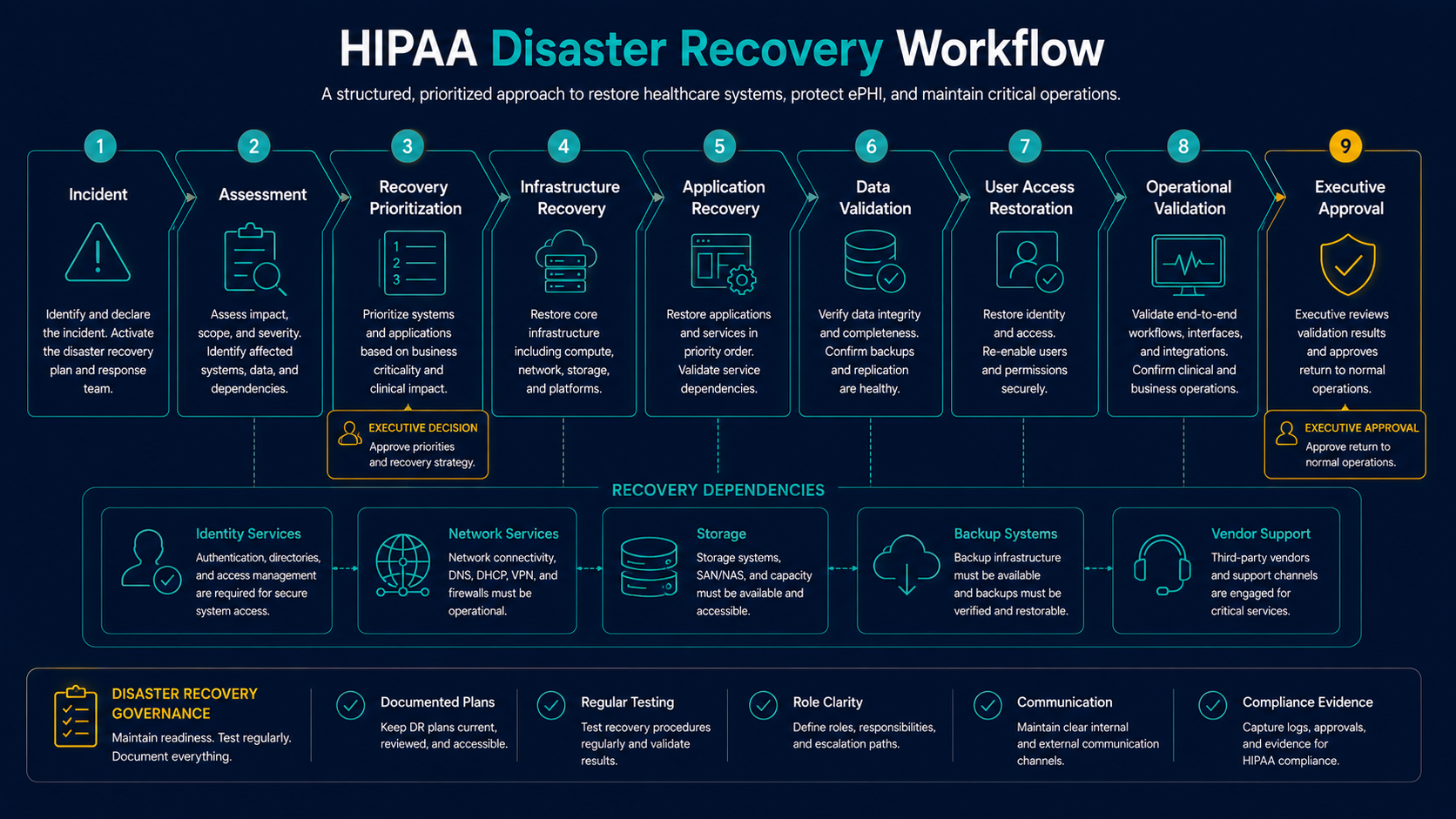
Disaster recovery planning defines how systems, applications, and data will be restored after an outage or destructive event. For healthcare organizations, disaster recovery should be tied to patient care, ePHI availability, revenue cycle operations, communications, and security operations.
A disaster recovery plan should define recovery priorities, recovery time objectives, recovery point objectives, responsible teams, required vendors, required credentials, communication steps, validation activities, and executive decision points.
| Recovery Planning Item | Why It Matters | Practical Question |
|---|---|---|
| Recovery Time Objective | Defines how quickly a system should be restored | How long can this system be unavailable before clinical or business harm occurs? |
| Recovery Point Objective | Defines how much data loss may be tolerable | How much recent data can the organization afford to recreate or lose? |
| System Dependency Map | Identifies the services required to restore an application safely | Does the EHR depend on identity, network, database, storage, vendor, or remote access services? |
| Recovery Runbook | Provides repeatable steps during a high-pressure event | Can the recovery team follow documented steps without improvising? |
| Validation Criteria | Confirms restored systems are usable and trustworthy | Who confirms the application, data, access, and security controls are working? |
Emergency Mode Operation Planning
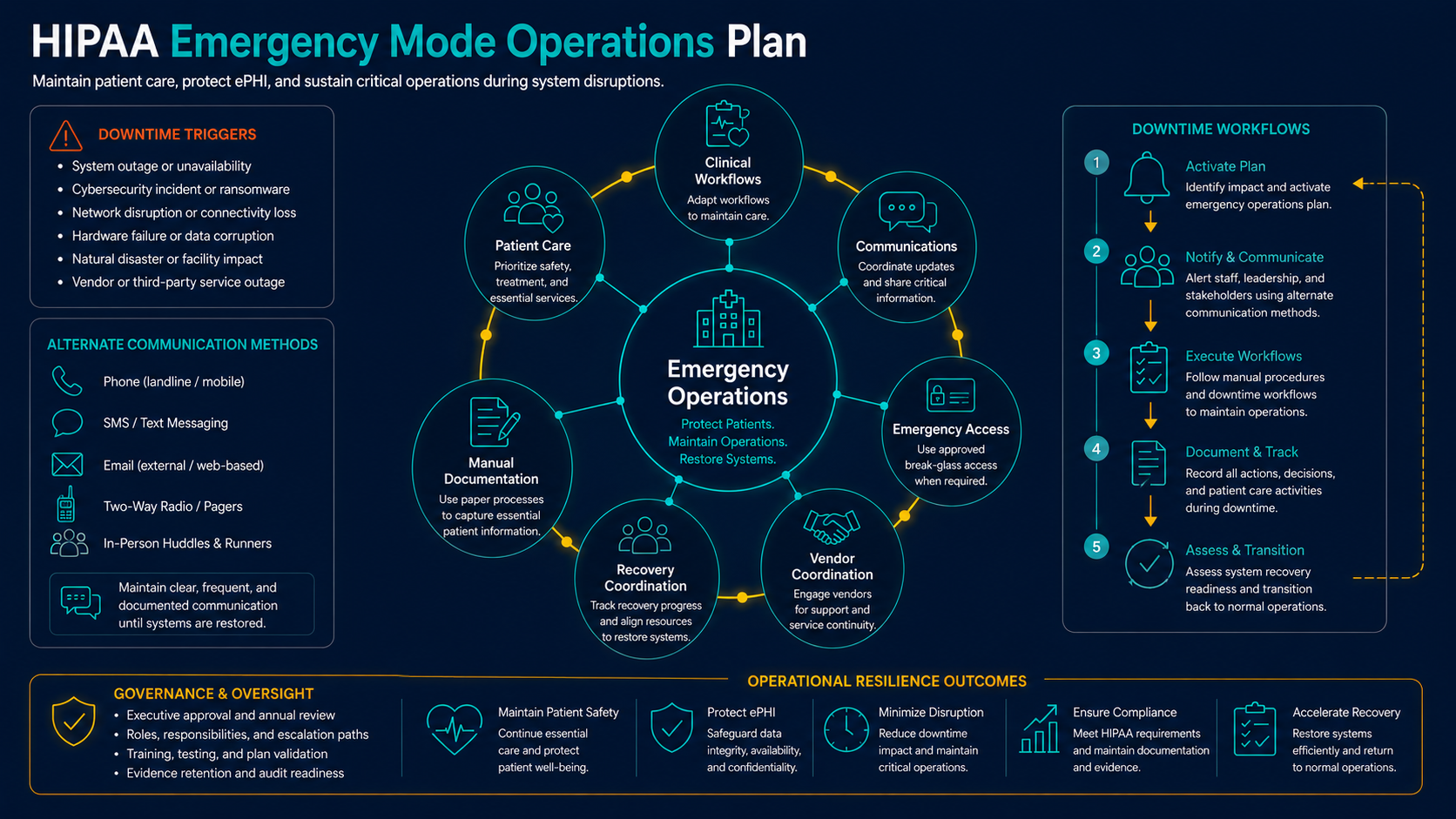
Emergency mode operation planning focuses on how the healthcare organization continues critical operations while normal systems are degraded, unavailable, or untrusted. This may involve downtime procedures, alternate communication methods, paper workflows, emergency access, temporary routing, manual documentation, and recovery coordination.
Emergency operations should be realistic. A plan that assumes all staff know what to do during an outage may fail during an actual emergency. Workforce members should understand where downtime procedures are stored, who makes operational decisions, how patient care workflows continue, and how information is reconciled after systems are restored.
- Define downtime procedures for clinical and business workflows.
- Identify communication channels if email, phones, or collaboration tools are unavailable.
- Maintain emergency contacts for leadership, IT, security, compliance, vendors, and key departments.
- Document emergency access procedures for critical systems.
- Define how manual records are protected and later reconciled.
- Include business associate and vendor escalation paths.
- Train workforce members on their role during downtime.
Application and Data Criticality Analysis
Application and data criticality analysis helps healthcare organizations prioritize recovery. Not every system has the same operational impact. A public website, a patient portal, an EHR, an imaging platform, a billing system, an identity provider, and a backup console may all matter, but they may not have the same recovery sequence.
A practical criticality analysis should consider clinical impact, ePHI sensitivity, user population, revenue impact, vendor dependency, security dependency, recovery complexity, downtime workaround availability, and regulatory importance.
| Criticality Factor | Why It Matters | Example |
|---|---|---|
| Clinical Impact | Systems that affect patient care may require faster recovery | EHR, imaging, lab systems, medication workflows |
| ePHI Sensitivity | Systems with large volumes of patient data may require stronger protection and evidence | Patient portal, billing database, document repositories |
| Operational Dependency | Some systems enable other systems or workflows | Identity provider, network services, remote access, backup platform |
| Revenue Impact | Business disruption can affect billing, claims, scheduling, and collections | Practice management, revenue cycle systems, payment platforms |
| Vendor Dependency | Recovery may require third-party support or hosted service availability | EHR vendor, cloud provider, MSP, MSSP, application vendor |
Ransomware Readiness and Backup Resilience
Ransomware is one of the clearest reasons contingency planning matters. Ransomware can affect system availability, data integrity, backup recoverability, incident response, breach notification analysis, and business continuity. A contingency plan that does not address ransomware is incomplete for modern healthcare operations.
Healthcare organizations should evaluate whether backup systems are isolated, protected by strong authentication, monitored, retained long enough to support recovery, and tested against realistic recovery scenarios.
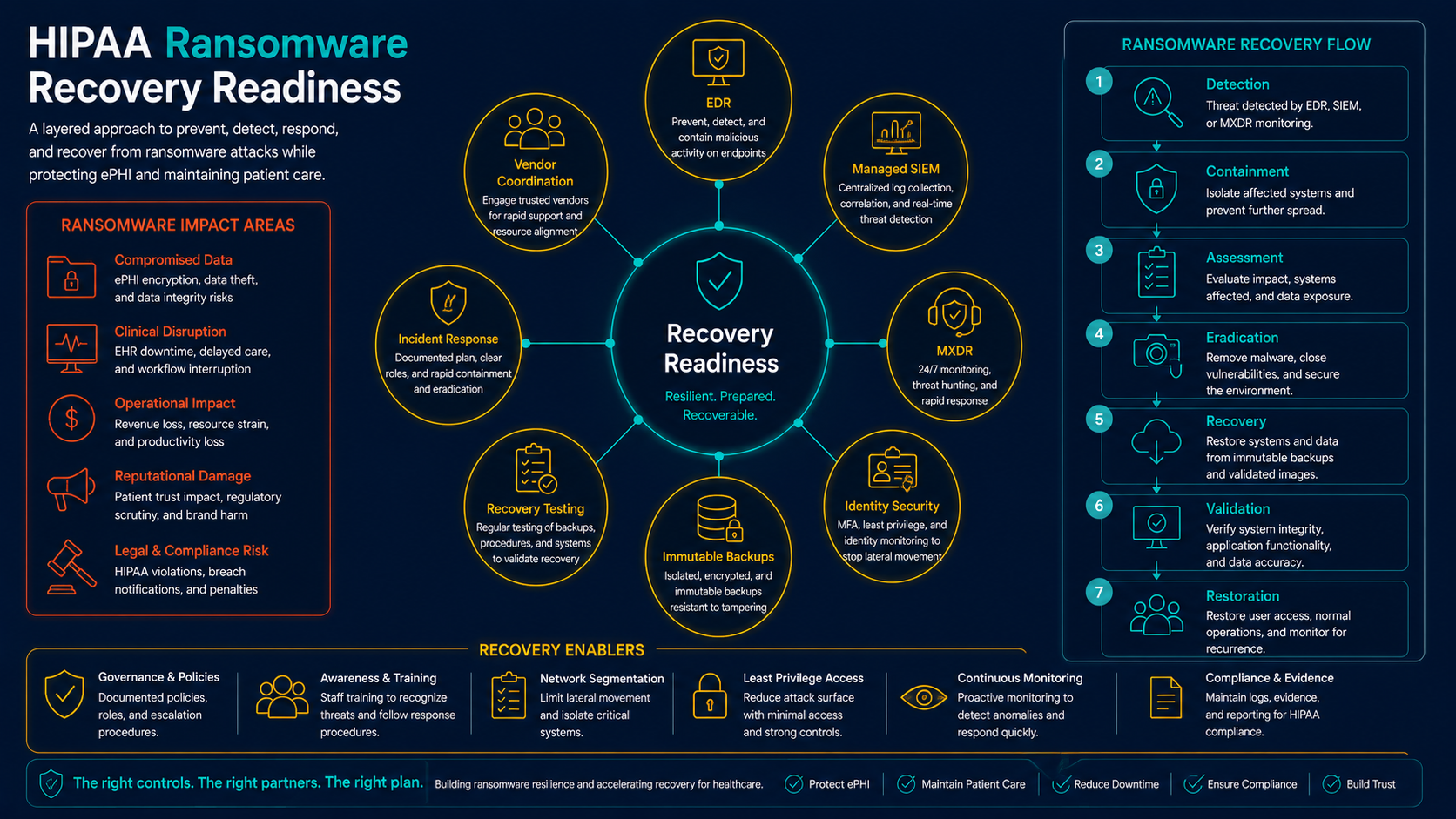
- Use strong authentication for backup administration.
- Restrict privileged access to backup consoles and repositories.
- Monitor backup deletion, encryption, failure, or configuration changes.
- Protect backups from domain-wide compromise where possible.
- Maintain offline, immutable, or logically separated backup copies where appropriate.
- Test recovery from a ransomware scenario, not only from accidental file deletion.
- Define who approves restoration, rebuild, containment, and communication decisions.
Operational Caution
Ransomware recovery is not just a backup issue. Recovery may require endpoint containment, identity reset, network isolation, vulnerability remediation, legal review, vendor coordination, and validation that restored systems are clean and trustworthy.
Testing and Revision Procedures
Testing and revision procedures help confirm that contingency plans work before an actual emergency. Testing should not be limited to a document review. Healthcare organizations should test recovery procedures, downtime workflows, communications, vendor escalation, emergency access, and decision-making.
Testing can include technical restoration tests, tabletop exercises, backup recovery validation, contact list verification, emergency access review, ransomware scenario exercises, and after-action reviews.
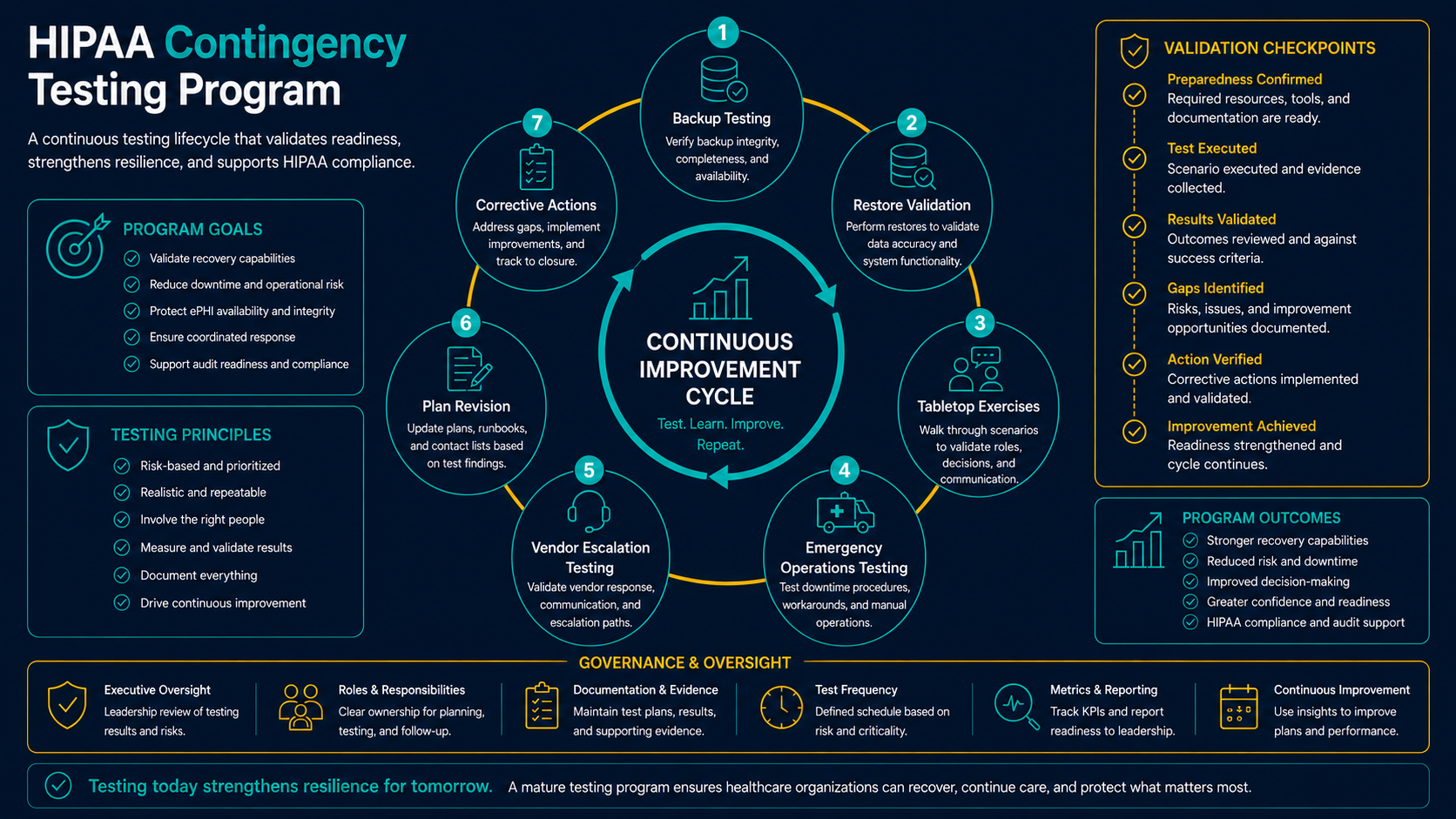
| Testing Activity | Purpose | Evidence to Maintain |
|---|---|---|
| Backup Restoration Test | Validate that data and systems can be restored successfully | Restore test results, screenshots, ticket records, validation sign-off |
| Disaster Recovery Tabletop | Walk through roles, decisions, dependencies, and escalation procedures | Scenario notes, participant list, decisions, gaps, action items |
| Emergency Mode Exercise | Confirm staff understand downtime procedures and alternate workflows | Exercise records, communication tests, workflow observations, lessons learned |
| Vendor Escalation Test | Validate that critical vendors can be reached and understand their role | Contact validation, response notes, vendor commitments, escalation updates |
| Plan Revision Review | Ensure the plan changes when systems, vendors, risks, or workflows change | Version history, approval records, updated runbooks, corrective action closure |
Vendor and Business Associate Dependencies
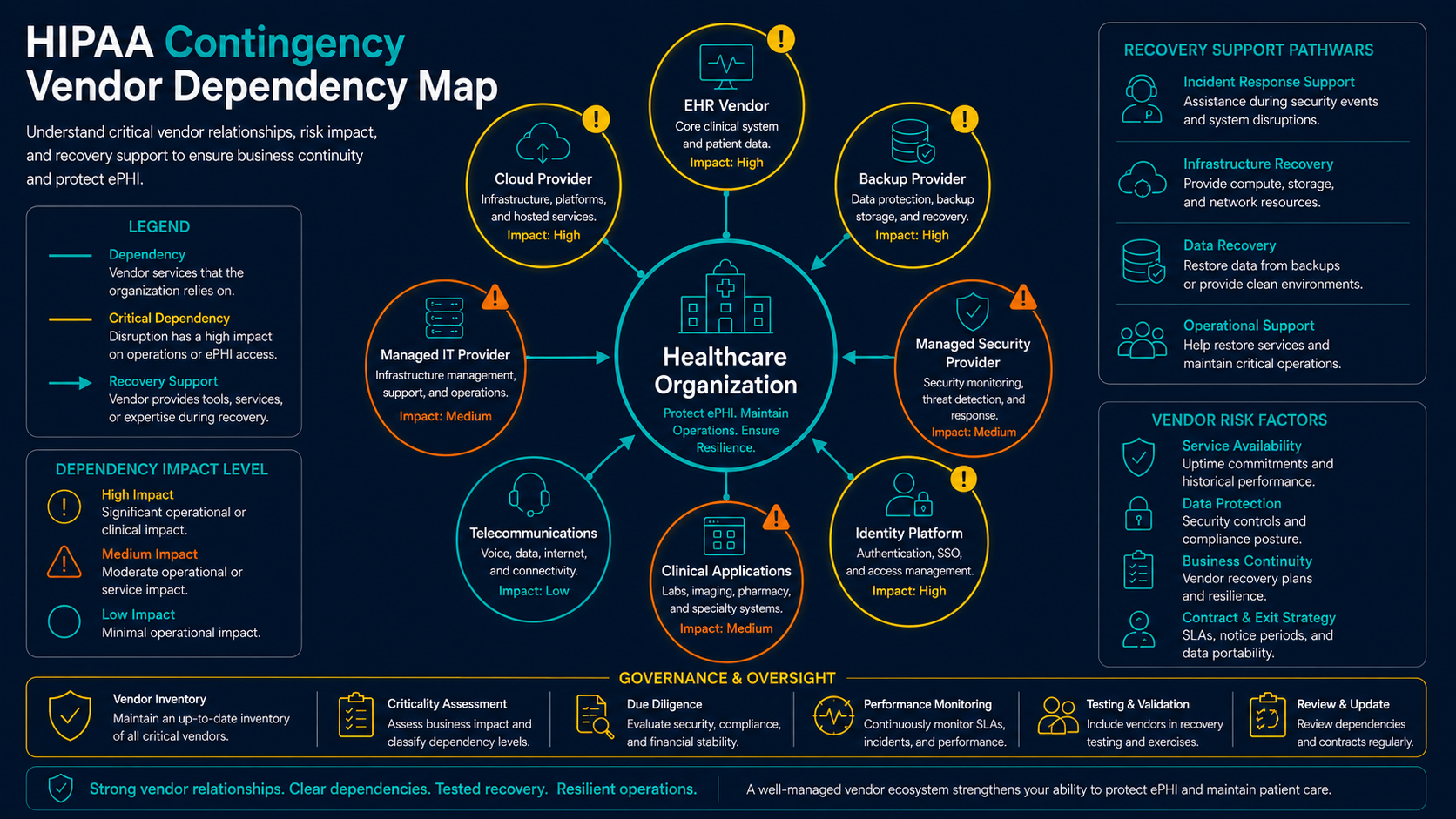
Healthcare contingency planning often depends on vendors. Cloud providers, EHR vendors, managed IT providers, managed security providers, backup providers, billing platforms, remote access services, and application vendors may all play a role in recovery.
A contingency plan should identify which vendors are required for backup, recovery, emergency operations, notification, troubleshooting, access restoration, and incident coordination. The organization should also understand what evidence vendors can provide during recovery.
- Maintain emergency vendor contact information.
- Document which vendors support critical systems or ePHI workflows.
- Confirm vendor support expectations during outages and ransomware events.
- Understand contractual service levels and escalation procedures.
- Identify vendor-held logs, backups, reports, and recovery evidence.
- Review business associate obligations where ePHI is involved.
Common HIPAA Contingency Planning Gaps
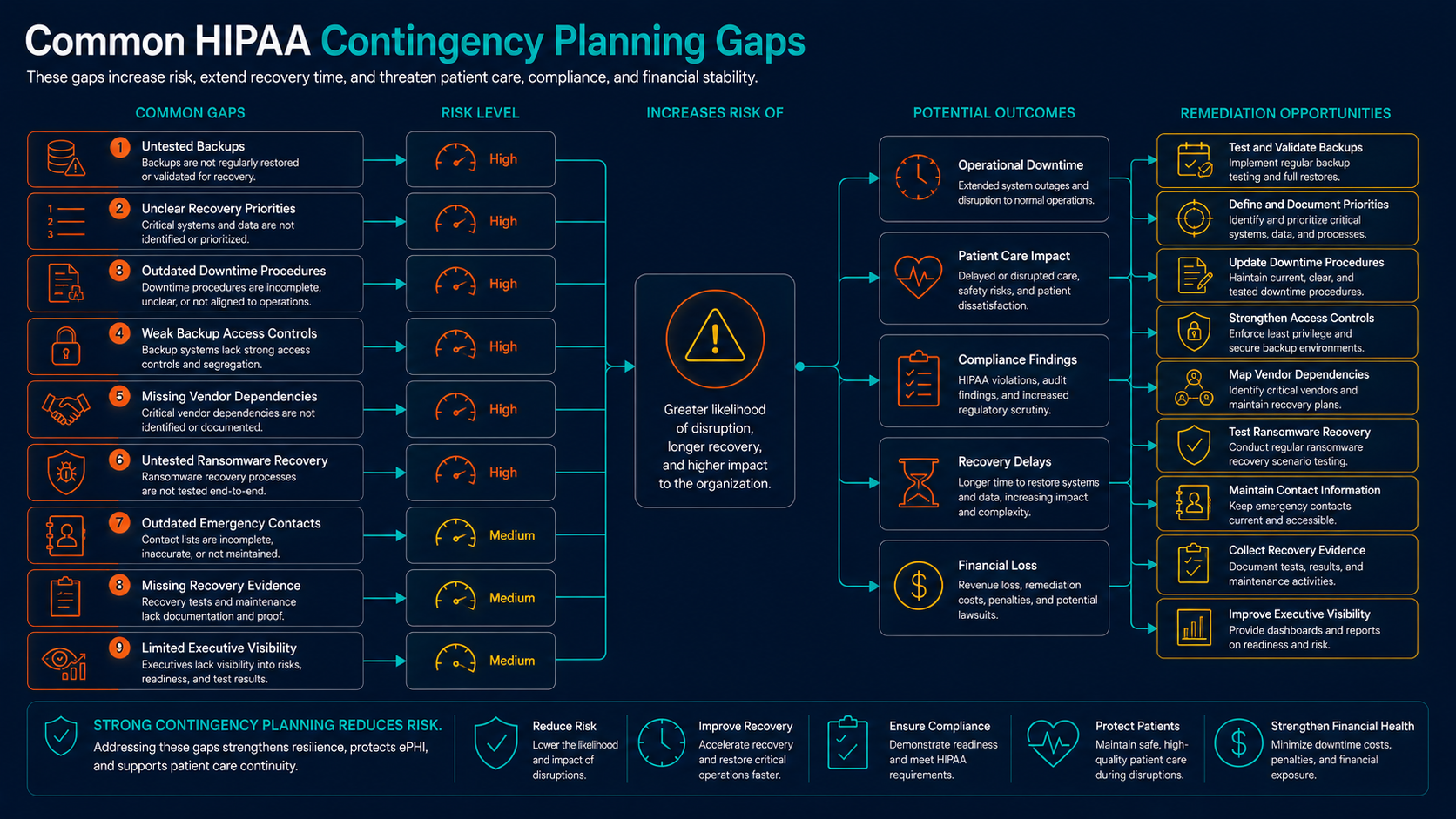
Contingency planning gaps often appear during ransomware events, outages, audits, cyber insurance reviews, and disaster recovery tests. The most common issue is that organizations have backup tools but lack a complete recovery and downtime operating program.
- Backups are not tested: Backup jobs run, but restoration capability is not validated.
- Critical systems are not prioritized: Recovery order is unclear during a major incident.
- Downtime procedures are outdated: Emergency workflows do not reflect current systems or staffing.
- Backup access is overprivileged: Too many users can modify or delete backup data.
- Ransomware scenarios are not tested: Recovery plans assume systems are clean and credentials are trustworthy.
- Vendor dependencies are missing: The organization does not know which third parties are needed for recovery.
- Emergency contacts are outdated: Leadership, IT, vendor, or department contacts are not current.
- Recovery evidence is missing: The organization cannot show test results, plan revisions, or corrective action closure.
- Leadership lacks visibility: Executives do not receive reporting on recovery readiness or unresolved risks.
How Managed IT and Managed Security Services Support Contingency Planning
Managed IT and managed security services can help healthcare organizations operationalize contingency planning by improving backup visibility, endpoint protection, monitoring, recovery testing, documentation, vendor coordination, and executive reporting.
| Contingency Planning Need | Supporting DBT Capability | Compliance-Ready Output |
|---|---|---|
| Backup Visibility | Backup monitoring, backup alerting, protected systems review, recovery readiness support | Backup job reports, failed backup tickets, protected asset lists, retention evidence |
| Recovery Testing | Restoration testing support, DR tabletop exercises, recovery runbook review | Restore test records, tabletop notes, recovery gaps, corrective actions |
| Ransomware Resilience | EDR, MXDR, managed SIEM, identity hardening, backup access review | Containment evidence, alert timelines, access review records, recovery validation |
| Critical System Prioritization | Asset discovery, application dependency review, risk assessment support | Critical systems inventory, dependency map, recovery priority list |
| Vendor Coordination | Vendor access review, responsibility mapping, third-party risk documentation | Vendor contact records, responsibility matrix, support escalation notes |
| Executive Reporting | Readiness metrics, remediation tracking, risk reporting, evidence collection | Executive dashboards, open risk reports, test history, remediation status |
Executive and Board-Level Considerations
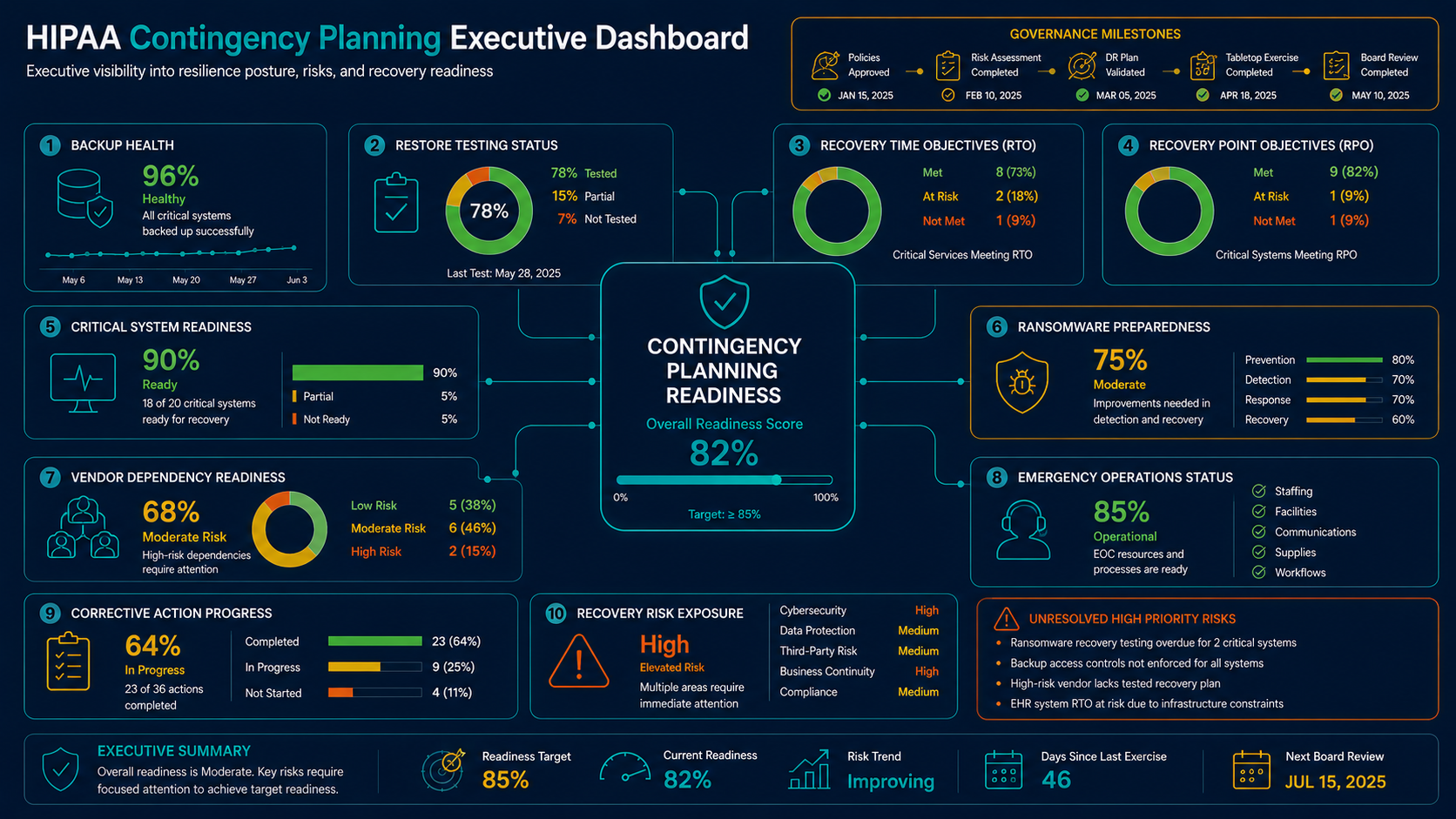
Contingency planning should be visible to leadership because it affects patient care, operational continuity, ransomware resilience, regulatory exposure, cyber insurance, financial loss, and community trust. Executives do not need to manage backup jobs, but they should understand whether the organization can recover from realistic disruption scenarios.
Useful leadership questions include:
- Do we know which systems are critical to patient care and ePHI availability?
- Are backups protected from ransomware and unauthorized deletion?
- When was the last successful restore test for critical systems?
- Can we continue essential operations if the EHR, email, network, or cloud systems are unavailable?
- Are recovery priorities and downtime procedures documented?
- Which vendors are required during recovery, and how do we contact them?
- Have we tested a ransomware recovery scenario?
- Are emergency access procedures controlled and reviewed?
- What recovery risks remain unresolved?
- How is contingency readiness reported to leadership?
How DBT Helps Healthcare Organizations
DBT helps healthcare organizations strengthen the operational technology and security capabilities that support HIPAA contingency planning readiness. We help organizations improve backup visibility, recovery readiness, ransomware resilience, documentation, testing, and executive visibility.
DBT can support HIPAA contingency planning readiness through:
- Backup and recovery readiness review
- Managed IT operations and backup monitoring
- Disaster recovery planning support
- Recovery testing and evidence collection
- Endpoint detection and response
- Managed SIEM, MXDR, and security monitoring
- Identity and privileged access review for backup systems
- SASE and ZTNA access control improvements
- Vendor dependency and responsibility mapping
- Ransomware readiness assessment
- Executive reporting and remediation tracking
DBT does not replace legal counsel or the healthcare organization’s internal compliance ownership. We help build, operate, monitor, test, and document the technology capabilities that support HIPAA contingency planning readiness.
Related DBT Resources
For the governance foundation behind contingency planning, review HIPAA Administrative Safeguards Explained. For incident response context, review HIPAA Incident Response Requirements Explained. For technical safeguards that support resilience, review HIPAA Technical Safeguards Explained.
Healthcare organizations evaluating operational support should also review DBT’s Managed IT Services, Cybersecurity Operations, Compliance & Risk Management, and Healthcare Cybersecurity Services pages.
Final Thoughts
HIPAA contingency planning is about more than having backups. It is about preparing the organization to protect ePHI availability, continue essential operations, recover critical systems, validate restoration, coordinate with vendors, and document readiness before disruption occurs.
The strongest healthcare organizations connect contingency planning to risk analysis, incident response, technical safeguards, vendor management, ransomware resilience, and executive reporting.
When contingency planning is implemented well, healthcare leaders gain stronger operational resilience, better recovery confidence, reduced ransomware exposure, improved audit readiness, and a more defensible approach to protecting the availability of ePHI.