
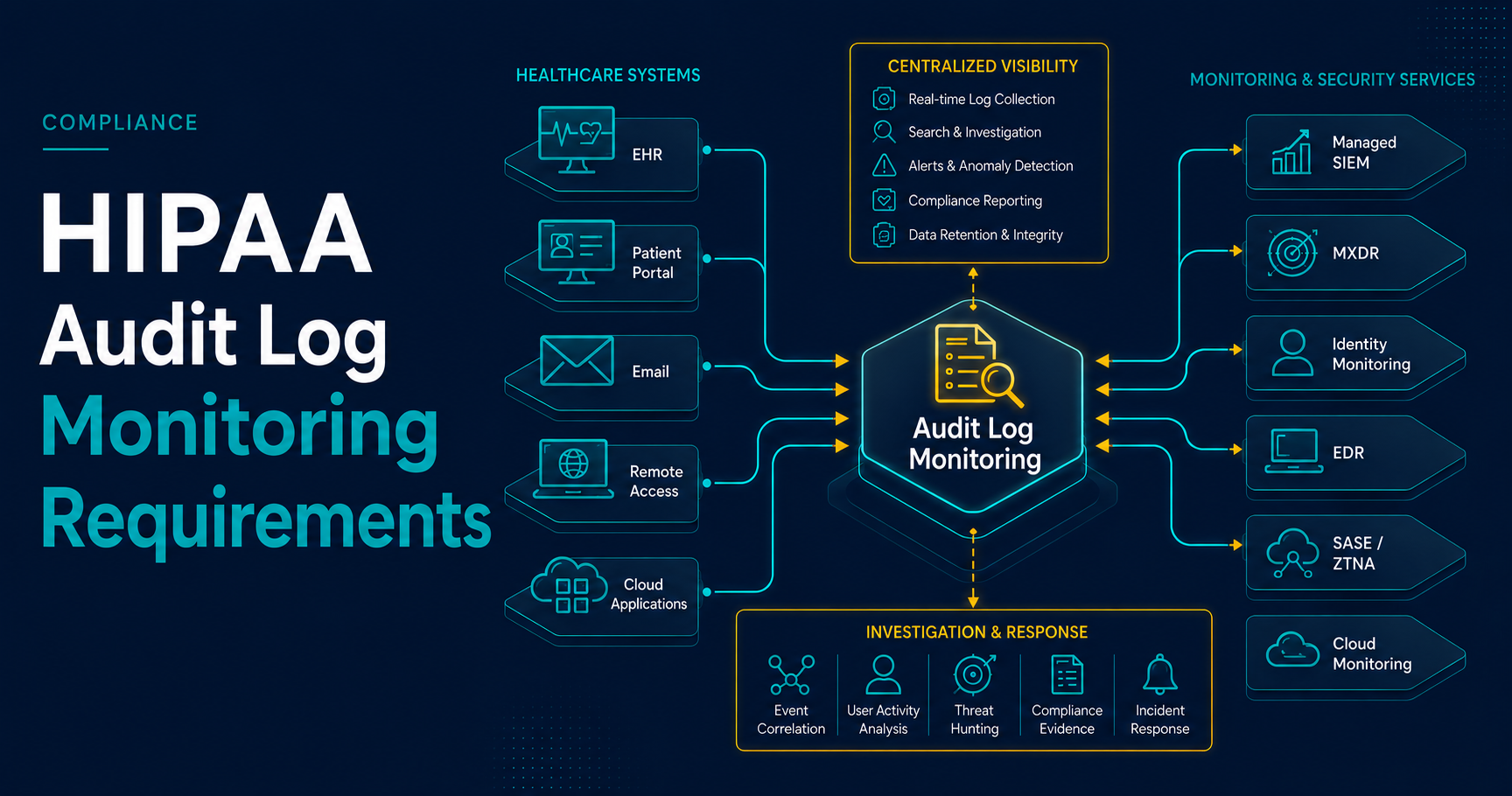
What Are HIPAA Audit Log Monitoring Requirements?
HIPAA audit log monitoring requirements come from multiple parts of the HIPAA Security Rule. Technical Safeguards include Audit Controls, which require mechanisms to record and examine activity in information systems that contain or use electronic protected health information, commonly referred to as ePHI. Administrative Safeguards also include information system activity review, which requires organizations to review records such as audit logs, access reports, and security incident tracking reports.
In practical terms, healthcare organizations need the ability to collect useful security logs, review system activity, investigate suspicious access, preserve evidence, and demonstrate that monitoring is part of an ongoing security program. Logs are not valuable simply because they exist. They become valuable when they are collected from the right systems, retained long enough to support investigation, reviewed consistently, and connected to incident response.
For executives, audit log monitoring helps answer a critical question: can the organization detect and investigate unauthorized activity involving patient information before the incident becomes larger, more expensive, or harder to explain?
Key Takeaways
- HIPAA audit log monitoring connects Technical Safeguards, Administrative Safeguards, incident response, and evidence collection.
- Healthcare organizations should identify which systems contain or provide access to ePHI and which logs are required for visibility.
- Logs should be collected, retained, reviewed, escalated, and used during investigations.
- Managed SIEM, MXDR, EDR, identity logs, cloud logs, and remote access logs can support HIPAA readiness.
- Leadership should receive reporting on log coverage, alert response, investigation activity, and monitoring gaps.
Audit Controls vs. Log Monitoring
Audit controls and log monitoring are closely related, but they are not identical. Audit controls are the technical mechanisms that record activity. Log monitoring is the operational process of collecting, reviewing, correlating, investigating, and escalating that activity.
A healthcare organization may have audit controls enabled in an EHR, email system, identity platform, or firewall, but still have weak monitoring if nobody reviews the logs, alerts are not triaged, logs are not retained, or suspicious activity is not escalated.
| Concept | Primary Purpose | Practical Output |
|---|---|---|
| Audit Controls | Record activity in systems that contain or use ePHI | System logs, access logs, authentication records, application audit trails |
| Log Management | Collect and retain logs from important systems in a consistent location | Log source inventory, retention settings, centralized log repository |
| Security Monitoring | Review logs and alerts for suspicious, unauthorized, or risky activity | Alert tickets, triage notes, escalation records, investigation timelines |
| Incident Response Evidence | Use logs to determine scope, timing, affected accounts, affected systems, and response actions | Evidence exports, event timelines, investigation reports, corrective action tracking |
The HIPAA Audit Log Monitoring Framework
A practical HIPAA audit log monitoring program should connect systems, users, vendors, security tools, workflows, and incident response. The goal is not to collect every possible log. The goal is to collect the logs needed to detect suspicious activity, support investigations, validate controls, and produce evidence.
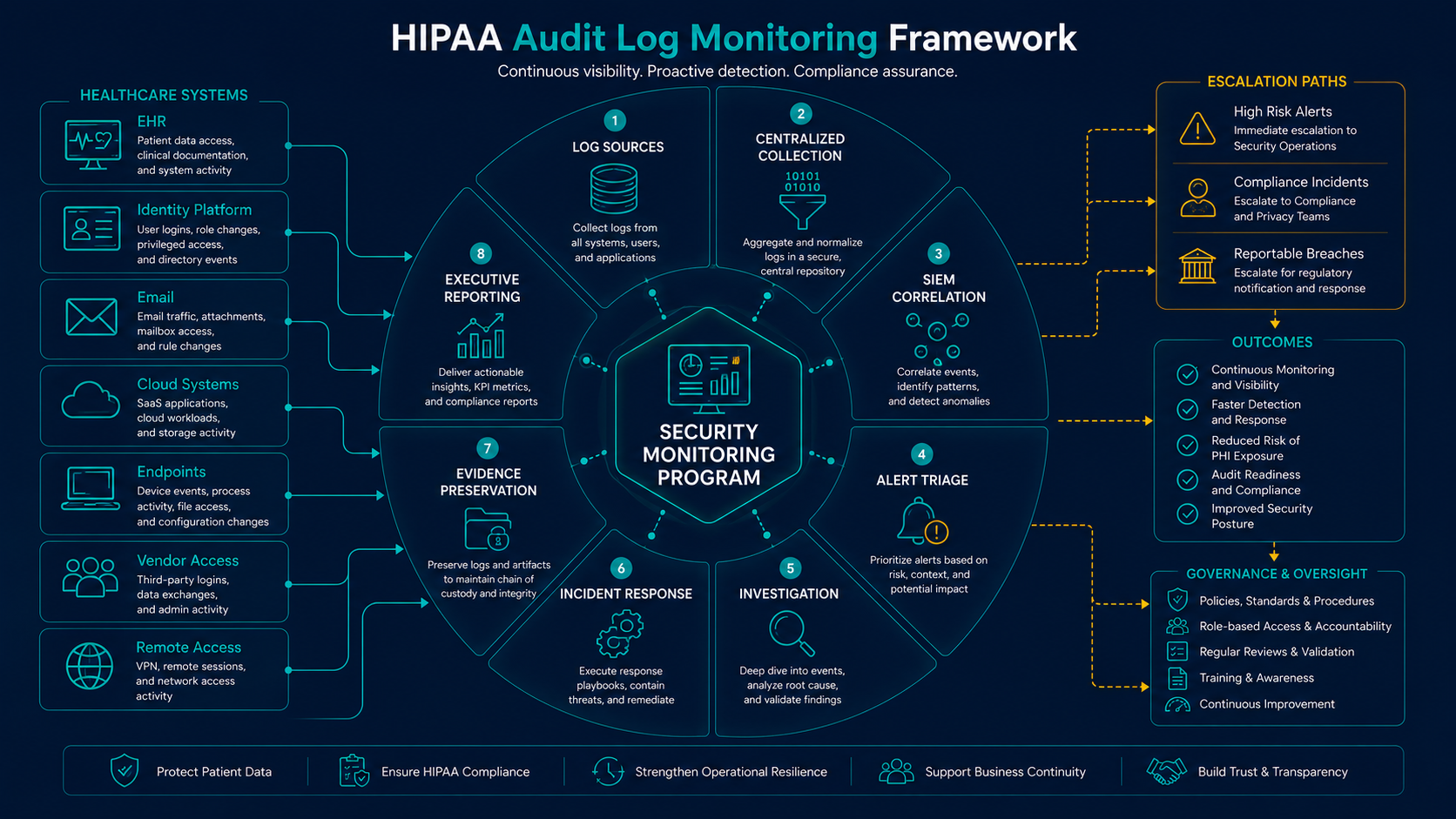
| Monitoring Layer | Purpose | Example Evidence |
|---|---|---|
| Log Source Inventory | Identify systems that contain, transmit, or provide access to ePHI | EHR logs, identity logs, email logs, endpoint logs, cloud logs, remote access logs |
| Centralized Collection | Bring important security activity into a managed location for review and correlation | SIEM log source list, ingestion status, parsing records, retention policy |
| Alerting and Triage | Detect suspicious activity and determine whether escalation is required | Alert rules, triage notes, escalation tickets, analyst summaries |
| Investigation Workflow | Use logs to reconstruct events and determine scope | Timeline exports, account activity review, endpoint records, incident notes |
| Reporting and Governance | Show leadership whether monitoring coverage and response processes are working | Executive reports, coverage metrics, unresolved findings, corrective action status |
Which Logs Matter for HIPAA Readiness?
The right log sources depend on the organization’s environment, ePHI locations, risk analysis findings, user workflows, and vendor dependencies. A small clinic and a multi-site healthcare organization may have different logging requirements, but both should understand which systems create, receive, maintain, transmit, or provide access to ePHI.
Healthcare organizations should evaluate logs from:
- Electronic health record and patient portal systems
- Identity providers and authentication platforms
- Email and collaboration systems
- Cloud platforms and SaaS applications
- Endpoints, servers, and clinical workstations
- Endpoint detection and response platforms
- Firewalls, VPN, SASE, and ZTNA platforms
- Remote desktop and remote support tools
- File shares and document repositories
- Backup and recovery systems
- Security tools and administrative consoles
- Vendor access pathways and third-party portals
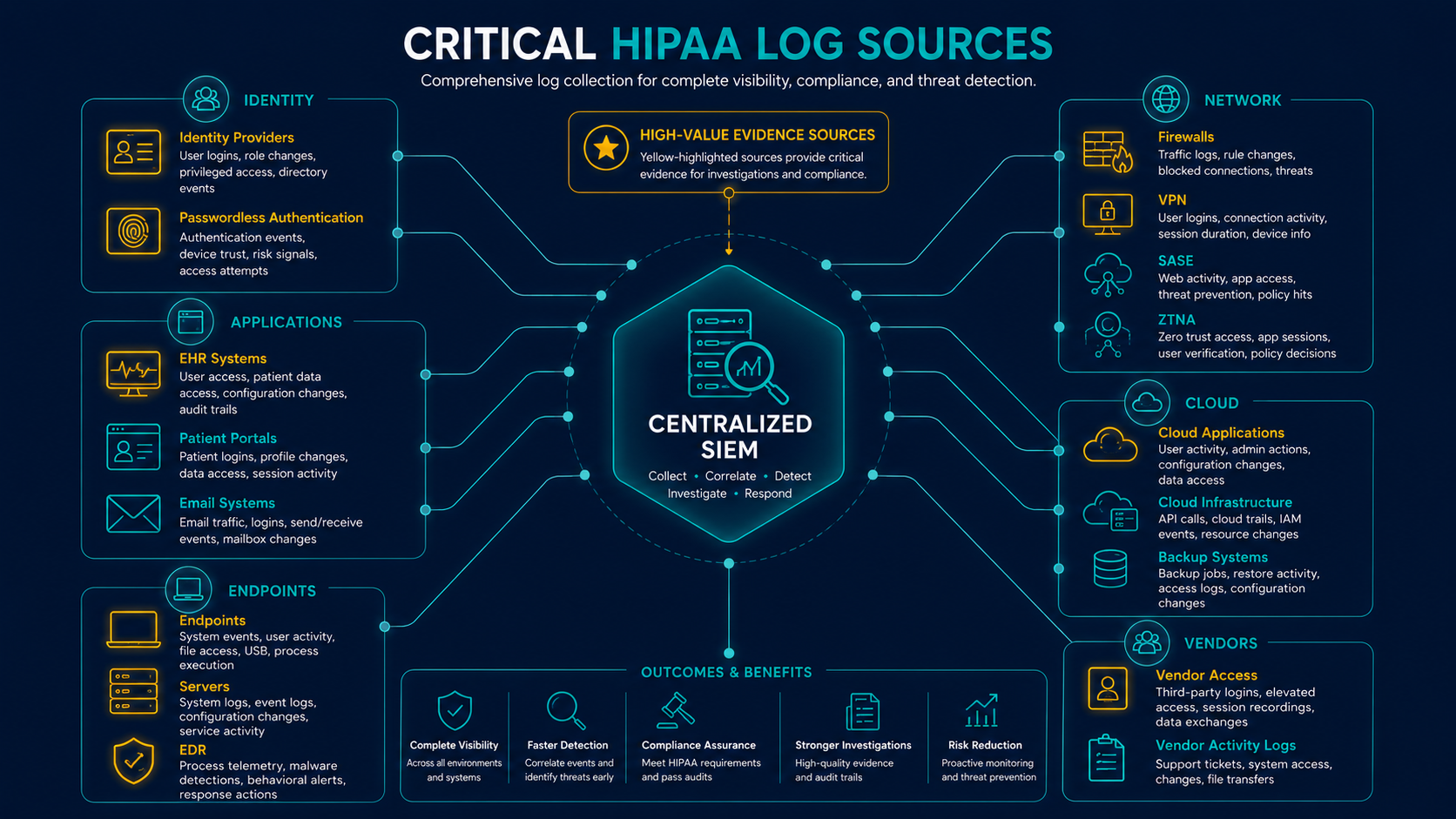
Identity and Access Logs
Identity logs are often among the most important evidence sources in healthcare security investigations. Many breaches begin with compromised credentials, stolen sessions, weak MFA coverage, vendor account misuse, or privileged account abuse.
Identity and access monitoring should help answer:
- Who authenticated?
- Which account was used?
- Was MFA required and completed?
- Was the access from an expected location, device, or network?
- Was the account privileged?
- Was access granted to a system containing ePHI?
- Were there failed login spikes, impossible travel events, suspicious prompts, or account changes?
- Was vendor or remote access involved?
Monitoring Principle
Identity activity should be treated as a high-value signal. Authentication logs, MFA events, passwordless activity, privileged access records, and remote access logs are often essential for determining whether ePHI systems were accessed by authorized users or compromised accounts.
EHR and Application Audit Logs
EHR and application audit logs help determine whether patient records were accessed, modified, exported, printed, or viewed outside expected workflows. These logs are especially important when investigating insider misuse, unauthorized patient lookup, compromised accounts, inappropriate access by a workforce member, or suspicious activity involving a patient portal.
Organizations should understand what their EHR and critical healthcare applications can log, how long the logs are retained, who can access them, and how audit events are reviewed. They should also know whether logs can be exported or correlated with identity, endpoint, and network records during an investigation.
| Application Activity | Why It Matters | Investigation Value |
|---|---|---|
| Patient Record Access | Identifies whether a user viewed records outside expected job duties | Supports insider misuse review and affected patient analysis |
| Record Modification | Shows changes to clinical or administrative data | Supports integrity review and timeline reconstruction |
| Export or Print Activity | May indicate data movement outside normal workflows | Supports PHI exposure analysis and corrective action |
| Administrative Changes | Shows changes to permissions, configuration, or audit settings | Supports privileged access and system integrity investigation |
| Failed Access Attempts | May indicate unauthorized access attempts or workflow issues | Supports access control review and alert tuning |
SIEM, MXDR, and Continuous Monitoring
Healthcare organizations often have logs spread across many platforms. A managed SIEM helps centralize and correlate those signals. MXDR adds analyst review, escalation, triage, and response support. Together, they improve the organization’s ability to detect suspicious activity and maintain evidence for investigations.
For HIPAA readiness, the value of SIEM and MXDR is not only detection. These services also help establish repeatable log review, alert handling, escalation records, and leadership reporting.
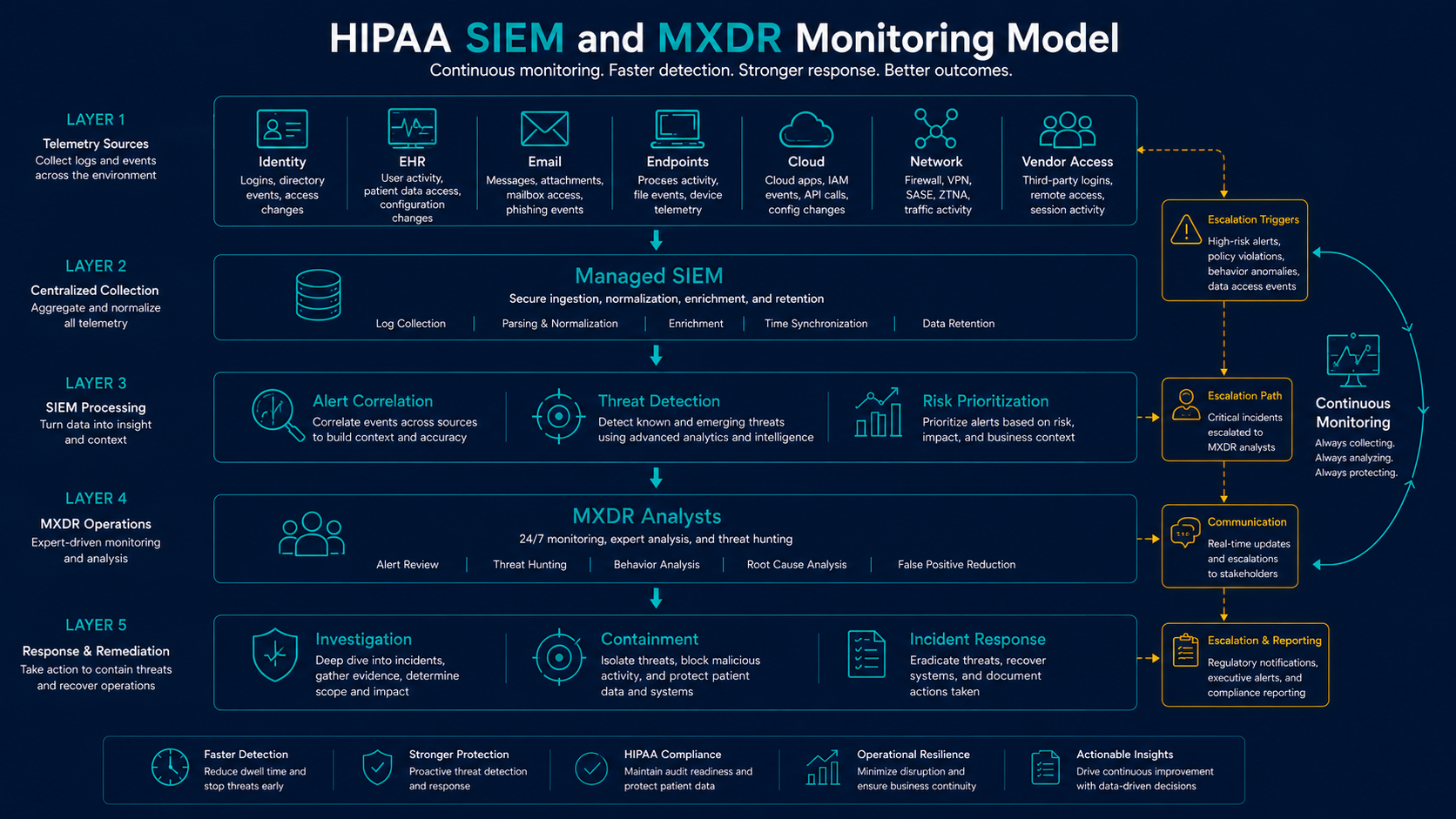
Log Review and Escalation Procedures
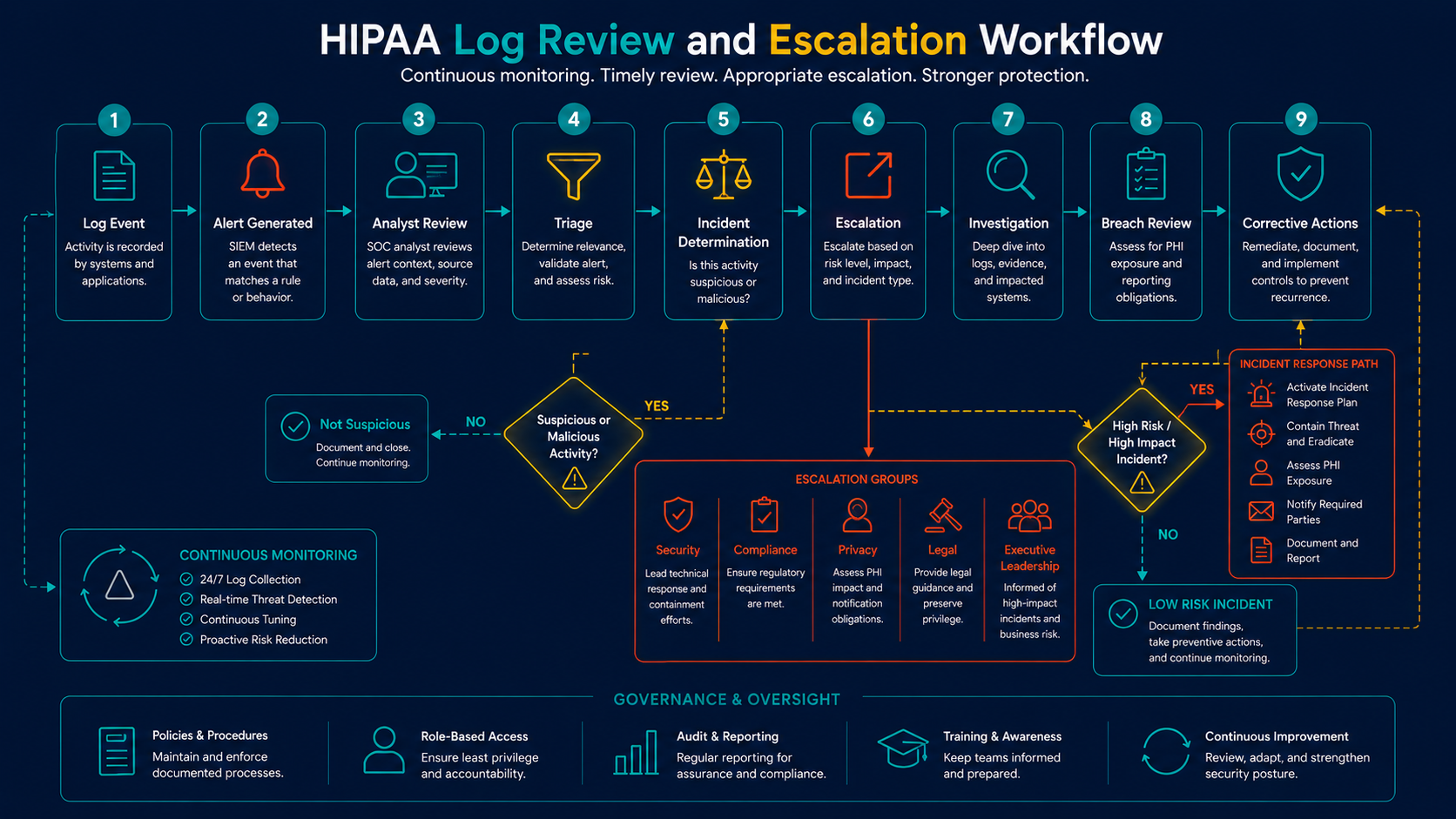
Audit log monitoring should have a defined review and escalation process. If an alert fires, the organization should know who reviews it, what criteria determine escalation, when compliance or privacy teams are notified, when legal counsel should be involved, and how evidence is preserved.
Log review procedures should define:
- Which alerts are reviewed by IT, security, or a managed security provider
- Which events require immediate escalation
- How potential PHI exposure is identified
- When an event becomes a security incident
- When privacy, compliance, legal, or executive leadership are notified
- How investigation notes are documented
- How false positives are closed
- How corrective actions are tracked
Log Retention and Evidence Preservation
Log retention should be aligned to business risk, technical capacity, legal guidance, regulatory expectations, contractual requirements, cyber insurance expectations, and incident response needs. HIPAA does not provide a simple one-size-fits-all retention period for every security log, so organizations should define a practical retention strategy that supports investigations and audit readiness.
From an operational perspective, short retention windows can create major problems. If suspicious activity is discovered weeks or months after it began, missing logs may prevent the organization from determining scope, timing, account activity, or PHI exposure.
| Retention Consideration | Why It Matters | Practical Question |
|---|---|---|
| Incident Discovery Delay | Suspicious activity is not always discovered immediately | Will logs still exist when the incident is found? |
| Breach Scope Analysis | Logs may be needed to determine which accounts, systems, or records were accessed | Can we reconstruct user and system activity? |
| Business Associate Evidence | Vendor logs may be required to understand third-party activity | Do contracts define log availability and evidence sharing? |
| Cyber Insurance Expectations | Insurers may expect monitoring and evidence retention after an incident | Can we produce records that support the claim and investigation? |
| Audit and Governance Reporting | Leadership needs evidence that monitoring is operating over time | Can we show review activity, alerts, and response records? |
Common HIPAA Audit Log Monitoring Gaps
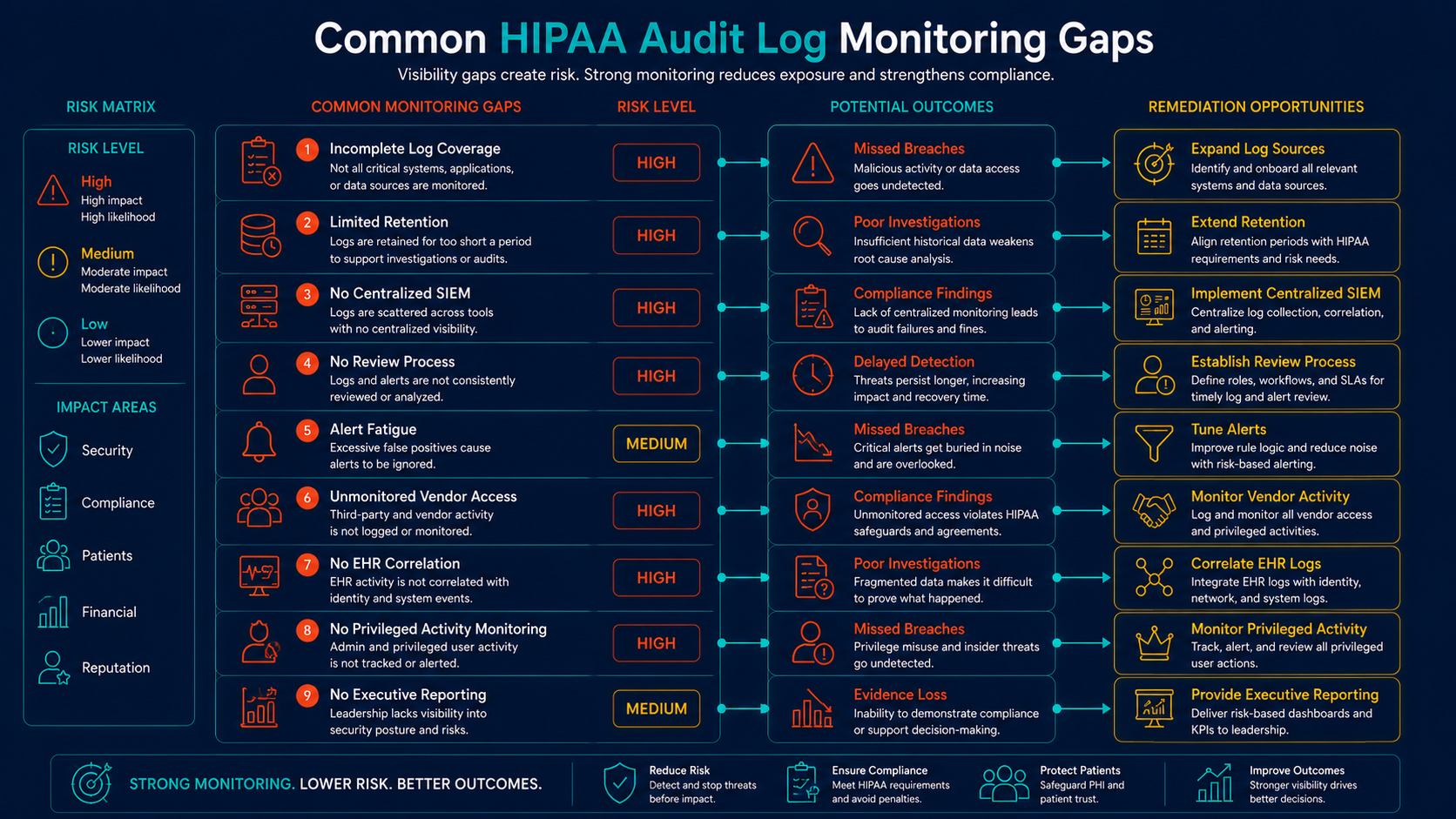
Audit log monitoring gaps often appear during incidents, audits, cyber insurance reviews, and security assessments. The most common issue is not that a healthcare organization has no logs. The issue is that logs are incomplete, scattered, unreviewed, or unavailable when needed.
- Incomplete log source inventory: The organization has not identified which systems contain ePHI or provide access to ePHI.
- Critical logs are not centralized: Important activity remains isolated in separate tools, portals, or vendor systems.
- Logs are retained too briefly: Evidence disappears before suspicious activity is discovered or investigated.
- No documented review process: The organization cannot show who reviews logs, how often, or what happens when alerts occur.
- Too many false positives: Alert fatigue causes important activity to be ignored or closed without investigation.
- Vendor access is not monitored: Business associate or support activity is not reviewed or retained.
- EHR audit logs are not correlated: Patient record access cannot be connected to identity, endpoint, or remote access activity.
- Privileged activity is not reviewed: Administrative changes are not monitored consistently.
- Leadership does not receive reporting: Log visibility gaps and monitoring performance are not visible to executives.
How Audit Log Monitoring Supports Incident Response
Audit log monitoring is one of the strongest bridges between HIPAA compliance and real-world cybersecurity operations. During a suspected incident, logs help determine what happened, when it happened, which accounts were involved, what systems were touched, whether PHI may have been accessed, and which corrective actions are required.
Without logs, the organization may be forced to make decisions with incomplete facts. With well-managed logs, the response team can build a clearer timeline and make more defensible decisions.
| Incident Response Question | Relevant Log Source | Why It Matters |
|---|---|---|
| Was the account compromised? | Identity provider logs, MFA logs, passwordless authentication records | Supports account takeover analysis and access control review |
| Was ePHI accessed? | EHR audit logs, file access logs, application logs | Supports PHI scope analysis and breach assessment |
| Was data exfiltrated? | Firewall, SASE, ZTNA, cloud, email, and endpoint logs | Supports data movement and exposure analysis |
| Was malware present? | EDR telemetry, endpoint logs, SIEM alerts | Supports containment, eradication, and recovery decisions |
| Was vendor access involved? | Remote access logs, vendor portal logs, privileged access logs | Supports third-party risk review and business associate coordination |
Executive and Board-Level Considerations
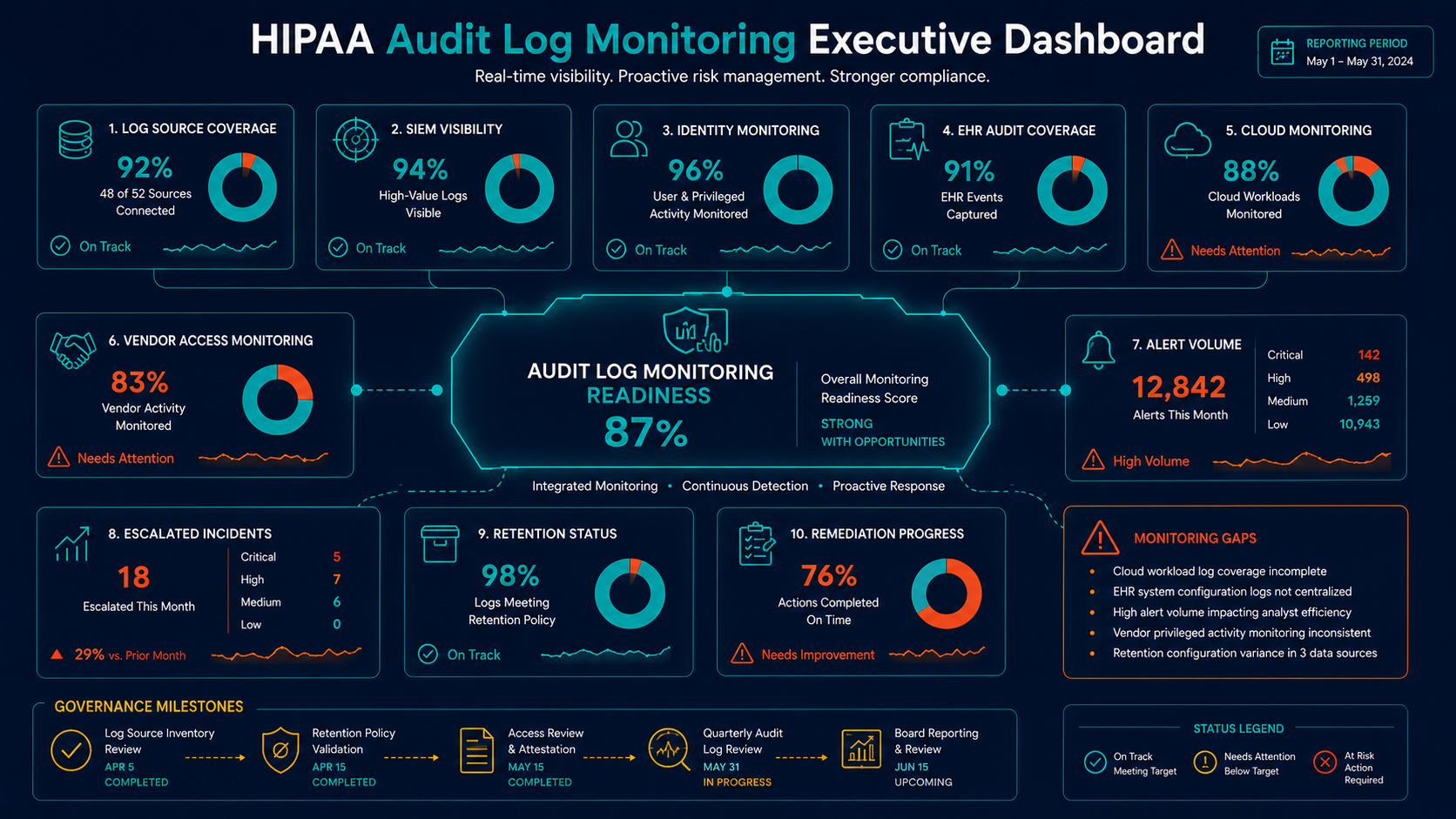
Audit log monitoring should be visible to leadership because it affects breach detection, incident response, audit readiness, cyber insurance, regulatory exposure, and patient trust. Executives do not need to review raw logs, but they should understand whether the organization has enough visibility to detect and investigate material security events.
Useful leadership questions include:
- Do we know which systems contain or provide access to ePHI?
- Are logs from those systems collected and retained?
- Are identity, EHR, email, endpoint, cloud, and remote access logs monitored?
- Do we have a managed SIEM or other centralized monitoring capability?
- Who reviews alerts, and how are escalations documented?
- Can we reconstruct suspicious user activity involving patient information?
- Are vendor and business associate access paths monitored?
- Do we know where log coverage gaps exist?
- Are monitoring findings tied to remediation plans?
- What log monitoring metrics are reported to leadership?
How DBT Helps Healthcare Organizations
DBT helps healthcare organizations strengthen the monitoring, evidence collection, and reporting capabilities that support HIPAA audit log readiness. We help organizations identify important log sources, centralize activity, monitor alerts, investigate suspicious behavior, and report visibility gaps to leadership.
DBT can support HIPAA audit log monitoring readiness through:
- Managed SIEM and log management
- MXDR and security monitoring
- Log source inventory and onboarding support
- Identity and authentication monitoring
- Endpoint detection and response
- Cloud, email, and remote access monitoring
- SASE and ZTNA access visibility
- Vendor and privileged access review
- Incident response support
- Evidence collection and reporting
- Monitoring gap identification
- Executive reporting and remediation tracking
DBT does not replace legal counsel or the healthcare organization’s internal compliance ownership. We help build, operate, monitor, and document the cybersecurity capabilities that support HIPAA audit log monitoring readiness.
Related DBT Resources
For the broader technical safeguard context, review HIPAA Technical Safeguards Explained. For incident response requirements, review HIPAA Incident Response Requirements Explained. For breach response context, review HIPAA Breach Notification Rule Explained.
Healthcare organizations evaluating operational monitoring should also review DBT’s Cybersecurity Operations, Compliance & Risk Management, Identity & Access Security, and Healthcare Cybersecurity Services pages.
Final Thoughts
HIPAA audit log monitoring is where compliance expectations meet operational visibility. Healthcare organizations need more than enabled logs. They need a repeatable process for collecting, reviewing, escalating, investigating, preserving, and reporting security activity.
The strongest healthcare organizations treat audit log monitoring as part of a broader security operations program. They connect EHR activity, identity logs, endpoint alerts, cloud events, remote access activity, vendor access, SIEM correlation, incident response, and executive reporting.
When audit log monitoring is implemented well, healthcare leaders gain better visibility into ePHI access, faster detection of suspicious activity, stronger investigation evidence, improved incident readiness, and a more defensible HIPAA compliance posture.