
Why Passwordless Authentication Matters for VPN Access
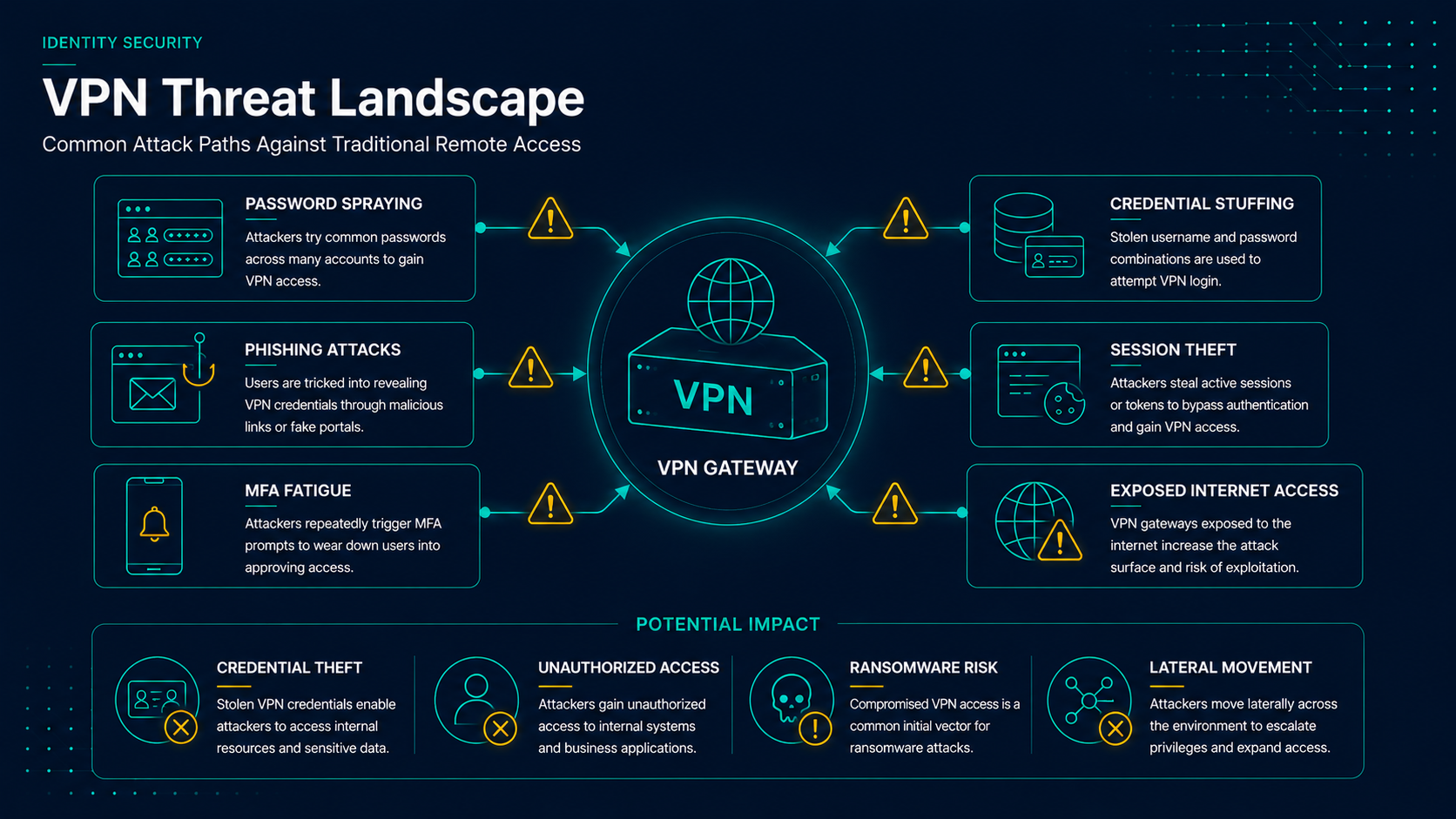
Remote access has become a critical business requirement, but it has also become one of the most frequently targeted attack paths. Virtual Private Networks (VPNs) remain widely used for remote connectivity, yet many organizations still rely on passwords and traditional MFA methods that attackers increasingly know how to bypass.
Credential phishing, MFA fatigue attacks, session hijacking, password reuse, and stolen credentials continue to drive successful compromises of remote access systems.
Passwordless authentication helps address these risks by removing password entry from the authentication process while strengthening identity verification and improving the user experience.
Key Takeaways
- Passwords remain one of the most commonly targeted attack vectors.
- Traditional VPN MFA can still be vulnerable to phishing attacks.
- Passwordless authentication reduces credential exposure.
- Modern VPN solutions increasingly support phishing-resistant authentication.
- Passwordless VPN access aligns closely with Zero Trust security strategies.
Why VPN Authentication Is a High-Value Target
VPNs often provide direct access to internal business systems, making them highly attractive to attackers. Compromising a VPN account can provide access to file shares, internal applications, administrative systems, and sensitive business data.
Common VPN Attack Paths
- Password spraying
- Credential stuffing
- Phishing campaigns
- MFA fatigue attacks
- Session theft
- Social engineering
As organizations increase remote work capabilities, VPN authentication becomes one of the most important identity security controls in the environment.
Traditional VPN Authentication Challenges
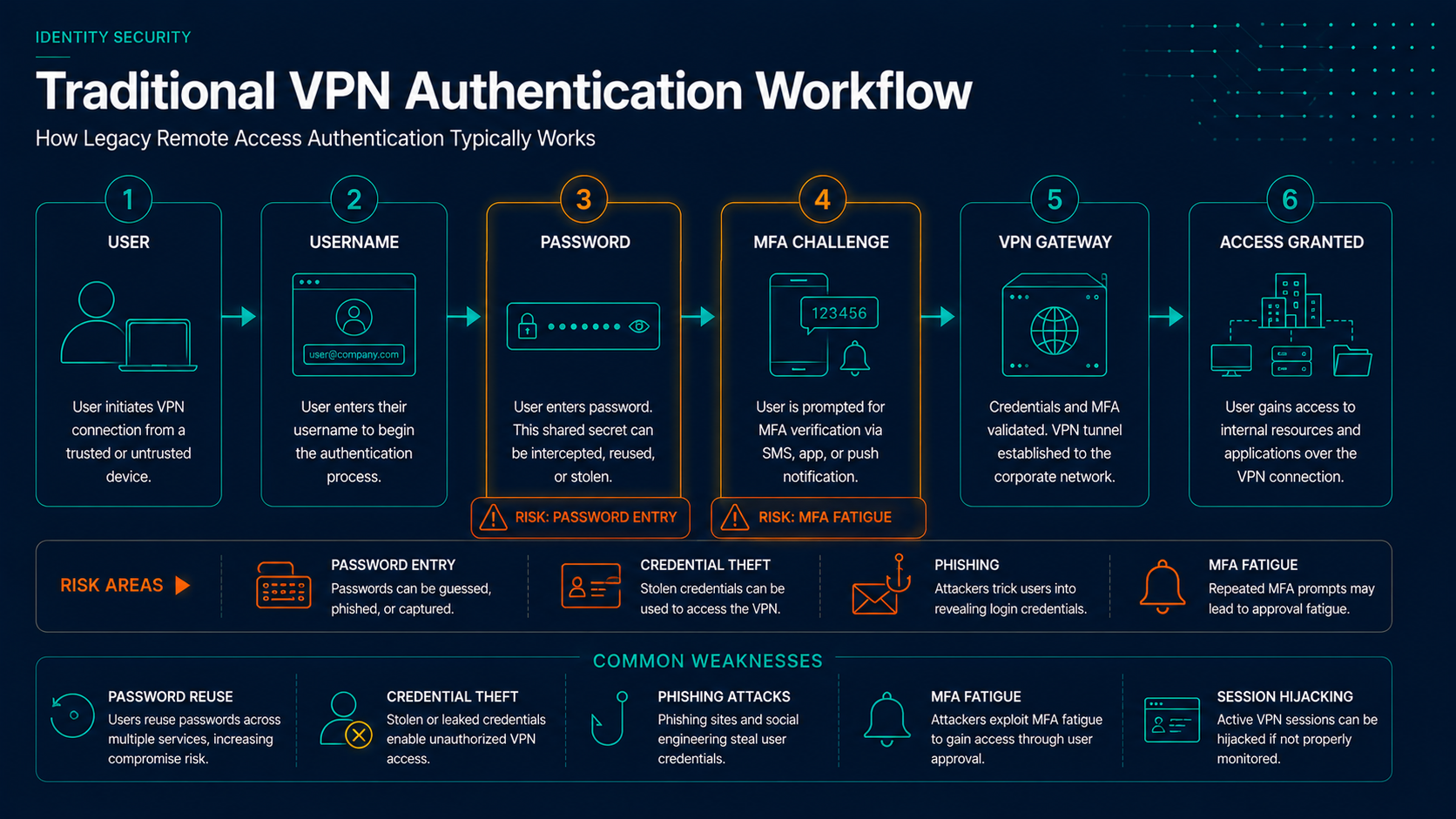
Most VPN deployments still rely on usernames, passwords, and traditional MFA methods to authenticate users. While this model is significantly more secure than password-only authentication, it still depends on users protecting credentials and accurately identifying legitimate authentication requests.
Attackers increasingly exploit these dependencies through credential theft, phishing campaigns, MFA fatigue attacks, and session hijacking techniques. As remote access becomes more critical to business operations, organizations are looking for ways to reduce reliance on passwords while strengthening identity verification.
How Passwordless VPN Authentication Works
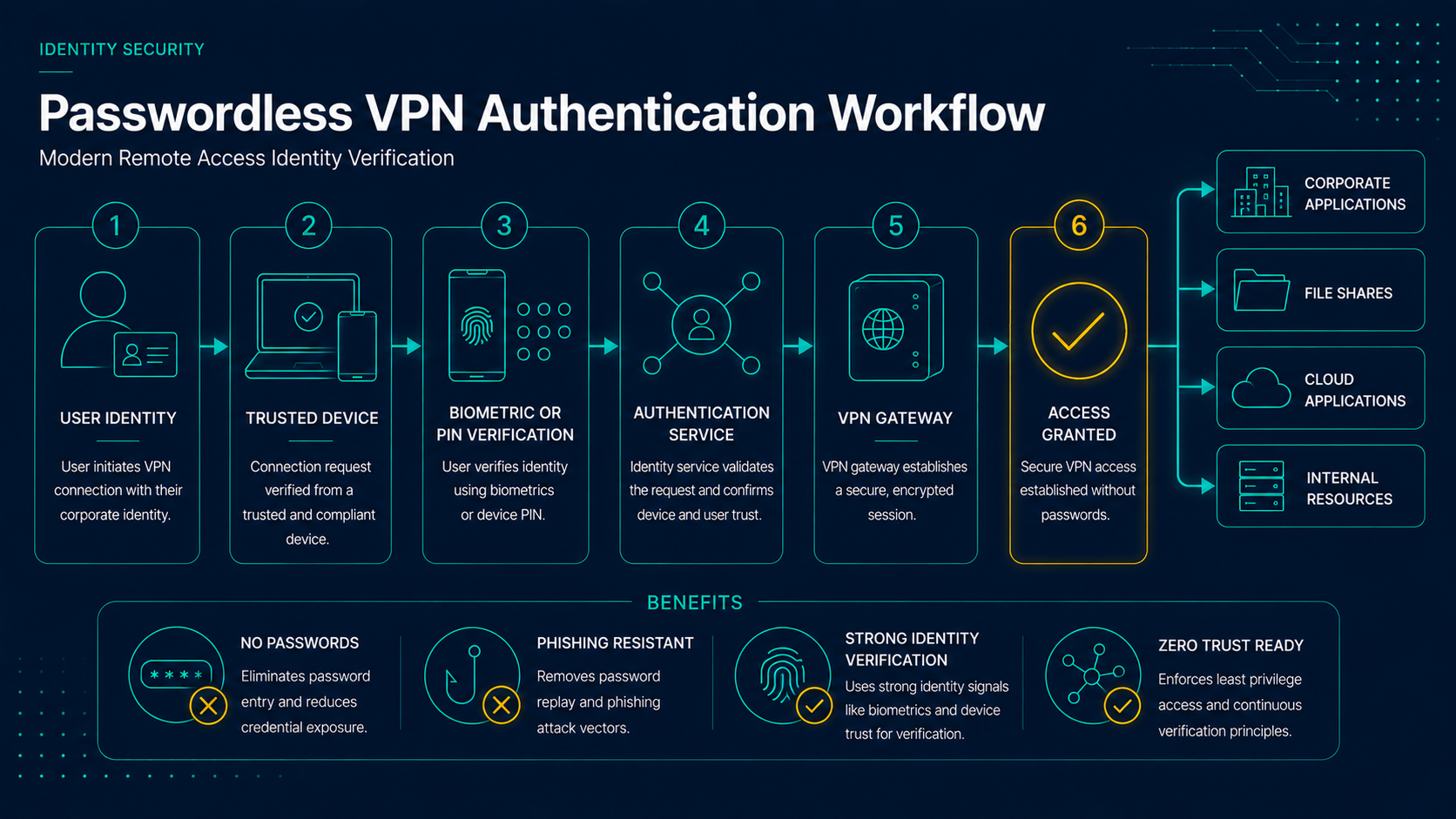
Passwordless authentication replaces the traditional password entry process with stronger authentication methods such as:
- FIDO2 security keys
- Passkeys
- Mobile authenticators
- Biometric verification
- Certificate-based authentication
The user authenticates using a trusted device rather than a shared secret that can be stolen or reused.
Passwordless VPN Authentication Benefits
- Reduced Password Exposure: Eliminates daily password entry during remote access authentication.
- Phishing Resistance: Protects users from credential harvesting attacks.
- Lower Helpdesk Costs: Reduces password resets and account lockouts.
- Improved User Experience: Faster and more convenient authentication workflows.
Why Organizations Are Moving Beyond Traditional VPNs
Remote Access Modernization Trend
Traditional SSL VPNs have served as the primary remote access solution for many organizations, but they increasingly introduce security and operational challenges.
- VPN gateways are commonly exposed directly to the internet.
- Credential theft attacks frequently target VPN authentication workflows.
- VPN vulnerabilities often become high-priority attack paths for ransomware operators.
- Network-level trust models provide broader access than many users actually require.
- Organizations are increasingly moving toward identity-centric access controls.
Modern Zero Trust architectures shift trust decisions away from network location and toward verified user identity, device trust, risk signals, and continuous access evaluation.
Recommended Modern Remote Access Architecture
Many organizations are modernizing remote access by replacing or reducing reliance on traditional VPN architectures with identity-driven access controls.
- Zero Trust Network Access (ZTNA) platforms.
- SASE architectures with integrated identity controls.
- Phishing-resistant authentication methods.
- Passwordless authentication for workforce access.
- Device trust and endpoint posture validation.
- Conditional access and continuous session evaluation.
This approach aligns closely with guidance from CISA and other cybersecurity organizations that recommend reducing dependence on legacy remote access models and strengthening identity-based security controls.
Common Integration Methods
- SAML Federation
- OpenID Connect (OIDC)
- RADIUS Authentication
- Certificate-Based Authentication
- Identity Provider Federation
VPN Platforms That Support Passwordless Authentication
Support varies by vendor and architecture, but many modern VPN and remote access platforms can integrate with passwordless authentication technologies.
Examples include:
- Palo Alto GlobalProtect
- Fortinet FortiGate
- Cisco Secure Access
- Microsoft Entra Private Access
- Pulse Secure / Ivanti
- OpenVPN
- ZTNA and SASE platforms
Authentication often occurs through SAML, OIDC, RADIUS, certificate authentication, or platform-specific integrations.
Passwordless Authentication and Zero Trust
Zero Trust architectures emphasize continuous identity verification rather than implicit trust based on network location.
Passwordless authentication complements Zero Trust principles by:
- Strengthening identity verification
- Reducing credential theft risk
- Supporting phishing-resistant authentication
- Improving authentication assurance levels
Organizations adopting Zero Trust frequently implement passwordless authentication as part of broader identity modernization initiatives.
At DBT, we generally recommend organizations move toward Zero Trust Network Access (ZTNA) and SASE architectures combined with phishing-resistant and passwordless authentication rather than relying exclusively on traditional SSL VPN deployments.
Migration Roadmap
Most organizations achieve the best results by deploying passwordless authentication in phases, beginning with high-risk users and remote access workflows before expanding to the broader workforce.
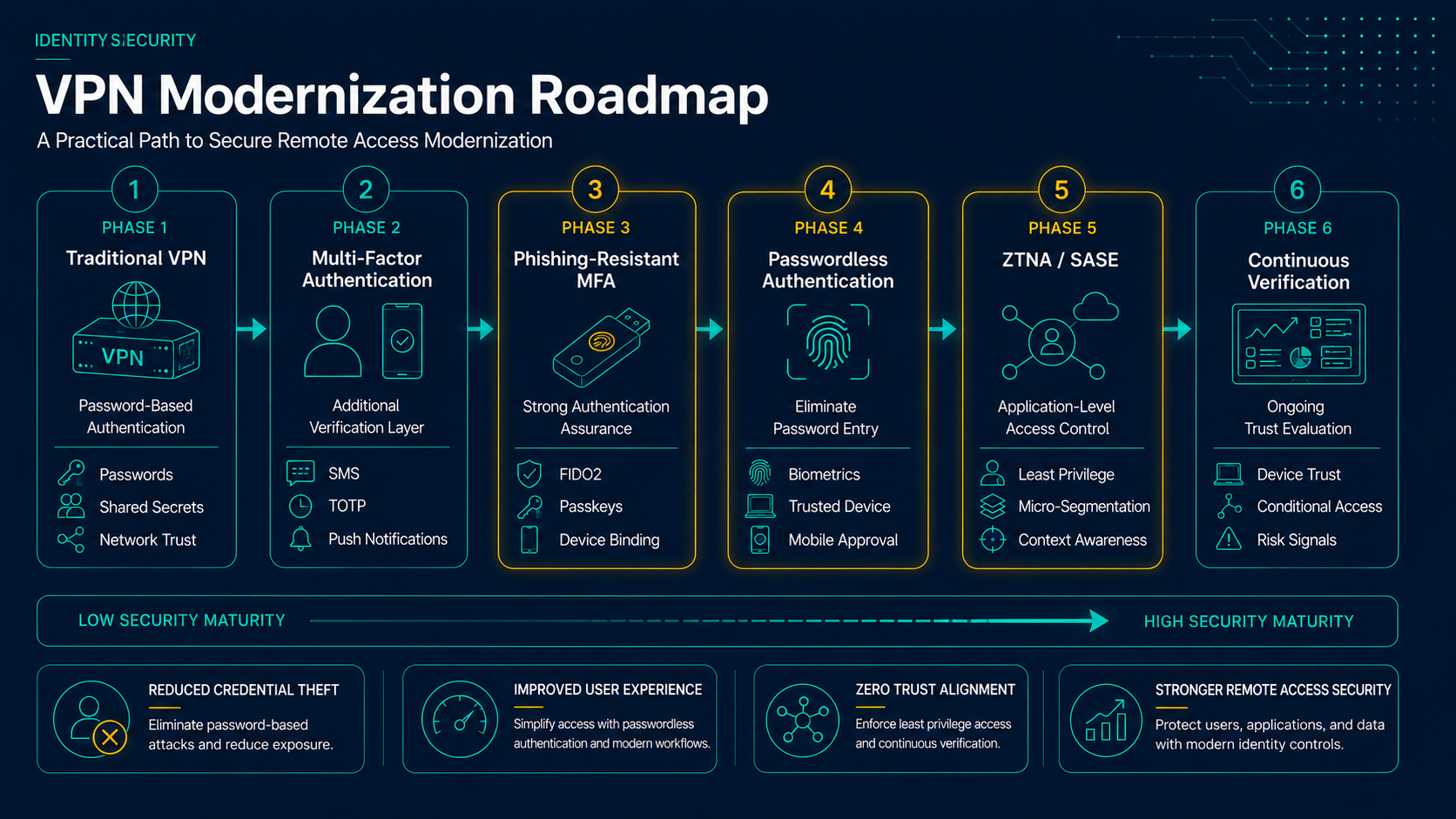
- Phase 1: Protect administrators and privileged remote access users.
- Phase 2: Expand passwordless authentication to high-risk departments.
- Phase 3: Deploy passwordless authentication across all remote access users.
When Passwordless VPN Authentication Makes Sense
Organizations should strongly consider passwordless VPN authentication when:
- Remote work is common.
- Cyber insurance requirements are increasing.
- Credential theft remains a concern.
- Phishing campaigns target employees regularly.
- Zero Trust initiatives are underway.
- Helpdesk resources spend significant time supporting password-related issues.
How VPN Access Fits Into Identity Modernization
VPN authentication is often one of the highest-value identity modernization opportunities because remote access systems are frequently exposed to the internet and heavily targeted by attackers.
Organizations commonly modernize VPN authentication alongside:
- Active Directory authentication
- Remote Desktop access
- Privileged access management
- Cloud application authentication
- Conditional access policies
Organizations that modernize authentication across VPN access, Remote Desktop, Active Directory, cloud applications, and privileged access workflows can significantly reduce credential exposure while improving the overall user experience.
Final Thoughts
VPN security ultimately depends on identity security. As attackers continue targeting passwords and traditional MFA workflows, organizations are increasingly adopting passwordless authentication to strengthen remote access security.
Whether through passkeys, FIDO2 security keys, passwordless authentication platforms, or broader Zero Trust initiatives, eliminating password dependence can significantly reduce risk while improving the user experience.
For organizations modernizing authentication, VPN access is often one of the highest-value places to begin.